
 Reading Time: 8 mins #
 This post may contain affiliate links.
I spent last Tuesday morning giving my attention to a stranger arguing about oat milk. Not someone I know. Not someone whose opinion shapes my life. A stranger, in a comment section, beneath a post I don’t remember clicking. Forty-five minutes evaporated. My actual work sat untouched. This is the attention management crisis nobody honestly talks about. We’re not distracted. We’re being pickpocketed in broad daylight.
Your attention is not infinite. It’s not even renewable on demand. It functions exactly like a bank account during a recession. Limited funds. Increasing demands. And far too many withdrawals are going to people who never earned access to your vault.
The Economy of Your Mind
Think about how you treat money. You track it. You budget. You hesitate before handing cash to strangers on the street. Yet your digital focus gets distributed freely to anyone with a notification sound or a provocative headline.
According to Microsoft Research, it takes an average of 23 minutes to regain focus after a single interruption fully. One ping. One glance. Twenty-three minutes of cognitive rebuilding. Multiply that across a day filled with interruptions, and you begin to understand why exhaustion arrives long before accomplishment.
This isn’t a willpower problem. It’s an economic one. You’re experiencing an attention recession, and the withdrawals are happening faster than the deposits.
Johann Hari’s Stolen Focus documents how the average American’s attention span on a single screen dropped from 2.5 minutes in 2004 to 47 seconds by 2021. We didn’t become weaker. The extraction machinery became stronger. Every app, every platform, every algorithmically-served outrage is engineered to pick your pocket. Your focus and productivity are the product being sold.
The Strangers in Your Account
Here’s what disturbs me most. I can name the five people whose opinions genuinely matter to my life. My partner. My closest friend. My mentor. My sister. My business partner. Five people.
Yet last week, I gave sustained attention to:
- A fitness influencer I’ll never meet
- A political commentator whose views I already know
- Three separate threads about a celebrity’s divorce
- Seventeen LinkedIn posts from people I couldn’t identify in a lineup
Why am I funding strangers while my own priorities starve?
This question changed my approach to attention management entirely. Not “how do I focus better” but “why am I giving my most valuable resource to people who will never repay it?”
The American Psychological Association confirms what we intuitively know: our brains cannot truly multitask. Doing two things simultaneously is actually rapid task switching, each switch costing cognitive resources. Every stranger you let into your attention is forcing your brain to pay a switching tax.
The Attention Audit
Before you can reclaim your attention, you need to know where it’s actually going. Not where you think it goes. Where it actually goes.
For 72 hours, track every attention shift. Every time you pick up your phone, note what draws you in. Every time you fall into a scroll, record how long before you surfaced. Every time someone else’s content hijacks your afternoon, write it down.
Most people discover something uncomfortable. Roughly 40% of their digital focus flows toward strangers. People they don’t know. Situations they can’t influence. Opinions that won’t change their lives. Drama that exists purely to extract engagement.
This isn’t judgment. It’s accounting. You cannot fix a budget you haven’t examined.

[“The Attention Solvency Protocol” – Image by moneycatzzz.com]
The Stranger Test
Once you’ve audited, apply a simple filter to every attention request. I call it the Stranger Test.
Before engaging with any content, any notification, any rabbit hole, ask yourself: Would I hand this person cash from my wallet?
Not metaphorical cash. Actual money. If a stranger approached you on the street and asked for twenty dollars to tell you their opinion about a trending topic, would you pay?
If the answer is no, why are you paying with something more valuable? Your attention compounds into your identity. Your focus shapes your capabilities. Your mindful use of technology determines whether you build a life or merely witness others build theirs.
The Stranger Test isn’t about becoming cold. It’s about becoming solvent.

The Investment Portfolio
Cal Newport’s Deep Work argues that the ability to focus without distraction is becoming increasingly rare and increasingly valuable. Those who cultivate this ability will thrive—those who don’t will struggle to produce anything of significance.
To reclaim your attention, start categorizing where it flows:
High-yield investments: Deep work on meaningful projects. Conversations with people who matter. Learning that builds capabilities. Rest that actually restores. These deposits compound over time, generating returns in skill, relationship, and well-being.
Low-yield investments: Passive scrolling. Background television. Idle browsing without purpose. These aren’t necessarily harmful, but they generate minimal return. Acceptable in small doses. Dangerous as defaults.
Negative-yield investments: Comparison with strangers. Outrage content is designed to provoke. Parasocial relationships with people who don’t know you exist. Drama that drains without depositing. These actively deplete your account while masquerading as engagement.
Your focus and productivity depend on ruthless rebalancing. Not perfection. Progress. Shift 10% from negative-yield to high-yield and watch what changes.
The Deposit Ritual
The Harvard Business Review emphasizes that protecting focused time isn’t optional for high performers. It’s foundational. The most successful professionals guard their attention like the scarce resource it is.
Here’s the practice that transformed my attention management more than any other: the first 90 minutes of my day belong to no one but me.
No email. No notifications. No strangers. No withdrawals.
This isn’t about waking earlier or grinding harder. It’s about establishing a deposit ritual before the world starts making withdrawals. Those 90 minutes of protected digital focus compound over weeks and months into completed projects, developed skills, and maintained clarity.
Nir Eyal’s Indistractable calls this “timeboxing” and presents research showing that scheduling focused blocks dramatically increases follow-through. The ritual matters less than the protection. Guard the vault before the thieves arrive.
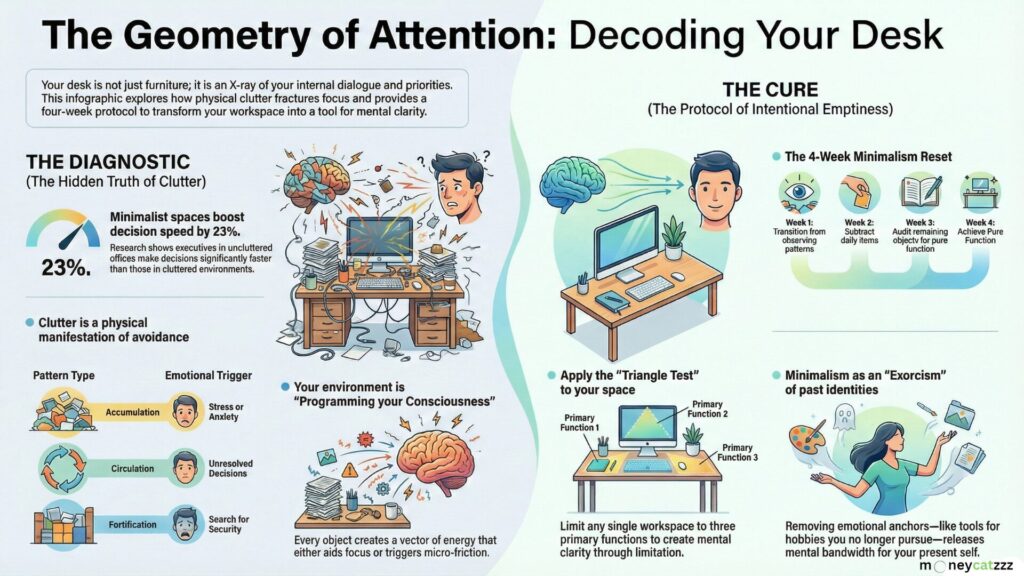
[“The Geometry of Attention” – Image by moneycatzzz.com]
The Reframe
You’ve been told that distraction is your fault, that you lack discipline. That you need more willpower, better apps, and stronger habits.
This framing serves the extractors, not you.
The truth is more straightforward and more empowering. You’re not weak. You’re being robbed. Every platform competing for your mindful technology use employs teams of engineers specifically designing triggers to capture and hold your attention. You’re not failing at focus. You’re succeeding at being a target.
Once you see the game, you can stop playing by their rules.
Attention management isn’t about becoming a productivity robot. It’s about recognizing that your focus is finite, valuable, and under constant assault. It’s about choosing who gets access to your cognitive resources, rather than letting algorithms decide for you.
The Vault Door
Your attention is the last resource you fully control. Not your circumstances. Not other people’s behavior. Not the economy or the algorithm or the news cycle. But where you place your focus, moment by moment, remains yours.
The recession is real. The pickpockets are skilled. The withdrawals are designed to feel painless until you check the balance and find nothing left.
But the vault door still has a lock. And you still hold the key.
Who have you been funding that never deserved the investment?

Add Your Heading Text Here
Stolen Focus

Indistractable
Deep Work
Disclosure: This post may contain affiliate links. We only recommend products we believe in, and we may receive a commission at no cost to you! Thank you for your support!
Acknowledgment: Cover Image by moneycatzzz.com
Disclaimer: The information is provided for general information only – moneycatzzz.com makes no representations or warranties in relation to the information, including but not limited to any representation or warranty as to the fitness for any particular purpose of the information to the fullest extent permitted by law. While every effort has been made to ensure that the information provided in this article is accurate, reliable, and complete as of the time of writing, the information provided in this article should not be relied upon to make any financial, investment, real estate or legal decisions. Additionally, the information should not substitute advice from a trained professional who can take into account your personal facts and circumstances, and we accept no liability if you use the information to form decisions.