 Reading Time: 8 mins #
 This post may contain affiliate links.
The city hums with the relentless pulse of ambition, a symphony of progress echoing from gleaming skyscrapers. Here, as in every global hub, the quest for success is a constant. We chase returns, optimize workflows, and battle for market share.
But what if the deepest levers of wealth and happiness aren’t found in a spreadsheet or a Silicon Valley pitch deck but in a philosophy?
For years, whispers of an enigmatic figure named Naval Ravikant have echoed through the tech world. An angel investor, entrepreneur, and philosopher, his insights on wealth, happiness, and life have been shared in fragmented tweets, podcast appearances, and casual conversations. Thanks to Eric Jorgenson’s meticulous compilation, “The Almanack of Naval Ravikant: A Guide to Wealth and Happiness,“ these scattered pearls have been strung into a coherent, compelling narrative. This isn’t just a book; it’s a field guide for building an untamed mind capable of flourishing amidst perpetual change.
I first stumbled upon Naval’s ideas not in a book but in a flurry of retweets. It was 2019, and I was deep in the grind of a demanding project, feeling the familiar squeeze of “not enough.” There is not enough time, not enough impact, and certainly not enough freedom.
A particularly resonant tweet popped up: “A busy man is a happy man. No. A busy man is a busy man.” It hit me like a splash of cold water. My identity had become synonymous with my hustle. With just a few characters, Naval began to untangle a pervasive myth.
This “Almanack” then is not just a collection of aphorisms; it’s the culmination of years of deep thought that challenges our default settings, offering a radical shift in perspective on how we approach prosperity and peace of mind.
The New Rules of Wealth: Leveraging Your Uniqueness, Not Just Your Time
The book’s core premise on wealth building is revolutionary in its simplicity: build leverage, own equity, and develop specific knowledge. It’s a stark departure from the traditional “work hard, climb the ladder“ mantra. Naval posits that trading your time for money is a low-yield game in the age of infinite leverage (code, media, capital, people).
This reminds me of a software engineer I know, Maya. Maya diligently put in 60-hour weeks at a major tech firm for years, she was well-compensated, but the ceiling felt concrete. Her real passion lies in creating educational content for aspiring developers. Inspired by Naval’s focus on “specific knowledge” – the kind you can’t be trained for, the kind you learn by doing – Maya started a side project: a series of video tutorials intuitively explaining complex coding concepts. She poured her unique understanding, her specific knowledge, into this media.

[“Naval Ravikan” – Image on Medium]
You may also like:

Mastering Mental Agility: Thrive in a Noisy World
The initial videos gained traction and then exploded. She built an audience, then a platform. Suddenly, her leverage wasn’t just her coding skills at a large company but her ability to scale her knowledge to millions through media. Today, Maya runs a highly successful online education business, earning multiples of her old salary, with a fraction of the direct hour-for-hour labor. She owns her intellectual property, her equity, and her time. This is the “Almanack’s” wealth thesis in action.
Naval also hammers home the concept of permissionless leverage: the ability to create without needing others’ approval. This is the internet’s gift, and the book champions its strategic exploitation. It’s about being a creator, not just a consumer, a builder, or a worker.

The Science of Happiness: Beyond Achievement, Towards Inner Peace
Perhaps the most surprising, and arguably most impactful, part of the Almanack is its deep dive into happiness. Naval doesn’t see happiness as a goal to be achieved but as a skill to be learned, a state of being to be cultivated. He argues that happiness isn’t a byproduct of external success but rather a precursor to it. This flips conventional wisdom on its head.
Alex’s success offers a glimpse of intangible longing, a driven entrepreneur who successfully exited his first startup for a substantial sum. He bought a fancy car and a big house and took exotic vacations. Yet, a nagging sense of emptiness persisted.
He expected happiness to arrive with the millions, but it didn’t. It wasn’t until he started exploring concepts similar to Naval’s – embracing equanimity, detaching from outcomes, and recognizing that desire is a contract you make with yourself to be unhappy until you get what you want – that he found a deeper sense of contentment. He realized his pursuit of external validation had been an endless treadmill. The book highlights practical “mind hacks” like radical acceptance, meditation, and understanding the nature of desire as pathways to genuine inner peace.
It’s a reminder that genuine freedom often comes from desiring nothing rather than everything.
This isn’t about passive acceptance or disengagement; it’s about active disarmament of the internal triggers that lead to suffering. Naval encourages rigorous self-awareness, urging readers to examine their thoughts and mental models. He views happiness as a choice, an internal game you can win, irrespective of your external circumstances.
The Integrated Life: Philosophy as an Operating System
Its holistic nature truly elevates “The Almanack of Naval Ravikant” beyond a typical self-help book. It doesn’t offer isolated tips; it presents an integrated lifestyle philosophy. Wealth and happiness aren’t separate pursuits but intertwined outcomes of a well-calibrated mind.
I recall a conversation with a mentor during a period of professional stagnation. I was fixated on a singular career path, unable to see alternatives. He said, “If you’re not getting what you want, change what you want.” It was a Naval-esque thought long before I read the book. The Almanack formalizes this kind of radical reframing, it teaches you to question societal scripts, challenge your deeply ingrained beliefs, and design a life of your choosing rather than one dictated by external pressures.
The book’s strength lies in its conversational yet profound tone. It feels like sitting down with a wise friend who has thought deeply about life’s biggest questions and generously shares his insights without pretense or jargon. It’s a distillation of timeless wisdom packaged for the modern age.
Is It a Panacea? A Semi-Review’s Caveat
While immensely valuable, “The Almanack” is not a magic bullet; its wisdom requires effort, consistent reflection, and a willingness to challenge deeply held beliefs. Some critics might argue that certain aspects of Naval’s philosophy, particularly on wealth, lean heavily on the opportunities afforded by the digital age and may be less accessible to those without specific knowledge or access to capital. While universal, his insights often resonate most strongly with those in the tech or entrepreneurial spheres.
Moreover, the book is a compilation, and while expertly organized by Jorgenson, it retains a certain aphoristic quality; it’s best consumed slowly, allowing individual insights to marinate rather than rush through like a novel.
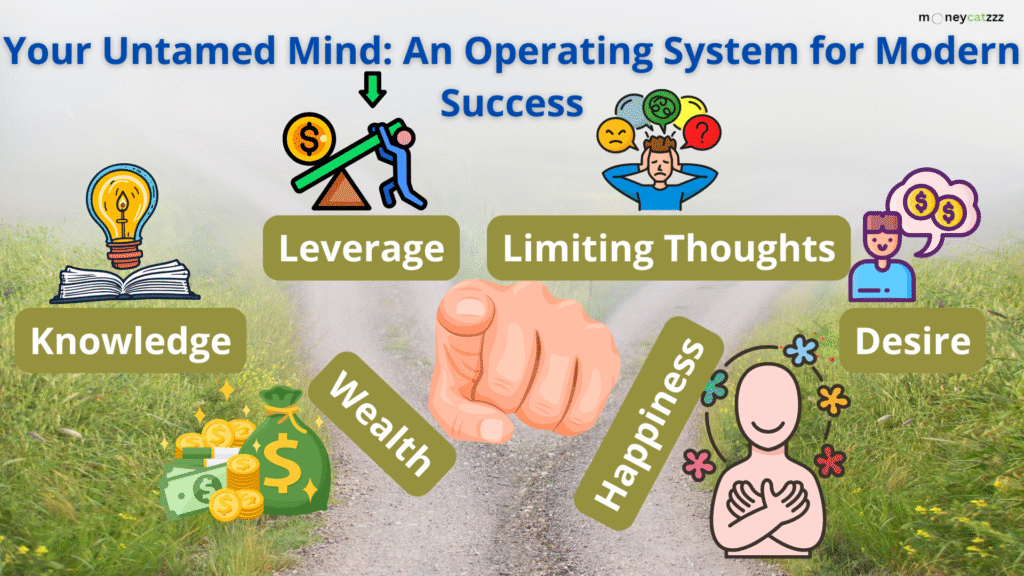
[“Naval Ravikant – Untamed Mind” – Image by moneycatzzz.com]
However, these are minor quibbles against the immense value provided. For anyone feeling trapped in the rat race, seeking a deeper sense of purpose beyond material accumulation, or simply looking for a mental framework to navigate the complexities of modern life; “The Almanack of Naval Ravikant” is an indispensable guide.
It forces you to confront uncomfortable truths: true wealth is freedom, genuine happiness is an internal state, and the greatest leverage lies within your mind. As we proceed into an automated future, where AI handles the routine, the human capacity for wisdom, creativity, and inner peace will become the ultimate currency.
What’s one aspect of your life where Naval’s philosophy could be the missing algorithm?
Choose wisely. Your untamed mind is waiting.
Recommended Resources to Go Deeper
For those ready to delve further into the ideas that shape Naval Ravikant’s philosophy, these resources offer pathways to unlock new dimensions of wealth, happiness, and personal freedom.
Reputable Resources & Ideas
- Tim Ferriss Podcast Interviews with Naval Ravikant: Often considered foundational, these lengthy conversations provide the raw, unfiltered wisdom that forms the core of the Almanack. Dive deep into his thoughts on specific knowledge, leverage, and the nature of desire.
- The World Economic Forum’s Future of Jobs Report: Understand the broader economic shifts that make “permissionless leverage” and unique human skills more valuable than ever.

Your Untamed Mind Is One Insight Away
Every concept you integrate and every thought pattern you question move you closer to a life of intentional design. So, ask yourself:
What’s the next paradigm you’re ready to shatter?
Books That Build Your Mental Operating System
These titles aren’t just reads, they’re transformative frameworks for a life well-lived.
- Sapiens: A Brief History of Humankind by Yuval Noah Harari: Gain a grand perspective on human history, systems, and beliefs, fostering a more critical and adaptable worldview, which aligns with Naval’s emphasis on questioning default settings.
- Thinking, Fast and Slow by Daniel Kahneman: Understand cognitive biases and the dual systems of human thought, essential for self-awareness Naval advocates for in decision-making and cultivating happiness.
- Antifragile: Things That Gain from Disorder by Nassim Nicholas Taleb: Explore benefiting from volatility, echoing Naval’s emphasis on building resilience and thriving in uncertain environments rather than merely surviving.
- Total Recall by Arnold Schwarzenegger: While seemingly disparate, Arnold’s biography highlights the power of relentless goal-setting, visualization, and self-belief: themes that underpin Naval’s approach to ambition and focused effort.
Tools & Practices to Cultivate Wisdom and Freedom
- Meditation Apps (e.g., Calm, Headspace): Essential for cultivating the mindfulness and equanimity that Naval champions as keys to happiness and reducing internal noise.
- Twitter (used mindfully): Follow Naval Ravikant (@naval) and other thoughtful individuals for bite-sized insights and a curated “idea feed,” mirroring the genesis of much of Almanack’s content.
- Journaling: A simple yet powerful tool for self-reflection, clarifying thoughts, and tracking progress toward specific knowledge and happiness.
Disclosure: This post may contain affiliate links. We only recommend products we believe in, and We may receive a commission at no cost to you! Thank you for your support!
Acknowledgement: Cover Image by moneycatzzz.com
Disclaimer: The information is provided for general information only – moneycatzzz.com makes no representations or warranties in relation to the information, including but not limited to any representation or warranty as to the fitness for any particular purpose of the information to the fullest extent permitted by law. While every effort has been made to ensure that the information provided in this article is accurate, reliable, and complete as of the time of writing, the information provided in this article should not be relied upon to make any financial, investment, real estate or legal decisions. Additionally, the information should not substitute advice from a trained professional who can take into account your personal facts and circumstances, and we accept no liability if you use the information to form decisions.