
 Reading Time: 8 mins #
 This post may contain affiliate links.
In today’s hyper-connected financial landscape, where algorithmic trades and market noise dominate headlines—the path to Long Term Wealth is not paved by luck or speed—it’s shaped by strategy, patience, and intention. Strategic Investing is the linchpin of wealth accumulation, but it must be executed purposefully.
This article presents a modern blueprint that combines financial intelligence with personal alignment to help you grow wealth that sustains your life goals—rather than distracts from them.
“The investor’s chief problem – and even his worst enemy – is likely to be himself.” – Benjamin Graham, The Intelligent Investor.
Here are ten essential principles for strategic investing designed to help you navigate wealth-building complexities with a sophisticated and informed mindset.
1. Define Financial Goals Within Life’s Context
Before choosing where to invest, determine why you’re investing. Are you building a college fund, launching a business, or aiming for early retirement? These distinct objectives demand different strategies.
Strategic investing begins with clarity. As Vicki Robin emphasizes in Your Money or Your Life, money should serve your values. Every dollar invested should move you closer to the life you want. Match your investment time horizon to your goal: short-term goals need liquidity, and long-term goals can handle volatility.
According to Forbes, founders and entrepreneurs must align investments with business cycles, for instance, reallocating profits into passive income-generating assets can stabilize income during slow quarters.

[“Weighing the Options: Balancing Risk and Reward for Success” – Image by Steve Buissinne]
2. Understand Risk Tolerance and Time Horizon
Risk isn’t just a financial metric—it’s an emotional gauge. Young investors might tolerate more volatility for potential growth, while older individuals may favor capital preservation.
Modern portfolio theory teaches us to adjust exposure based on time. But it takes self-awareness to stay composed during market downturns. Without a realistic understanding of your comfort with loss, even the most diversified portfolio can become a source of stress.
A recent Investopedia guide emphasizes that pairing risk questionnaires with Monte Carlo simulations empowers investors to model thousands of potential future scenarios—ranging from market crashes to bull-run growth—by repeatedly sampling from known data distributions. Monte Carlo simulation, a type of stochastic modeling, takes uncertain variables—like portfolio returns, inflation, and withdrawal rates—runs them through hundreds or thousands of simulations and produces a probability distribution of outcomes.
This approach helps identify the likelihood of meeting goals like retirement funding, exposing tail risks (e.g., 5% worst‐case losses via Value‑at‑Risk), and highlighting portfolio responsiveness to variables like savings rate or asset allocation. By visualizing a range of outcomes—rather than relying on single-point forecasts—investors can mitigate surprises and better manage emotional decision-making during market volatility.

3. Build a Solid Financial Foundation First
Don’t put the cart before the horse. Investing prematurely can backfire if your financial base isn’t secure. A strong foundation includes:
- 3–6 months of emergency savings
- Elimination of high-interest debt
- Proper insurance coverage (health, disability, life)
Only after covering these essentials should you deploy capital into markets. Otherwise, you risk having to liquidate during downturns, locking in losses.
Strategic investing is best pursued when your financial house is in order—enabling long-term thinking without fear.
4. Diversify Intelligently
As Nobel laureate Harry Markowitz declared, diversification is the only “free lunch” in investing. But diversification doesn’t mean owning a bit of everything—it means balancing assets that behave differently in various market conditions.
Consider a core-satellite strategy:
- Core (60%): Broad ETFs tracking global equities or bonds
- Satellites (40%): High-conviction themes like real estate, emerging markets, AI, or energy
This model balances stability and growth—according to Ray Dalio, thoughtful diversification can reduce portfolio risk by up to 80%—enhancing returns.
Alternative assets like real estate or private equity offer inflation protection and low correlation to traditional stocks. However, they require more due diligence and are often illiquid—choose them only when they complement your time horizon and goals.
5. Conduct Due Diligence and Embrace Fundamentals
Successful investors do their homework, whether eyeing a stock, a rental property, or a startup fund. It pays to attend to due diligence.
Key components include:
- Equities: Examine P/E ratios, debt levels, cash flow, and competitive edge
- Real Estate: Assess location, cap rate, occupancy trends, and neighborhood growth
- Private Investments: Look at the fund manager’s history, fee structure, and lock-up period
Moonfare’s investment due diligence guide outlines how understanding operational and legal risks can boost negotiating power and mitigate capital loss.
Books like Jackass Investing by Michael Dever explore how most investment myths—like “buy and hold is always best“—can be dangerous when not examined critically.
6. Optimize Taxes, Fees, and Consider Professional Advice
Fees and taxes are silent wealth eroders. Compounded over decades, even a 1% difference in fees can slash final portfolio value by hundreds of thousands.
Use tax-advantaged accounts (IRAs, Roth IRAs, HSAs) and choose low-cost index funds or ETFs with expense ratios under 0.20%. Avoid frequent trading that triggers capital gains.
As portfolios grow, professional guidance can add immense value. A fiduciary advisor can tailor strategies to your goals and help navigate complex events like inheritance, IPOs, or business exits.
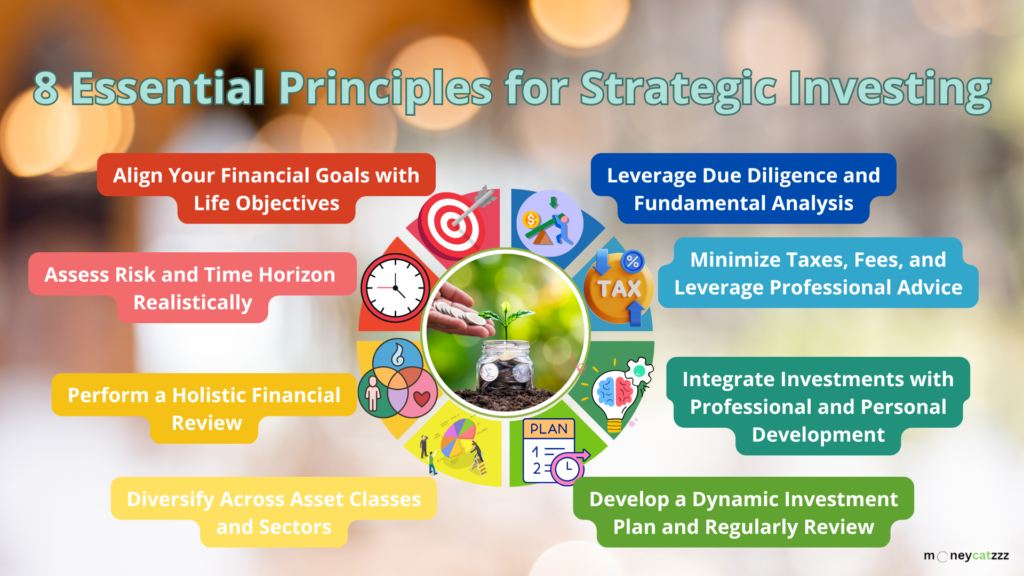
[“8 Essential Principles for Strategic Investing” – Image by moneycatzzz.com on Canva]
7. Integrate Your Career, Passions, and Investing
The most powerful portfolios don’t just reflect the market—they reflect the investor. Strategic Investing should align with your interests and expertise.
If you’re in tech, consider investing in emerging technologies you understand. If you’re a doctor, look into healthcare REITs or biotech ETFs. This alignment sharpens your edge and keeps you engaged.
Leverage your human capital. Use investment income to fund continued learning—executive education, certifications, or sabbaticals that fuel your growth. In The Millionaire Next Door, authors found that wealth builders consistently reinvest in themselves before making big-ticket lifestyle upgrades.
8. Use Leverage Prudently
Leverage isn’t a dirty word—it’s a tool. Used properly, it magnifies returns. Misused, it destroys wealth.
Real estate investing often involves mortgage leverage, allowing you to control a significant asset with relatively little capital. But it only works when:
- Debt payments are comfortably covered by income
- The asset appreciates or generates strong cash flow
- Risk is hedged (e.g., through insurance or fixed rates)
Margin investing in equities or options should only be attempted with a clear strategy and stop-loss controls. If you’re unsure, avoid it altogether.
Strategic leverage aligns with risk tolerance, asset quality, and your long-term vision.
9. Build a Dynamic Plan and Review Annually
A portfolio is a living organism. Markets evolve, life goals shift, and strategies must adapt.
Conduct an annual review:
- Reassess goals and timelines
- Rebalance to target allocations
- Review performance vs. benchmarks
- Optimize tax-loss harvesting
Use digital tools like robo-advisors or personal finance software to automate tasks. But let human judgment guide the strategic direction.
10. Strategic Investing Is Life Design
This approach transcends simple ROI. Strategic Investing aligns your money with your mission. It creates a margin for creativity, family stability, and freedom from paycheck dependency.
When done right, your portfolio reflects your deepest values—not the market’s mood. And that makes all the difference.

Quick Action Checklist
- ✍️ Define 3 key financial goals with timelines
- 🧱 Review and fund tax-advantaged accounts
- 📈 Check portfolio diversification
- 📃 List sectors or themes you’re compassionate about
- 📖 Read Principles by Ray Dalio or Simple Path to Wealth by JL Collins
Wealth With Purpose
Investing isn’t just a numbers game. It’s an intentional act of designing a future worth living.
When Strategic Investing, Diversification, and Leverage meet personal alignment, the result is more than wealth. It’s peace of mind, purpose, and the quiet power of knowing you’re playing the long game—with precision.
Disclosure: This post may contain affiliate links. We only recommend products we believe in, and We may receive a commission at no cost to you! Thank you for your support!
Acknowledgement: Cover Image by Tung Nguyen from Pixabay
Disclaimer: The information is provided for general information only – moneycatzzz.com makes no representations or warranties in relation to the information, including but not limited to any representation or warranty as to the fitness for any particular purpose of the information to the fullest extent permitted by law. While every effort has been made to ensure that the information provided in this article is accurate, reliable, and complete as of the time of writing, the information provided in this article should not be relied upon to make any financial, investment, real estate or legal decisions. Additionally, the information should not substitute advice from a trained professional who can take into account your personal facts and circumstances, and we accept no liability if you use the information to form decisions.