
 Reading Time: 8 mins #
 This post may contain affiliate links.
In a world that often mistakes possessions for prosperity, the enduring value of virtue is too easily forgotten. We live in an era where wealth is commonly measured in digits and decimal points, yet countless voices—from ancient philosophers to modern thinkers—remind us that true wealth lies not in what we own but in who we become.
While material possessions can offer temporary satisfaction, virtue—qualities like kindness, courage, wisdom, and integrity—yields the deepest and most sustainable form of value. Cultivating these virtues does more than shape our character; it enriches our lives in ways money never could. So, what if our culture recalibrated its definition of wealth? What if virtue wasn’t just noble but practical—and even essential—for a fulfilling life?
“The best index to a person’s character is how he treats people who can’t do him any good, and how he treats people who can’t fight back.” – Abigail Van Buren.

Virtue as Wealth: A Timeless Proposition
The belief that “virtue is wealth” is hardly new. In his Nicomachean Ethics, Aristotle proposed that human flourishing—what he called eudaimonia—was the highest good and could only be achieved through the consistent practice of virtue. For him, wealth wasn’t defined by possessions but by cultivating habits that align with reason and purpose. Courage, temperance, justice, and wisdom weren’t abstract ideals—but practical tools for building a deeply satisfying life.
Centuries later, Viktor Frankl—psychiatrist, Holocaust survivor, and author of Man’s Search for Meaning—echoed this idea. He observed that those who endured suffering with dignity often did so through the strength of inner virtue: love, hope, and resilience. For Frankl, virtue wasn’t just moral—it was existential, a lifeline in the darkest times. Such inner wealth allowed people to transcend even the worst external conditions.
In this way, virtue becomes a form of wealth that neither inflation nor misfortune can erode. It is an enduring, internal asset—gained through reflection, tested through challenge, and multiplied through application.
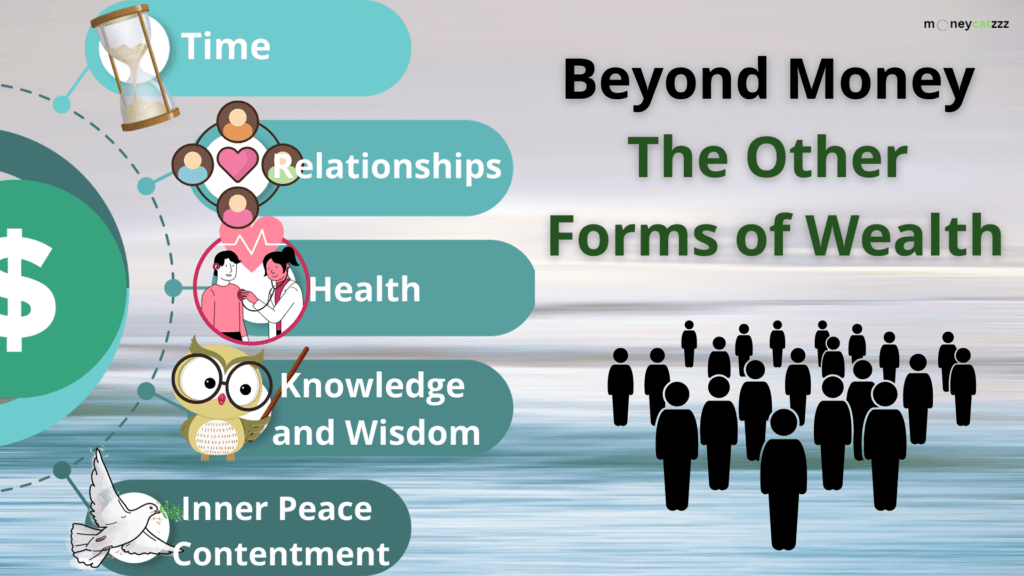
[“Beyond Money: The Other Forms of Wealth” – Image by moneycatzzz.com]
Beyond Possessions: Recognizing the Other Forms of Wealth
In a culture driven by accumulation, it’s easy to mistake possessions for value. Yet, some of life’s richest forms of wealth aren’t stored in bank accounts or displayed on social media—they’re cultivated through the quiet, enduring power of virtue. Let’s explore the five essential yet often overlooked dimensions of wealth that grow from character—not currency:
1. Time
Time, like virtue, is an irrecoverable asset. According to James Clear, author of Atomic Habits, the compounding effect of small daily actions creates long-term transformation. When we invest time in alignment with our values—nurturing relationships, engaging in meaningful work—or pursuing personal growth—we build a form of wealth that no amount of money can replicate.
2. Relationships
Deep human connection is one of the most profound sources of value. In I Know Why the Caged Bird Sings, Maya Angelou reveals how love, support, and community fortified her against hardship—such wealth is built through virtues like empathy, loyalty, and humility—qualities no possession can replace.
3. Health
Without health, the value of other resources diminishes drastically. Physical and mental well-being are upheld through medical systems and personal virtue—moderation, discipline, and care. Aristotle emphasized that virtue requires a sound body as a foundation for rational thought and joy. This idea echoes today in wellness philosophy: “Health is wealth” is more than a cliché—it’s a core truth.
4. Knowledge and Wisdom
Unlike fleeting possessions, wisdom can’t be bought, sold, or stolen. It accumulates through introspection, experience, and moral inquiry. Viktor Frankl’s Man’s Search for Meaning reminds us that suffering deepens our understanding of life when met with courage and reflection. Virtue sharpens wisdom, and wisdom, in turn, becomes a durable form of wealth—a compass in uncertain times.
5. Inner Peace and Contentment
Perhaps the most misunderstood wealth is inner peace—the calm that arises when we align with our values. Far from passive, peace is earned through virtues like patience, forgiveness, and gratitude. Unlike material success, which can breed anxiety, contentment is immune to market crashes or fashion trends. It’s the most personal and powerful kind of value we can possess.

[“Virtue Wealth Is More Than Just Money” – Photo by Oleksandr P]
Virtue in Action: Two Lives, Two Legacies
1. John Wooden: The Coach Who Measured Wealth in Character
Long before modern success gurus flooded bookshelves, legendary UCLA basketball coach John Wooden quietly built a dynasty on a foundation of moral integrity. Winning 10 NCAA championships might be his headline achievement, but his real legacy lives in how he defined success: not by accolades, but by the quality of one’s character.
Wooden developed the Pyramid of Success—a framework that placed values like industriousness, loyalty, and self-control above winning. He famously told players, “Success is peace of mind… in knowing you did your best to become the best you are capable of becoming.“ His approach created not just champions but grounded, self-aware individuals.
His enduring influence proves that wealth isn’t only what you accumulate but what you cultivate within.
2. Grace Lee Boggs: Revolutionary Wealth Through Community
Activist and philosopher Grace Lee Boggs offers another wealth blueprint rooted in virtue. Born in 1915 to Chinese immigrant parents, Boggs earned a Ph.D. in philosophy—but she turned away from academic prestige to walk alongside factory workers and community organizers in Detroit. Her decades of work in civil rights, Black Power, and grassroots activism reflected a radical but straightforward conviction: real wealth lies in relationships, purpose, and the courage to transform society from within.
Rather than chasing personal comfort, Boggs embraced discomfort to forge connection and meaning. In her later years, she mentored young leaders and emphasized sustainable change through individual transformation—underscoring that virtue is a lifelong act of creation.
The documentary American Revolutionary: The Evolution of Grace Lee Boggs captures her life’s work, a moving tribute to how one woman’s inner wealth reshaped her community.

The Price of Overvaluing Material Wealth
When we chase material possessions at the cost of virtue, the result is often a life rich in appearance but poor in substance.
In The Great Gatsby, F. Scott Fitzgerald crafts a cautionary tale: Jay Gatsby amasses enormous wealth, but it cannot buy him authenticity, peace, or love. His tragedy lies not in failure to acquire but in failure to cultivate value beyond the surface.
Leo Tolstoy’s The Death of Ivan Ilyich mirrors this message. Ivan achieves social standing and financial success, but as he nears death—he realizes that his possessions have not brought him lasting fulfillment. Redemption comes only through a final confrontation with mortality—and a belated embrace of virtue.
True wealth is not found in what we own but in who we become. It’s measured in moments of integrity, clarity, connection, and inner stillness—priceless returns that no portfolio can match.
A Personal Shift: When Time Became My Greatest Possession
Years ago, caught in the race for professional advancement, I mistakenly believed that wealth accumulation equated to success—I worked tirelessly, sacrificing time and relationships for financial security. Then, my father fell gravely ill.
That evening, I visited him in the hospital—we reminisced, laughed, and shared a quiet moment of connection—it struck me then that this—time, presence, love—was what truly mattered. No promotion or paycheck could rival the value of that hour. I began to see virtue not as a moral accessory but as the foundation for a rich and meaningful life.
True Wealth is Virtue in Action
Ultimately, virtue offers wealth that outlasts and outshines all material possessions. It is immune to market crashes, job loss, and even mortality. It reveals itself in how we treat others, endure suffering, and define success.
To live with virtue is to live with lasting value. It is to possess a wealth that enriches ourselves and everyone we touch. In an age obsessed with metrics and materialism, perhaps the boldest act is to measure our prosperity not by what we have—but by who we are.
Disclosure: This post may contain affiliate links. We only recommend products we believe in, and We may receive a commission at no cost to you! Thank you for your support!
Acknowledgement: Cover Image by eko pramono from Pixabay
Disclaimer: The information is provided for general information only – moneycatzzz.com makes no representations or warranties in relation to the information, including but not limited to any representation or warranty as to the fitness for any particular purpose of the information to the fullest extent permitted by law. While every effort has been made to ensure that the information provided in this article is accurate, reliable, and complete as of the time of writing, the information provided in this article should not be relied upon to make any financial, investment, real estate or legal decisions. Additionally, the information should not substitute advice from a trained professional who can take into account your personal facts and circumstances, and we accept no liability if you use the information to form decisions.