
 Reading Time: 8 mins #
 This post may contain affiliate links.
Transform Your Perspective: The Power of Re-telling Narratives
Stories have always been at the heart of the human experience. Long before written language, we shared tales around fires, passed down oral histories, and carved symbols into stone to understand our place in the world. Today, stories continue to shape our identities, perspectives, and cultures. But not all narratives age well. Some become rigid, others incomplete. And many—far too many—go untold.
In this light, we must explore the power of stories and the urgency of re-telling them. Because re-telling isn’t about revisionism or distortion; it’s about reflection, reclamation, and progress. A story that no longer serves the truth—or never did—deserves another telling.
“Until the lion learns to write, every story will glorify the hunter.” – African Proverb.
The Danger of a Single Story
In her groundbreaking TED Talk, The Danger of a Single Story, Chimamanda Ngozi Adichie speaks to the harm of narratives that offer just one perspective. Her experience growing up reading Western literature—with characters who didn’t look, speak, or live like her—made her internalize a version of the world that didn’t include her voice.
That single narrative is not unique to Adichie. It’s prevalent in classrooms, media, and boardrooms, shaping how entire communities see themselves. For me, the dominant story of success growing up was linear: college, career, climb. Deviations were failures. I only later encountered narratives that valued entrepreneurship, artistry, or choosing work-life balance over corporate accolades.
These rigid frameworks don’t just narrow opportunity; they narrow identity. A single story excludes alternative possibilities and perpetuates stereotypes. And when societies cling to dominant narratives, entire histories and perspectives are erased.
[“Chimamanda Ngozi Adichie – TED Talk “The Danger of a Single Story”]
Why Narratives Matter
Stories are more than entertainment; they’re evolutionary tools. According to Jonathan Gottschall in The Storytelling Animal: How Stories Make Us Human, storytelling is deeply entwined with survival. Our brains are wired for narrative, helping us make sense of complexity and connect emotionally with others.
From family legends to national myths, stories bind people together. Consider the simple act of sharing childhood anecdotes. The funny mishaps. The difficult lessons. The moments of triumph. These aren’t just memories—they are building blocks of our identities and the glue of community.
But what happens when those stories are inaccurate? Or told only from one viewpoint? That’s where re-telling becomes not just important but essential.

Re-Telling Without Revisionism
Re-telling a story requires care—critics may argue that revisiting historical narratives can lead to revisionism or manipulation. They’re not wrong to be cautious. Distorting facts to fit an agenda is a dangerous slope.
But ethical re-telling isn’t about changing the truth. It’s about completing it—it’s about:
- Accuracy: Re-telling should be grounded in verified facts and credible sources. It’s not about rewriting history; it’s about including parts that were left out.
- Transparency: Acknowledge the lens through which a story is told. Whose perspective is dominant? Whose is missing?
- Context: History doesn’t happen in a vacuum. People act within systems and constraints. Recognizing complexity prevents over-simplified morality tales.
- Multiplicity: There is rarely one correct version of a story. Diverse perspectives deepen our collective understanding—make the narrative richer.
When these principles are honored, re-telling becomes an act of restoration—not revisionism.
Hidden Narratives and Silenced Voices
The victors often tell history, meaning many perspectives are systematically excluded. The process of re-telling involves bringing those silenced stories to the forefront.
A People’s History of the United States is a prime example of centering the voices of Native Americans, the working class, enslaved people, and women; Howard Zinn revealed a more inclusive narrative of American history. His work didn’t negate the founding story of the U.S.; it added dimensions essential to understanding the full picture.
Similarly, projects like The 1619 Project by The New York Times attempt to reframe the national narrative by placing slavery and the contributions of Black Americans at the heart of the American story. Predictably, this initiative stirred debate. But its goal wasn’t to erase—it was to expand.
These efforts underscore that our collective narrative is still in progress and that storytelling remains one of the most powerful tools for justice.
[“The Power of Perspective: How Different Voices Shape the Narrative” – moneycatzzz.com]
Re-Telling as Personal Transformation
The process of re-telling isn’t limited to national history or cultural memory. It’s also deeply personal. We each carry stories about ourselves: I’m not good enough. I always fail. I’ll never be successful. These internal narratives often stem from childhood experiences, societal expectations, or trauma.
In The Body Keeps the Score, psychiatrist Bessel van der Kolk emphasizes how trauma embeds itself in both body and mind. Re-telling one’s story in a safe, supportive environment can be healing. It allows us to reinterpret past experiences and reclaim agency.
I remember a time when I felt like I’d lost my narrative. A career setback left me disoriented. Journaling and conversations with close friends helped me reframe the experience. What once felt like failure began to look like a necessary pivot—a plot twist that led to deeper growth—that’s the transformative power of narrative: the ability to live through something and learn from it.
The Role of Media and Technology
Anyone with an internet connection can tell their story these days—social media, blogs, podcasts, and YouTube channels have democratized storytelling. Communities once invisible in mainstream media can now amplify their perspectives globally.
But this democratization comes with responsibility—the sheer volume of content online makes it easy for misinformation and manipulation to spread. Algorithms can reinforce biases, creating echo chambers that drown out dissenting voices.
In Net Smart: How to Thrive Online, Howard Rheingold advocates for digital literacy and attention management. Critical thinking is a must. We must train ourselves to distinguish between curated and authentic narratives—between manipulation and truth.

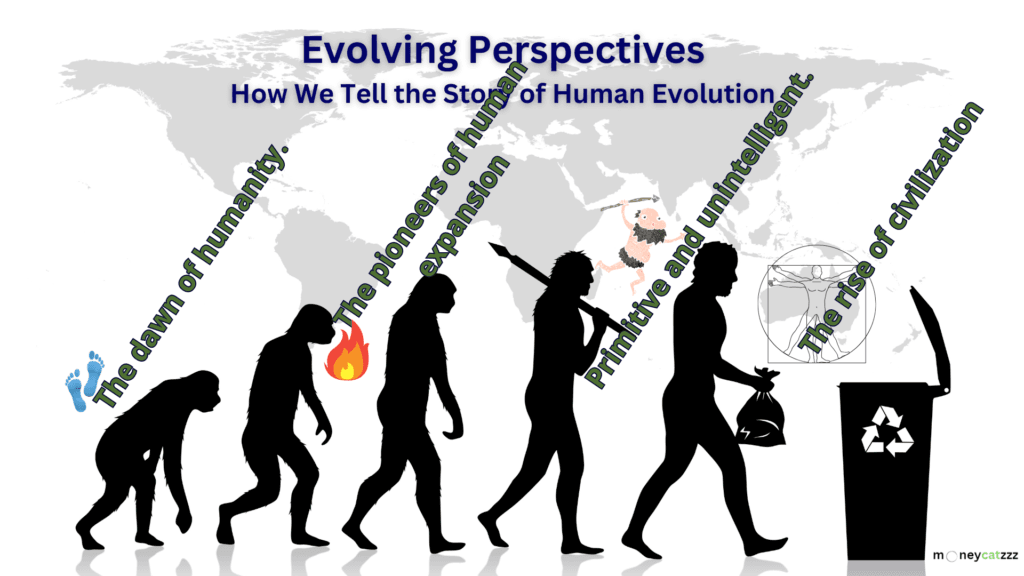
[“Revisiting the Narrative: A New Perspective” – Image by moneycatzzz.com on Canva]
Imagining Future Narratives
Re-telling isn’t only about looking backward. It’s also about shaping what comes next. In Sapiens: A Brief History of Humankind, Yuval Noah Harari notes that human cooperation hinges on shared myths—belief systems about money, government, or justice that exist only in our collective imagination.
If that’s the case, the future is a narrative waiting to be written.
We need new stories: stories of sustainable innovation, equitable economies, inclusive leadership, and the flourishing of both people and the planet. These narratives will guide policies, shape businesses, and redefine success for future generations.

Real-World Application: Re-Tell Your Own Story
How can you start?
- Audit your inner narrative: What limiting beliefs do you hold about yourself? Where did they originate?
- Collect alternative stories: Read widely. Listen to diverse voices. Seek stories that challenge your worldview.
- Rewrite a chapter: Take an experience that felt negative and reinterpret it. What did you learn? How did you grow?
- Share your voice: Your story matters—whether through a blog, podcast, or conversation, sharing it may give others the courage to re-tell their own.
The Ongoing Narrative
Narratives are not static; they evolve. But they also don’t develop on their own. We, the storytellers, shape them through action, reflection, and courage.
When we retell a story with honesty, empathy, and nuance, we expand our collective understanding. We give voice to the unheard, context to the misunderstood, and meaning to the chaotic.
So let us commit to re-telling—not to revise, but to reveal because the next chapter of our shared human experience depends on the stories we carry forward.
Disclosure: This post may contain affiliate links. We only recommend products we believe in, and We may receive a commission at no cost to you! Thank you for your support!
Acknowledgement: Cover Photo by Suzy Hazelwood
Disclaimer: The information is provided for general information only – moneycatzzz.com makes no representations or warranties in relation to the information, including but not limited to any representation or warranty as to the fitness for any particular purpose of the information to the fullest extent permitted by law. While every effort has been made to ensure that the information provided in this article is accurate, reliable, and complete as of the time of writing, the information provided in this article should not be relied upon to make any financial, investment, real estate or legal decisions. Additionally, the information should not substitute advice from a trained professional who can take into account your personal facts and circumstances, and we accept no liability if you use the information to form decisions.