 Reading Time: 8 mins #
 This post may contain affiliate links.
In today’s always-on world, phrases like “go with the flow” can sound like quaint bumper sticker wisdom—nice in theory but impractical in the pressure cooker of real life. With inboxes overflowing, deadlines tightening, and expectations rising, it’s no wonder many professionals wonder what “flow” means anymore. Is passivity dressed as advice, or is there a deeper framework to help us lead better, more grounded lives?
As it turns out, the roots of this familiar phrase run deeper than most realize. Long before “life coaches” and self-help authors popularized the idea of letting go, ancient Chinese philosophy had already articulated a powerful framework for this way of living: Wu Wei.
And unlike the Western caricature of idleness, Wu Wei is neither passive nor lazy. Instead, it offers a radical reframing of productivity, peace, and purpose—and emerging psychological research suggests it may be more relevant now than ever.
If you’ve ever felt this way, you’re not alone. The concept of ‘going with the flow‘ is deeply rooted in ancient Chinese philosophy, specifically in the principle of Wu Wei—one of Taoism’s most profound and transformative ideas. Understanding Wu Wei can bring a sense of relief, knowing that there’s a deeper meaning to ‘going with the flow ‘.
Wu Wei (pronounced “woo-way“) is a central concept in Taoism, often translated as “non-action” or “effortless action.” But don’t let the word “non-action” fool you. It’s not about doing nothing – it’s about aligning yourself with the natural flow of life and acting in harmony with it, rather than struggling or forcing outcomes. When appropriately practiced, Wu Wei can help us live more fully, find peace, and easily navigate life’s challenges.
“The journey of a thousand miles begins with a single step.” – Lao Tzu.
Wu Wei in Practice: Rethinking Success Without Strain
At first glance, “doing without doing” can sound absurd in Western productivity-driven cultures. But when you look closer—Wu Wei aligns perfectly with today’s rising interest in sustainable success.
Let’s break it down into tangible, modern applications:
1. Don’t Force It: Let Outcomes Emerge
We’ve all had those moments—endlessly tweaking an email draft, obsessing over a conversation that hasn’t happened yet, or forcing a creative idea that won’t come. Wu Wei offers a powerful alternative: step back.
When we let go of obsessive control, something shifts. It’s not surrender—it’s strategic disengagement. Neuroscience backs this up. According to a study in the Cerebral Cortex, the brain’s default mode network—activated during rest or daydreaming—is key to creative insight and problem-solving. Scientific American confirms that mental downtime is not wasted time—it’s essential.
By easing our grip on the wheel, we allow clarity to arise. In this sense, Wu Wei is about trusting the process, not passively, but with deliberate openness.
2. Align with Your Natural Rhythms
Wu Wei also means learning to recognize and ride your internal current—energy, focus, and creative cycles.
A Forbes article on chronotypes and productivity explains how honoring your body’s natural peaks and dips in alertness can dramatically improve performance. Are you a morning strategist or a night owl creator? Forcing yourself into a rhythm that clashes with your biology leads to frustration, not flow.
Wu Wei encourages you to work with your body, not against it. That might mean shifting your schedule to reflect your most alert hours—or simplifying your mornings to honor your natural pace. The result isn’t laziness. It has maximum output with minimal internal friction.
3. Act When the Moment Is Ripe
Wu Wei doesn’t mean waiting forever. It means recognizing the moment of natural readiness. Think of it as the difference between pushing a boulder uphill and waiting for gravity to lend a hand.
In business, this shows up in timing decisions, negotiations, or pivots. Acting too soon—or out of fear—can backfire. But waiting too long can stall progress. The sweet spot? Calm awareness + intuitive timing, which Wu Wei cultivates.
A classic example is Steve Jobs’ approach to innovation. As highlighted in Walter Isaacson’s biography, Jobs often waited for technology and culture to align before launching a new product. He didn’t invent MP3s, smartphones, or tablets—he launched them when right. That’s Wu Wei in action: poised patience meets intuitive execution.

[“Wu Wei: The Way of Life” – Image by pixabay.com]
Wu Wei at Work: Redefining Leadership and Decision-Making
Wu Wei flips the script completely in leadership. It challenges the assumption that constant involvement equals good management. Instead, it suggests that the best leaders often influence without excessive interference.
An MIT Sloan Management Review study shows that leaders who foster autonomy rather than micromanage increase team innovation and engagement. That’s the spirit of Wu Wei: trust the system, guide with light hands, and know when to step in or step back.
Executives turn to mindfulness and Taoist principles for clarity and strategic calm, even in high-pressure environments like finance or tech. Jack Dorsey, co-founder of Twitter and Block, is known for incorporating Zen and Eastern practices into his daily routine—including walking meditations that mirror the “effortless effort” of Wu Wei.

Bridging Cultures: Wu Wei and the Global Language of Ease
What’s remarkable is how Wu Wei shows up—under different names—across cultures.
- In Japanese Zen, the mushin (no-mind) concept reflects similar themes of intuitive, unforced action.
- In Indian philosophy, the Bhagavad Gita speaks of “action without attachment”—doing your duty without obsessing over the outcome.
- In Western Stoicism, Epictetus teaches: “Make the best use of what is in your power, and take the rest as it happens.”
This suggests a universal hunger—not just for success, but for easeful success, for actions that feel aligned, meaningful, and wise. Wu Wei is the name Taoism gives to that deep intuitive alignment.
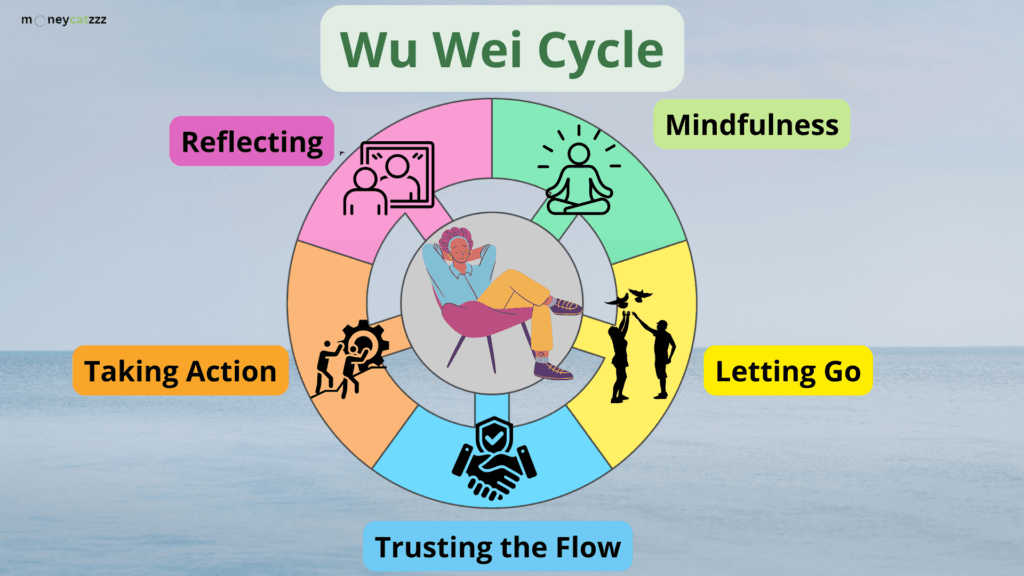
[“The Wu Wei Cycle” – moneycatzzz.com]
Micro-Applications: Practicing Wu Wei in Daily Life
How do you start practicing Wu Wei today? Not in theory—but in lived experience?
Here are a few micro-habits to begin with:
- Pause before reacting. When you’re triggered, tempted to reply instantly, or anxious to fix something—pause. Breathe. Often, the non-action is the wisest move.
- Follow your curiosity. Instead of forcing focus, follow what you’re naturally drawn to for a set period each day. You may find breakthroughs happen when you’re not chasing them.
- Audit your energy, not just your time. Instead of filling your calendar, ask: When do I feel most alive? Design your day around those peaks.
- Trust your timing. Not everything needs to be done now. Some things will come together when you’re not pushing. Delayed action can be wise action.
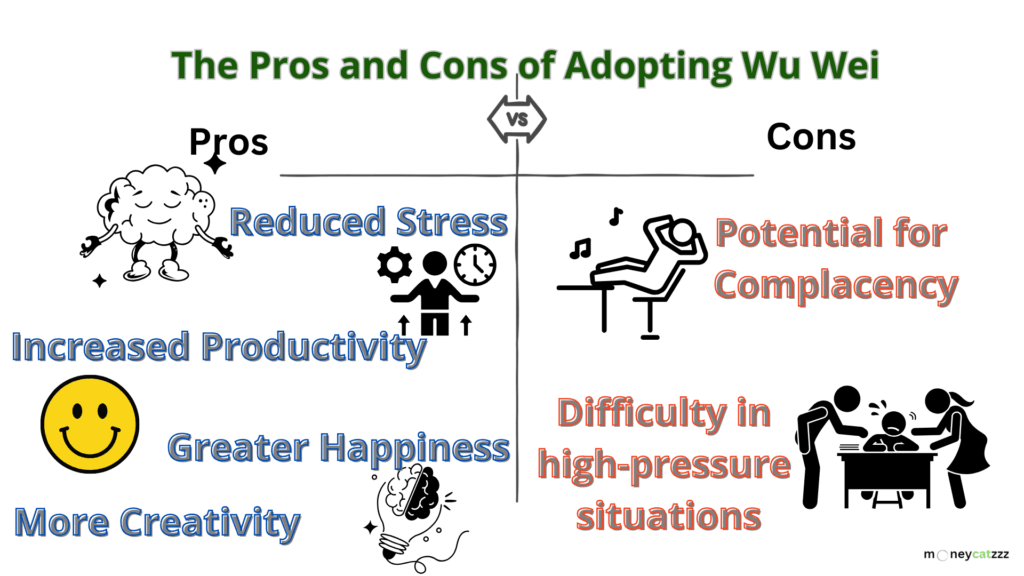
[“The Benefits of Wu Wei” – moneycatzzz.com]
The Case for Strategic Surrender
At its core, Wu Wei isn’t about disengagement but intelligent engagement. It asks: What if the most powerful moves require the least resistance?
In a world obsessed with hacking productivity and chasing edge, Wu Wei reminds us the edge is already within you when you stop fighting the current.
You don’t have to grind to matter. You don’t have to push to progress. What if the next level of success is not about doing more—but about doing differently?
Wu Wei is not a retreat from life. It’s a new rhythm for meeting it—with calm, trust, and just the right amount of deliberate grace.
Let your next big move be small but intentional. Let it be in flow.
That’s Wu Wei. And it might just be the most strategic philosophy you’ve ever tried.

Further Reading: Dive Deeper into Effortless Action & Flow
To deepen your understanding of Wu Wei and cultivate a more easeful approach to success, explore these highly relevant works:
- Tao Te Ching by Lao Tzu: The foundational text of Taoism, offering the purest wisdom on living in harmony with the natural order and embracing effortless action.
- Flow: The Psychology of Optimal Experience by Mihaly Csikszentmihalyi: Scientific insights into achieving “flow states” – moments of deep absorption and effortless productivity – directly aligning with Wu Wei’s spirit.
- Effortless: Make It Easier to Do What Matters Most by Greg McKeown: Practical strategies to simplify tasks and achieve significant outcomes with less strain, echoing Wu Wei’s emphasis on intelligent, not forced, action.
- The Power of Now: A Guide to Spiritual Enlightenment by Eckhart Tolle: Focuses on present moment awareness and letting go of resistance, crucial elements for cultivating the calm, unforced presence central to Wu Wei.
Disclosure: This post may contain affiliate links. We only recommend products we believe in, and We may receive a commission at no cost to you! Thank you for your support!
Acknowledgement: Cover Image by moneycatzzz.com on Canva
Disclaimer: The information is provided for general information only – moneycatzzz.com makes no representations or warranties in relation to the information, including but not limited to any representation or warranty as to the fitness for any particular purpose of the information to the fullest extent permitted by law. While every effort has been made to ensure that the information provided in this article is accurate, reliable, and complete as of the time of writing, the information provided in this article should not be relied upon to make any financial, investment, real estate or legal decisions. Additionally, the information should not substitute advice from a trained professional who can take into account your personal facts and circumstances, and we accept no liability if you use the information to form decisions.