
 Reading Time: 6 mins #
 This post may contain affiliate links.
I remember the day it hit me like a ton of bricks. I was sitting in my cramped studio apartment, surrounded by empty takeout containers, staring at a blinking cursor on my laptop screen. Another missed deadline loomed over me like a dark cloud. How did I get here? I was smart, ambitious, and hardworking – or so I thought. Yet somehow, I kept ending up in this spot, feeling like I was running on a hamster wheel of my own making. Let me tell you, it wasn’t a pleasant feeling.
Then I stumbled upon this book called “Mindset: The New Psychology of Success.“ It was like a breath of fresh air! Suddenly, I understood why I felt so stuck. Like many people, I had these bad habits holding me back, and I didn’t even realize it! This realization brought relief and empowerment, knowing that I had the power to change my situation.
“Be kind, for everyone is fighting a battle you know nothing about.” – Unknown
Why We Struggle to Break Free from Self-Sabotaging Habits
These habits are sneaky. They disguise themselves as protection, comfort, or even productivity. But in reality, they keep us in a cycle of self-doubt, procrastination, and fear. The good news? You can break free from self-sabotaging habits by identifying and replacing them with healthier patterns.
Today, I’m sharing the four most insidious habits I discovered—not just in myself but in many others I’ve met. More importantly, I’ll show you how I broke free from them and how you can.
Let’s dive in and take the first step toward breaking free from self-sabotaging habits together!
1. The Comparison Trap: Break Free from Self-Sabotaging Thoughts
We’ve all been there. You’re scrolling through Instagram, and suddenly, you’re hit with a wave of inadequacy. Your college roommate just got promoted (again), and your neighbor’s kids seem to be winning awards left and right. Here you are, still trying to figure out how to fold a fitted sheet.
I used to be the queen of comparison. I’d spend hours stalking successful people in my field, convinced that if I could figure out their secret, I’d finally “make it.” But all it did was leave me feeling small and discouraged.
The turning point came when I read The Gifts of Imperfection by Brené Brown. Her words hit home: “Comparison is the thief of happiness.” I realized I was so busy looking at everyone else’s path that I’d lost sight of myself.
How to Break Free from the Comparison Trap
- Practice gratitude: Shift your focus to what you have rather than your lack.
- Limit social media exposure: Curate your feed to follow accounts that uplift and inspire you.
- Celebrate small wins: Keep a “success journal” to remind yourself of your progress.
By making these small but intentional changes, I could break free from self-sabotaging habits that made me feel inadequate. And so can you.

[“Break Free” – Photo by Becca Tapert on Unsplash]
How to Break Free from the Comparison Trap
Here’s how I broke free from self-sabotaging habits tied to comparison:
- I started a “Wins Journal”: Every day, I wrote down one thing I was proud of, no matter how small. It could be as simple as “I flossed today“ or as significant as “I landed a new client.“ This practice helped me focus on my progress rather than others’. It’s a simple yet powerful tool that can shift your mindset from comparison to self-appreciation. I highly recommend it to anyone struggling with the comparison trap.
- I curated my social media: I unfollowed accounts that made me feel bad about myself and instead sought out content that inspired me. I discovered Mindfulness Exercise, which posts daily reminders to stay in your lane and focus on your unique journey.
- I practiced “Compare and Repair”: Whenever I caught myself comparing, I immediately listed three things I was grateful for. It’s hard to feel envious when you’re focusing on gratitude.
A case study published by ResearchGate found that limiting social media use to 30 minutes daily significantly reduced loneliness and depression. This further reinforced my decision to cut down on mindless scrolling and focus on my path. You can also read more about this study [here].

2. The Procrastination Puzzle: Break Free from Self-Sabotaging Delays
Oh, procrastination. My old frenemy. I used to clean the entire apartment to avoid writing a single paragraph of my thesis. I’d convince myself I was being productive, but deep down, I knew I was avoiding the hard stuff.
It wasn’t until I read Atomic Habits by James Clear that I understood the actual cost of procrastination. Clear explains how small, consistent actions compound over time—for better or worse. My habit of putting things off wasn’t just affecting my work and eroding my self-trust and personal growth.
How to Break Free from Procrastination
Here’s how I broke free from self-sabotaging habits related to procrastination:
- I embraced the “Two-Minute Rule”: If a task takes less than two minutes, I do it immediately—no exceptions. This helped me build momentum and tackle more significant functions with ease.
- I started time-blocking: I use the app Toggl to track how I spend my time. Seeing those blocks of “productive procrastination” was a wake-up call that forced me to be more intentional with my schedule.
- I found an accountability partner: My friend Paula and I have weekly check-ins where we share our goals and progress. Knowing I’ll have to fess up if I don’t follow through is a powerful motivator.
A National Institutes of Health study found that procrastination can lead to increased stress, reduced well-being, and poorer health outcomes. You can read more about the effects of procrastination [here].
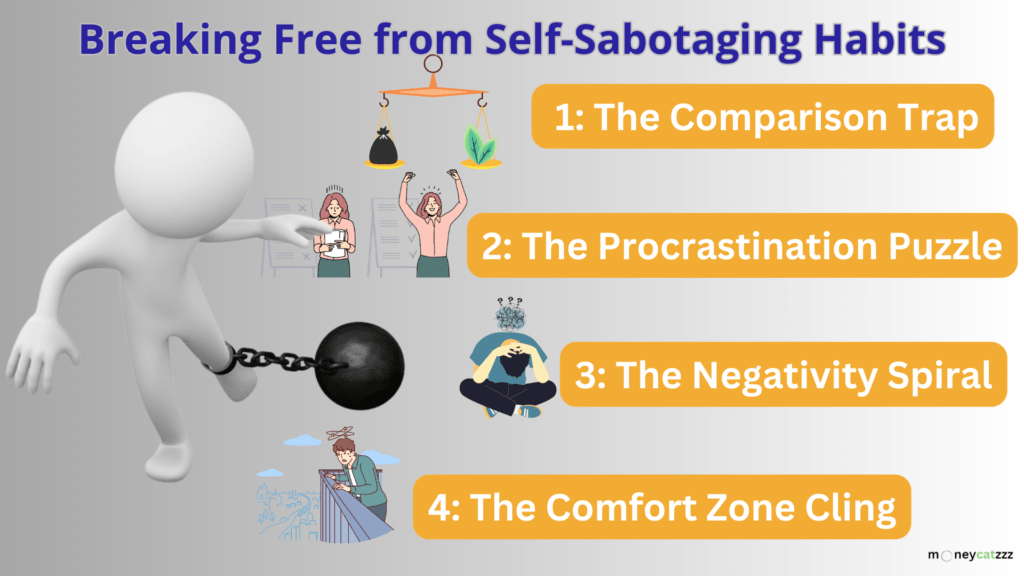
[“Breaking Free from Self-Sabotaging Habits” – moneycatzzz.com]
3. The Negativity Spiral: When Your Inner Critic Becomes Your Constant Companion
Do you constantly doubt yourself? Does your inner critic hold you back from achieving your true potential? If so, you’re not alone. One of the most common self-sabotaging habits is the relentless negativity spiral—where every mistake is proof of failure.
My inner critic used to have a megaphone. Every setback convinced me I would never succeed. This cycle of negative self-talk was exhausting and prevented me from making progress in every area of my life.
How I Tamed My Inner Critic and Stopped Self-Sabotaging
Reading Learned Optimism by Martin Seligman was a game-changer. Seligman’s research reveals that optimism isn’t just a personality trait—it’s a skill that can be cultivated. By applying these techniques, I was able to break free from self-sabotaging thought patterns:
1. Name Your Inner Critic
I called mine “Debbie Downer.“ Assigning a name helped me create distance from those relentless negative thoughts. Whenever she spoke up, I reminded myself that I am not my thoughts—I am in control.
2. Practice Thought-Stopping
Whenever Debbie started rambling, I’d say “Stop!“ out loud. Then, I’d replace the negative thought with a more balanced, empowering statement. For example, instead of thinking, “I always mess things up,” I’d reframe it as “I’m learning and improving every day.”
3. Keep an Evidence Journal
I started an evidence journal where I recorded proof that contradicted my negative beliefs. Each night, I’d write down small wins and positive experiences. Over time, this habit built an undeniable case against my inner critic, reinforcing a healthier, more optimistic mindset.
The Science Behind Self-Compassion and Emotional Resilience
A study published in the Journal of Personality and Social Psychology found that self-compassion is strongly linked to emotional resilience and psychological well-being. When you replace self-judgment with self-kindness, you develop the strength to move forward instead of staying in negativity.
By recognizing and challenging your inner critic, you can break free from self-sabotaging habits and reclaim control over your mindset. If you’re ready to take the next step, check out more about the power of self-compassion here.

4. Break Free from Self-Sabotaging Habits: Overcoming the Comfort Zone Cling
The Comfort Zone Cling: When “Better the Devil You Know“ Keeps You Stuck
Does fear keep you from taking action? If so, you’re not alone. One of the most common self-sabotaging habits is clinging to the comfort zone, where familiarity feels safe but leads to stagnation and unfulfilled potential.
My comfort zone used to be my fortress. I’d convince myself I was happy there, but deep down, I felt stuck. I longed to try new things, but fear always held me back.
How I Broke Free from My Comfort Zone and Stopped Self-Sabotaging
Reading Feel the Fear and Do It Anyway by Susan Jeffers changed everything. Jeffers emphasizes that fear is a natural part of growth, and the key is to move forward despite it. By applying these strategies, I was able to break free from self-sabotaging behaviors and embrace change:
1. Adopt the 1% Rule
Instead of overwhelming myself, I committed to doing one tiny thing that scared me daily. This could be as simple as trying a new food, speaking up in a meeting, or initiating a conversation. Small steps added up, and my confidence grew over time.
2. Reframe Fear as Excitement
Whenever I felt nervous, I replaced thoughts of fear with thoughts of excitement. I’d tell myself, “I’m not scared; I’m excited!“ Since anxiety and excitement share similar physical sensations, this mental shift transformed my approach to new experiences.
3. Celebrate Failures as Wins
I started celebrating every attempt—the successes and the failures. Each time I stepped out of my comfort zone, I rewarded myself, reinforcing the idea that growth is more important than perfection.
The Psychology Behind Facing Fear and Building Confidence
A study published in Psychology Today found that individuals who viewed anxiety-provoking situations as challenges rather than threats performed better and felt more confident. When you shift your mindset, stepping outside your comfort zone becomes a powerful tool for personal growth.
By challenging yourself daily, embracing fear as a natural part of progress, and celebrating every step forward, you can break free from self-sabotaging habits and unlock new opportunities. If you’re ready to push past fear and step into growth, check out more about this research here.
[“Liberate” – Photo by Pixabay]
Your Turn to Break Free
Looking back, I’m amazed at how far I’ve come. That overwhelmed girl in the messy apartment feels like a different person. But the truth is, we all have the power to break free from self-sabotaging habits and transform our lives. It’s not always easy, and the journey isn’t linear, but every step forward is worth it.
Embrace Progress, Not Perfection
Remember, you’re not alone in this struggle. We all face these challenges to some degree. The key is to be gentle with yourself as you work on changing them. Celebrate your progress, no matter how small, and acknowledge that growth happens one step at a time.
Take the First Step Today
So, which of these self-sabotaging habits resonates with you the most? What’s one small step you can take today to start breaking free? Drop a comment below—let’s support each other on this journey of growth and self-discovery.
Your future self is cheering you on. You’ve got this!
Disclosure: This post may contain affiliate links. We only recommend products we believe in, and We may receive a commission at no cost to you! Thanks for your support!”
Acknowledgement: Cover Photo by Hussain Badshah on Unsplash
Signup to our Newsletter for regular updates:
Disclaimer: The information is provided for general information only – moneycatzzz.com makes no representations or warranties in relation to the information, including but not limited to any representation or warranty as to the fitness for any particular purpose of the information to the fullest extent permitted by law. While every effort has been made to ensure that the information provided in this article is accurate, reliable, and complete as of the time of writing, the information provided in this article should not be relied upon to make any financial, investment, real estate or legal decisions. Additionally, the information should not substitute advice from a trained professional who can take into account your personal facts and circumstances, and we accept no liability if you use the information to form decisions.