 Reading Time: 8 mins #
 This post may contain affiliate links.
Navigate Life | Expect the Unexpected
When Life Unfolds Differently Than Planned
The morning sunlight filtered through my blinds, golden and full of promise. I stood in front of the mirror, adjusting my tie with a mix of nerves and anticipation. Today was the day—the interview. Marketing Director at a fast-growing tech startup, a role I’d prepared for over months. My talking points were rehearsed, my resume polished, my shoes shined. I had a plan.
And then, the phone rang.
It was my mother. Her voice cracked—my grandfather had suffered a heart attack. Everything around me faded. The suit came off within minutes, the suitcase stayed by the door, and I was on my way to the hospital.
I never made it to the interview.
“The difference between an obstacle and an opportunity is our attitude.” – W. Clement Stone
Instead, I spent the next three days at my grandfather’s bedside, holding his hand, soaking in the soft rhythm of the machines and the quieter rhythm of goodbye. He passed that weekend.
It was heartbreaking, yes. But it was also deeply human. In losing one plan, I gained something irreplaceable: a final chance to be present with someone I loved. That lesson, though wrapped in grief, was simple and profound:
Life doesn’t follow our schedule. And sometimes, the detour is the destination.
The Planning Fallacy and Life’s Curveballs
We like to think we’re in control. We plan, schedule, optimize. However, as Daniel Kahneman and Amos Tversky famously discovered, humans are inherently overconfident in our predictions—a cognitive glitch known as the planning fallacy. Students think they’ll finish their term papers in three days. Project managers think they’ll deliver ahead of schedule. And we all assume the road ahead will be clear.
But then the tire blows. The email doesn’t come. The job falls through. Or a loved one falls ill.
In his book The Black Swan, Nassim Nicholas Taleb digs deeper into these rare but high-impact events—those jolting moments we never see coming but that changes everything. Some are tragic, others transformative. The internet, for instance, was a Black Swan that reshaped society. The pandemic? Another. They remind us that unpredictability isn’t the exception—it’s the rule.
So, how do we live meaningfully in a world that refuses to go according to plan?
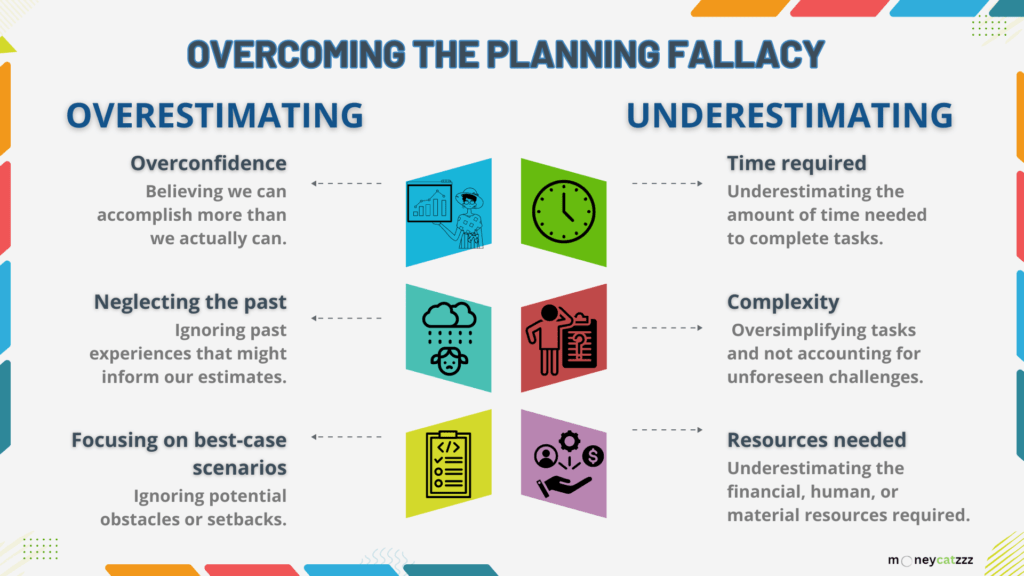
[“Don’t Underestimate the Unknown: Avoiding the Planning Fallacy” -moneycatzzz.com]
Shifting the Lens: Fixed vs. Growth Mindset
Psychologist Carol Dweck offers a clue. In her work on the growth mindset—she highlights the power of believing that our abilities are not fixed but developable. Those with a fixed mindset see failure as proof of inadequacy. Those with a growth mindset? They see it as feedback.
Imagine two young artists. Both apply to an elite art school. Both are rejected—the first, deflated, stores away their brushes. The second takes the rejection as a challenge—studies feedback, sharpens technique and grows. Years later, one finds her work in a gallery; the other still wonders if she ever had “enough talent.”
The difference wasn’t skill. It was story—the story they told themselves about what failure meant.

How I Turned Setback into Opportunity
In the days after my grandfather passed, the disappointment of missing that interview returned. But something had shifted. I no longer felt desperate to chase a title or impress a panel. Instead—I began reaching out to connections, not with urgency but with intention—looking for work that truly aligned with my values.
And wouldn’t you know it? A few weeks later, a former colleague referred me to a company I hadn’t considered. The role wasn’t as flashy, but the culture was healthy, the pace humane, and the work meaningful. It was a better fit than the dream job I’d lost.
Life closed one door. But the window it opened offered sunlight I didn’t know I needed.
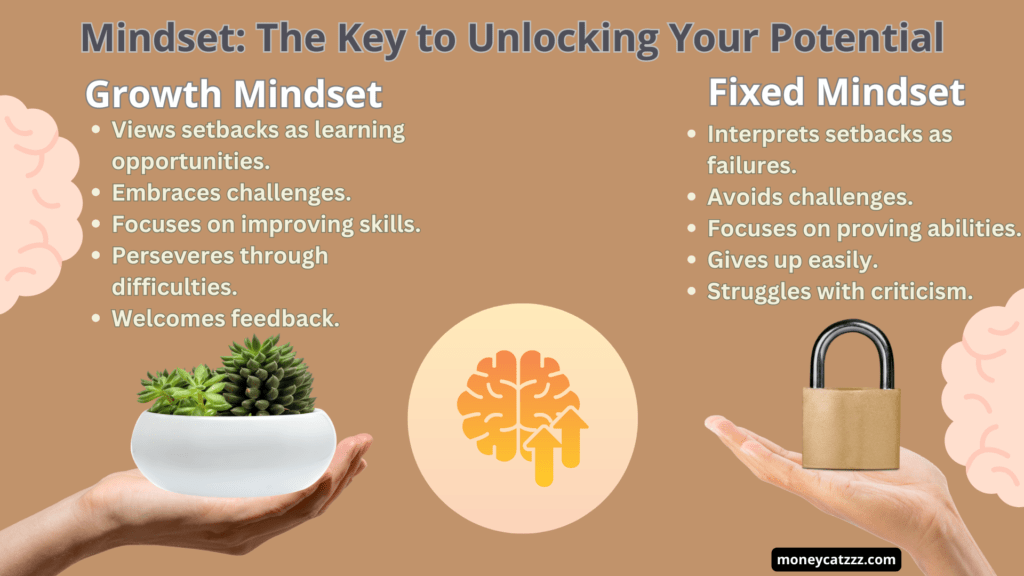
[“Fixed Mindset vs. Growth Mindset” – moneycatzzz.com]
Building Your Resilience Toolkit
Resilience isn’t about “bouncing back” as if nothing happened. It’s about growing through what you go through. Here’s how to strengthen that muscle:
- Self-Awareness
- Reflect regularly. What are your strengths? What triggers your stress? Know your defaults—then choose differently when it matters most.
- Grit & Perseverance
- Angela Duckworth defines grit as passion + persistence. Think of it as showing up for your future self—even when present-you feel defeated.
- Support Systems
- No one climbs out of life’s valleys alone. Lean on friends, mentors, and even professionals. Vulnerability isn’t weakness—it’s wisdom.
- Healthy Coping Mechanisms
- Journal your thoughts. Meditate. Walk. Lift something heavy. Create something useless. Emotions need release valves.
Real Lives, Real Lessons
Some of the world’s most extraordinary stories began with detours.
- Once chasing acting dreams, Jessica Brody pivoted after repeated rejection to co-found LearnVest, a fintech platform that sold for $600 million.
- Malala Yousafzai, shot by the Taliban for advocating girls’ education, turned tragedy into a global movement, becoming the youngest Nobel Prize laureate.
- Arnold Schwarzenegger, mocked for his accent, didn’t just become a movie star—he became governor of California. His story is less about muscle and more about mindset.
Finding Meaning in the Mess
Viktor Frankl, psychiatrist and Holocaust survivor, offers perhaps the most powerful perspective. In Man’s Search for Meaning, he writes:
“When we can no longer change a situation, we are challenged to change ourselves.”
Frankl found meaning even inside a concentration camp—not by denying suffering, but by finding purpose through it. He taught that we always have the freedom to choose our response, no matter how dire the circumstances.
It’s not about turning pain into positivity. It’s about turning pain into presence—a deeper engagement with what matters.
Umbrellas on Sunny Days: A Metaphor for Preparedness
When we say “expect the unexpected,” we’re not saying to walk around paranoid, with an umbrella in hand, bracing for storms. We’re saying: pack your character like an umbrella. You may not need it today, but when the skies change—and they will—you’ll be glad you have it.
Prepare by cultivating flexibility. Invest in relationships. Build skills that transcend industries. Ground yourself in values, not vanity metrics. That’s the kind of preparedness that weathers more than rain.

The Gift of the Present
Here’s the final irony: when we stop clinging to rigid plans, we often become more available to the present moment—and all the richness it contains.
The final days I spent with my grandfather were unscripted. There was no productivity tracker. No career milestone. Just the hush of the hospital room, the warmth of his hand in mine, and the quiet knowledge that I was exactly where I was meant to be.

[“Unpredictability” – Photo by krakenimages on Unsplash]
What’s Your Story?
The unexpected will come. The only real question is: how will you respond?
Will you resist it or reshape it?
Will you see only what’s lost or also what’s found?
Will you give up—or grow?
We all carry umbrellas we didn’t plan to open. But sometimes, the storm is what softens us. Sometimes, the detour is the destination.
If you’ve had a moment where life surprised you—and that surprise became a turning point—I’d love to hear it. Share your story in the comments. Someone out there may need to see your resilience and believe in themselves.
Let life surprise you. It may be the start of something better than you planned.
Disclosure: This post may contain affiliate links. We only recommend products we believe in, and We may receive a commission at no cost to you! Thanks for your support!”
Acknowledgement: Cover Image by rawpixel.com
Disclaimer: The information is provided for general information only – moneycatzzz.com makes no representations or warranties in relation to the information, including but not limited to any representation or warranty as to the fitness for any particular purpose of the information to the fullest extent permitted by law. While every effort has been made to ensure that the information provided in this article is accurate, reliable, and complete as of the time of writing, the information provided in this article should not be relied upon to make any financial, investment, real estate or legal decisions. Additionally, the information should not substitute advice from a trained professional who can take into account your personal facts and circumstances, and we accept no liability if you use the information to form decisions.