
 Reading Time: 8 mins #
 This post may contain affiliate links.
Master Focus: Beat the Law of Disengagement
As humans, we have a tendency to withdraw mental energy, emotional investment, and active participation when confronted with overwhelming complexity, perceived irrelevance, or a lack of discernible reward.
From the abandoned Duolingo streaks on our profiles to the quiet quitting trend silently reshaping workplaces and the stagnant investment portfolios failing to keep pace with inflation, the law of disengagement subtly erodes our potential across personal, professional, and financial landscapes. Understanding its underlying mechanisms and developing multifaceted strategies to combat disengagement is becoming an indispensable skill for thriving in the 21st century.
“If you don’t design your own life plan, chances are you’ll fall into someone else’s plan. And guess what they have planned for you? Not much.” – Jim Rohn.
The relentless demands of the modern economy and the constant connectivity of the digital age create an environment ripe for disengagement. As Cal Newport astutely argues in Deep Work: Rules for Focused Success in a Distracted World, our capacity for deep, focused attention is a finite and increasingly precious commodity, constantly eroded by the demands of a digitally saturated world.
The Personal Fallout: Beyond Willpower to Holistic Well-being
Often, what we intend doesn’t match what we do. We start with big dreams – a new skill, better health, a calmer mind – but that initial excitement can easily fade. It feels hard; the payoff is small, and easy things grab our attention. It’s not just being lazy; sometimes, we don’t know what we want or feel like, and the world distracts us. Even just getting by can make big goals seem unimportant. To care, we need to look at ourselves and our lives.
Daniel Pink, in his insightful exploration of motivation, Drive: The Surprising Truth About What Motivates Us, underscores the critical roles of autonomy, mastery, and purpose in sustaining engagement. When our pursuits lack these fundamental elements, they become highly susceptible to the law of disengagement. For instance, instead of a vague goal like “get healthier,” setting SMART goals (Specific, Measurable, Achievable, Relevant, Time-bound), like “practice a 15-minute yoga routine four times a week,” provides clarity and allows for tracking progress, fostering mastery. Even a little daily mindfulness, like a ten-minute meditation app, can give us more meaning and help us be present, making well-being feel more important. Younger folks often care about their minds and might avoid too much stress. They need to fit what we like, be in small chunks, and have support to reach our goals.

[“Law of Disengagement – Slave to the Rhythm” – Image by moneycatzzz.com]
Professional Drift: Systemic Reforms and the Future of Work
Disengaged workers lead to low productivity, stalled innovation, absenteeism, and high turnover, often stemming from poor communication, limited growth, value mismatches, and job stress. Experiments like Perpetual Guardian’s four-day week show engagement and productivity gains. Laws like California’s AB5 aim to address this for gig workers, highlighting the need to rethink traditional work and consider cultural impacts on voice and engagement.
As Patrick Lencioni powerfully illustrates in The Five Dysfunctions of a Team, a lack of clarity and commitment are foundational dysfunctions that directly fuel disengagement. Companies that give regular feedback help employees grow and make them feel safe to speak up usually have more engaged workers. Dealing with the gig economy’s challenges needs different solutions, including benefits that move with workers and rules for fair pay and good working conditions. To fix disengagement, companies must truly value how their employees are doing and make them feel they belong and that their work matters.

Financial Apathy: Active Stewardship and Real-World Examples
We often disconnect from our finances; investing feels complex, and saving seems sufficient, leading to passivity. Student debt can worsen this, creating despair. Disengagement means lost growth, poor planning, and financial risk. The solution is active management, not avoidance, even with economic worries. Financial education should also consider generational differences.
As The Richest Man in Babylon teaches, you must actively manage your finances to build wealth. Kristy Shen and Bryce Leung (FIRE, Quit Like a Millionaire) are prime examples of retiring early by diligently tracking, saving, and investing. Evidence also suggests actively managing diverse investments often yields better long-term results than passive approaches. Therefore, increasing financial engagement means learning, setting goals, monitoring regularly, and studying real-world successes.
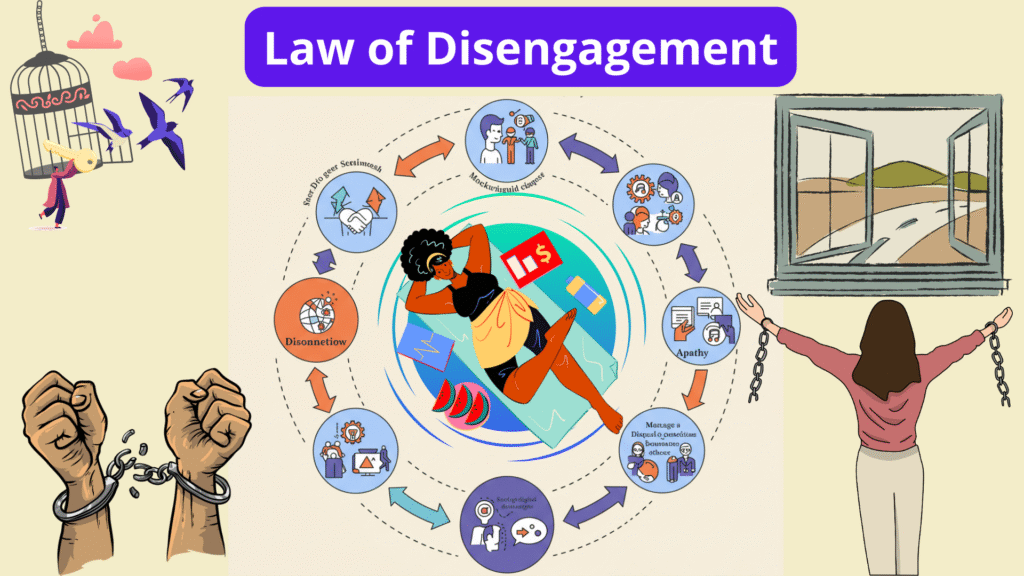
[“The Law of Disengagement” – Image by moneycatzzz.com]
Re-Engaging: Multi-Layered Strategies for Sustainable Focus and Drive
Fighting widespread disengagement requires a thoughtful, varied, and forward-thinking plan that looks at individual choices, bigger systems, and different viewpoints. Here are better ways to combat disengagement and get focused again:
- Cultivate Clarity of Purpose Through Values Alignment and Future Visioning: Go beyond simply stating goals. Identify your core values and visualize your ideal future across personal, professional, and financial domains. This deeper sense of purpose and clear future vision provide a powerful intrinsic motivator that can withstand external distractions and overcome apathy.
- Implement Micro-Habits, Gamification, and Time-Blocking: Tackle large tasks with tiny micro-habits. Boost motivation by tracking progress and rewarding milestones (gamification). Schedule dedicated focus time (time-blocking) and limit distractions using tools like Freedom or app screen time controls.
- Foster Autonomy Through Choice, Skill Development, and Collaborative Input: Actively seek opportunities for greater control over how you approach tasks and projects by investing in yourself to enhance your competence and mastery.
- Build Strong Social Connections, Seek Supportive Communities, and Embrace Diverse Perspectives: Actively cultivate positive relationships and seek mentors and supportive communities offering diverse perspectives to better understand socioeconomic, cultural, and generational factors influence strategies for tackling disengagement.
- Embrace Active Information Consumption, Critical Evaluation, and Digital Detoxes: Seek good info, think critically, and regularly do “digital detoxes” to clear your head and stay engaged.
- Practice Mindfulness, Self-Compassion, and Seek External Support When Needed: Cultivate present moment awareness through mindfulness practices—practice self-compassion when facing setbacks or feelings of disengagement. Recognize when external support, such as therapy or coaching, might be beneficial in addressing deeper issues contributing to disengagement.
- Advocate for Systemic Change, Support Ethical Organizations, and Engage in Policy Discussions: Understand that outside forces matter. Support groups and rules that help workers promote ethical business (like Patagonia) and create a fairer economy.
Understanding that disengagement comes from within us, from society, and our different lives, we can fight it by developing a strong sense of purpose, using targeted strategies like micro-habits and digital boundaries, building strong relationships, actively learning, advocating for systemic improvements, and being mindful of diverse experiences. This will allow us to reclaim our focus, motivation, and engagement personally, professionally, and financially.

A Brief Addendum on Policy/Organizational Reforms:
Examples like California’s AB5 law, aiming to reclassify some gig workers as employees, and Patagonia’s long-standing commitment to ethical sourcing, environmental sustainability, and robust employee benefits demonstrate proactive attempts at policy and organizational levels to address factors contributing to disengagement, highlighting a need for big changes for better worker rights, ethical businesses, and a more human way of working.
Concrete Financial Case Studies:
- The Frugal Minimalist: Sarah, a teacher with a modest income, achieved financial independence in her late 40s by embracing minimalism and focused on aggressive saving and index fund investing to reduce her expenses and consistently investing a significant portion of her income, demonstrating that active engagement and a clear strategy can overcome income limitations.
- The Debt Snowball Success: David and Emily tackled big student loans with Dave Ramsey’s “debt snowball,” paying off small debts first. This gave them momentum and control, freeing up money to invest and plan for the future. Their focused effort on debt changed their finances.
Re-engagement is a continuous choice, demanding individual action and a supportive setting. Understanding why we disconnect and using these full strategies lets us build purposeful, productive, and satisfying lives instead of just reacting. Will you commit to lasting engagement and control your focus in a distracting world?
Disclosure: This post may contain affiliate links. We only recommend products we believe in, and We may receive a commission at no cost to you! Thank you for your support!
Acknowledgement: Cover Image by Unsplash.com
Disclaimer: The information is provided for general information only – moneycatzzz.com makes no representations or warranties in relation to the information, including but not limited to any representation or warranty as to the fitness for any particular purpose of the information to the fullest extent permitted by law. While every effort has been made to ensure that the information provided in this article is accurate, reliable, and complete as of the time of writing, the information provided in this article should not be relied upon to make any financial, investment, real estate or legal decisions. Additionally, the information should not substitute advice from a trained professional who can take into account your personal facts and circumstances, and we accept no liability if you use the information to form decisions.