Mastering workplace chaos starts with learning to handle disruptive colleagues who drain productivity and morale—ever walked into the office only to be greeted by a coworker’s gloomy aura, sucking the joy out of the room faster than a Dementor in a donut shop? Or perhaps you’ve been caught in the crossfire of office gossip that spreads faster than rumors about a new free donut day?
According to the Society for Human Resource Management (SHRM), 70% of employees report dealing with difficult coworkers. These negativity-spreading pessimists or Emily from The Devil Wears Prada wannabes, can erode team morale, hinder productivity, and even contribute to burnout.
By mastering workplace chaos, you can develop the emotional intelligence, communication skills, and boundary-setting strategies needed to navigate these challenges effectively—ensuring a more positive and productive work environment.
This article equips you with the tools and strategies to navigate these situations like a boss. By developing practical communication skills, emotional intelligence, and healthy boundaries, you can transform your workplace tornado into a collaborative teammate.
The Cost of Disruption
Mastering workplace chaos starts with understanding the toll disruptive colleagues take on your productivity, morale, and mental well-being. These individuals come in many forms—the chronic complainer who drains energy, the gossip who thrives on drama, or the micromanager who stifles creativity. Regardless of their approach, their impact is undeniable.
Constant negativity creates a toxic work environment, sapping motivation and lowering team morale. Gossip erodes trust, fueling workplace divisions that make collaboration difficult. Micromanagement hinders productivity, making employees feel powerless and undervalued.
According to the American Psychological Association (APA), navigating workplace disruptions can lead to increased stress, anxiety, and even burnout. You can take control, set boundaries, and implement strategies that foster a more positive and productive work environment by mastering workplace chaos.

[“Disruption” – Image from LinkedIn]
Understanding Disruptive Colleagues
Mastering workplace chaos begins with understanding why disruptive colleagues behave as they do. Before tackling negativity, gossip, or micromanagement, it’s crucial to recognize the root causes behind these behaviors. Often, workplace disruptions stem from deeper emotional or psychological struggles. Identifying these triggers allows for a strategic response rather than a reactive one.
Common Reasons Behind Workplace Disruptions
🔹 Insecurity – Some colleagues use negativity as a defense mechanism to mask self-doubt. By complaining or criticizing, they attempt to deflect attention from their perceived shortcomings or form connections through shared dissatisfaction.
🔹 Frustration – Employees who feel undervalued, overwhelmed, or unheard may resort to gossip or passive-aggressive behavior to vent their frustrations. This often arises from an unfair workload, lack of recognition, or an unhealthy workplace culture.
🔹 Lack of Trust – Micromanagement is often a symptom of deeper trust issues. Managers or team leads who struggle with delegation may feel the need to exert excessive control, fearing tasks won’t be completed correctly without their oversight.
How Emotional Intelligence (EQ) Helps You Respond
Developing emotional intelligence (EQ) is key to mastering workplace chaos. By recognizing the emotions driving disruptive behaviors, you can approach situations with empathy and strategy rather than frustration. Strengthening EQ enables you to de-escalate conflicts, establish boundaries, and foster a healthier, more productive work environment.
Building Emotional Agility in the Workplace
Beyond communication strategies, developing emotional agility equips you to remain calm and collected in the face of workplace disruptions. In Emotional Agility: Get Unstuck, Embrace Change, and Thrive in Work and Life, Susan David, Ph.D., presents a science-backed approach to handling challenges with greater self-awareness, adaptability, and resilience.
The Four Core Principles of Emotional Agility
Dr. David’s framework consists of four key principles that help individuals navigate emotions effectively:
1. Showing Up – Acknowledge Emotions Without Judgment
Showing Up involves recognizing them as they arise instead of suppressing, ignoring, or overanalyzing emotions. Accepting emotions without judgment allows for better emotional regulation and self-awareness.
2. Stepping Out – Gain Perspective on Your Emotions
This principle encourages detaching from emotions and viewing them objectively. Instead of being consumed by frustration or stress, individuals can observe their feelings with curiosity. Techniques such as mindfulness and self-reflection help create emotional distance, making responding thoughtfully rather than impulsively easier.
3. Walking Your Why – Align Actions with Core Values
Emotional agility is not just about managing emotions—it’s about ensuring that our responses align with our values and long-term goals. By identifying what truly matters, individuals can make intentional choices rather than being driven by fleeting emotions.
4. Moving On – Embrace Change with Mental Flexibility
Moving On emphasizes adaptability and resilience rather than getting stuck in rigid thought patterns. Small, deliberate changes in mindset and behavior help individuals grow, evolve, and effectively handle challenges in dynamic work environments.
[“The Four Core Principles of Emotional Agility” – Susan David Ph.D”]
Applying Emotional Agility in Workplace Interactions
To enhance emotional agility in professional settings, consider the following:
🔹 Recognize Emotional Triggers – Identify situations that cause frustration or stress and develop strategies to manage them proactively.
🔹 Practice Mindful Responses – Instead of reacting impulsively to workplace challenges, take a moment to reflect before responding.
🔹 Stay Solution-Oriented – Focus on constructive problem-solving rather than dwelling on negativity.
🔹 Cultivate Empathy – Understand your colleagues’ perspectives to foster healthier interactions.
By strengthening emotional agility, professionals can manage workplace disruptions effectively, reduce stress, and create a more positive, collaborative work environment.
Strategies for Effective Communication
When mastering workplace chaos, effective communication is your most powerful tool. Now that you understand the emotional triggers behind disruptive behavior, let’s explore proven strategies to navigate these challenges. Below are three powerful frameworks to help you communicate with clarity and confidence.
Crucial Conversations by Patterson et al.
This book identifies four crucial conversations that can be applied to address disruptive behavior. A key takeaway is the “STATE“ method, which provides a structured approach:
🔹 Share the Facts – Objectively describe the specific behavior causing concern. Avoid accusatory language and focus on concrete examples. Instead of saying, “You’re always complaining,“ try, “I’ve noticed you’ve been expressing a lot of negativity about the workload lately.”
🔹 Tell the Truth – Communicate how this behavior impacts you and the work environment. Express your feelings honestly and respectfully. For example, “This negativity makes it difficult for me to stay motivated, and I’m concerned it might also affect others.”
🔹 Ask Their Perspective – Seek to understand the underlying reasons behind their actions. Use open-ended questions to encourage dialogue. Try asking, “Is there anything specific that’s causing you frustration with the workload?“ or “What do you think would help make things feel more manageable?”
Mastering these strategies can transform workplace chaos into a productive and collaborative environment, ensuring smoother interactions and a more positive work culture.
[“Effective Communication” – Image by notion4teachers]
Effective Communication for a Positive Work Environment
Talk About Your Needs
Clearly articulate your desired outcome from the conversation. Be solution-oriented and focus on what you need from your colleagues to foster a more positive and productive work environment.
Example:
“I’d appreciate it if we could focus on finding solutions together. We could brainstorm ideas to make the workload more manageable, or maybe there’s a way to communicate concerns with our manager more effectively.
Explore Solutions Together
Work collaboratively to identify solutions that address both your needs and theirs. Be open to compromise and consider strategies that tackle the root cause of the issue.
This could involve:
- Delegating tasks to distribute the workload more efficiently.
- Requesting additional resources to ease the pressure.
- Establishing a clear communication plan with leadership for better alignment.
By fostering teamwork and constructive dialogue, you can Master Workplace Chaos and create a work environment that thrives on collaboration and mutual support.
Mastering Workplace Chaos: Robert Relaxes the Reins—Barbara’s Brilliant Maneuver
Barbara, a talented designer, felt stifled by Robert’s constant micromanagement, which hindered her creativity and autonomy.
Emotional Agility in Action
Instead of dwelling on frustration, Barbara focused on understanding the root cause of Robert’s behavior. She considered whether his micromanagement stemmed from concerns about quality control or a lack of trust in her abilities.
Crucial Conversation: Using the “STATE“ Method
Barbara applied the STATE framework to Master Workplace Chaos effectively:
- Share: She explained how frequent feedback was stifling her creativity.
- Tell: She expressed feeling uncertain due to Robert’s close oversight.
- Ask: She inquired about Robert’s reasons for his micromanagement style.
- Talk: She acknowledged that communication gaps might be contributing to the issue.
- Encourage: She suggested weekly design reviews, allowing them to exchange feedback in a structured way.
Robert welcomed Barbara’s suggestion and established a clearer, more balanced collaboration process that respected her creativity while maintaining quality control.
Emotional intelligence and strong communication skills, mainly through structured methods like STATE, empower professionals to overcome workplace challenges, foster trust, and build stronger, more productive working relationships.
Mastering Workplace Chaos: Navigating Difficult Conversations
Navigating difficult conversations with clarity and confidence is essential when mastering workplace chaos. In Difficult Conversations by Stone et al., challenging discussions are categorized into three emotional types: disappointed, angry, and fearful. Recognizing these emotions helps you tailor your approach for a more constructive resolution.
To further enhance your ability to handle disruptive behavior, use the GRIP method:
🔹 Goal – Clearly define the purpose of the conversation. Are you aiming to improve communication, set boundaries, or find a collaborative solution? Establishing a clear goal keeps the discussion focused and productive.
🔹 Roles – Clarify expectations and responsibilities for both parties. Defining roles prevents misunderstandings and micromanagement if the issue stems from confusion within a project or team.
🔹 Interests – Identify both your and your colleague’s underlying motivations. Understanding what drives their behavior allows you to align interests for a mutually beneficial outcome.
🔹 Process – Establish a structured approach to keep the conversation on track. This may include setting a dedicated time to talk, agreeing on respectful communication ground rules, or deciding on follow-up actions.
By leveraging the GRIP framework, you can transform difficult conversations into opportunities for collaboration, clarity, and workplace harmony—even amidst workplace chaos.
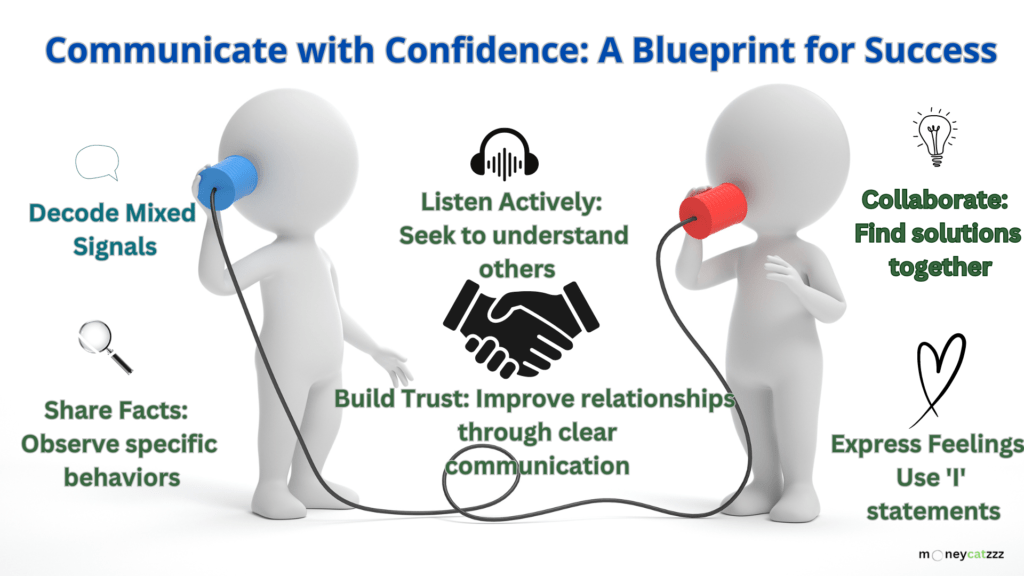
[“Communicate Clearly, Connect Deeply” – moneycatzzz.com]
Mastering Workplace Chaos: Getting GRIPS with Missed Signals
Imagine Jessica, a marketing manager, feeling frustrated due to a lack of direction from her manager, William. She worried about meeting expectations, leading to anxiety and a decline in performance. Unfortunately, Jessica never directly addressed her concerns, missing a critical opportunity for resolution.
Missed Opportunity
Had Jessica utilized the GRIP framework and initiated a conversation with William, they could have addressed the situation proactively:
- Goals: Jessica could have clarified overall marketing objectives and her specific role in achieving them.
- Roles & Responsibilities: They could have discussed William’s expectations, ensuring clear communication channels.
- Interpersonal Relationships: Addressing Jessica’s anxiety about the lack of direction could have fostered trust and collaboration.
- Processes: Establishing a regular feedback loop or scheduling check-in meetings would have kept Jessica on track.
The Power of Proactive Communication
By proactively addressing concerns using the GRIP framework, Jessica could have prevented the decline in performance and built a more productive working relationship with William. This case study highlights the importance of open communication and emphasizes the GRIP framework as a tool for navigating workplace conflict—a crucial step in Mastering Workplace Chaos.
Mastering Workplace Chaos with Nonviolent Communication by Rosenberg
This approach emphasizes clear communication that fosters empathy and understanding—key elements in Mastering Workplace Chaos. Nonviolent Communication (NVC) focuses on four essential components:
1. Honest Observation
Describe the specific behavior you’re observing without judgment. Please focus on the action itself, not the person.
Instead of saying, “You’re such a gossip,“ say:
“I noticed you were talking about Sarah with another colleague earlier.”
2. Identifying Feelings
Express how the behavior makes you feel (e.g., frustrated, disrespected). Use “I“ statements to take ownership of your emotions.
Instead of reacting emotionally, say:
“I feel frustrated when I hear gossip in the office because it creates a sense of distrust and makes it difficult to focus on my work.”
3. Needs-Based Requests
Clearly and positively articulate your needs. Focus on what you need from your colleague to improve the situation.
Instead of being confrontational, say:
“I need to feel like I can trust my colleagues to maintain confidentiality, and I would appreciate it if we could avoid gossiping about others in the workplace.”
4. Empathetic Listening
Actively listen to your colleague’s perspectives and understand their needs. This doesn’t mean agreeing with their behavior but showing a willingness to understand.
Instead of dismissing them, say:
“It sounds like you’re feeling frustrated.”
“Can you tell me more about why you need to gossip?”
By applying Nonviolent Communication, you can navigate workplace tensions with empathy and respect, ensuring a healthier, more productive environment while Mastering Workplace Chaos.
Case Study: Mastering Workplace Chaos Through the Power of Empathy
Imagine Mark, a software engineer, who felt constantly criticized by his colleague, Brenda. Mark interpreted Brenda’s direct feedback as negativity, leading to defensiveness and a strained working relationship. Unfortunately, Mark never truly understood Brenda’s perspective—a missed opportunity for collaboration and team cohesion in the quest to Master Workplace Chaos.
Missed Opportunity for Collaboration
Had Mark utilized the principles of Nonviolent Communication (NVC), he could have fostered empathy and a more productive dialogue:
- Observations: Mark could have focused objectively on describing Brenda’s behavior, e.g., “You often point out areas for improvement in my code.”
- Feelings: He could have expressed his emotions, e.g., “I feel discouraged when I receive frequent critical feedback.”
- Needs: By identifying his underlying needs, e.g., “I need to feel valued for my contributions and have a chance to learn from mistakes,“ Mark could encourage Brenda to communicate in a way that supports those needs.
- Requests: Mark could have made a specific request for future interactions, e.g., “Would you be open to offering suggestions more constructively, perhaps focusing on solutions rather than just problems?”
Building a Stronger Team
By using NVC to express his feelings and needs in a clear and non-accusatory way, Mark could have opened a dialogue for Brenda to explain her perspective. Brenda may have strived for high quality but needed more effective communication skills.
Through Mastering Workplace Chaos with empathy-driven communication, they could establish a more collaborative working relationship, enhancing mutual learning and team improvement.
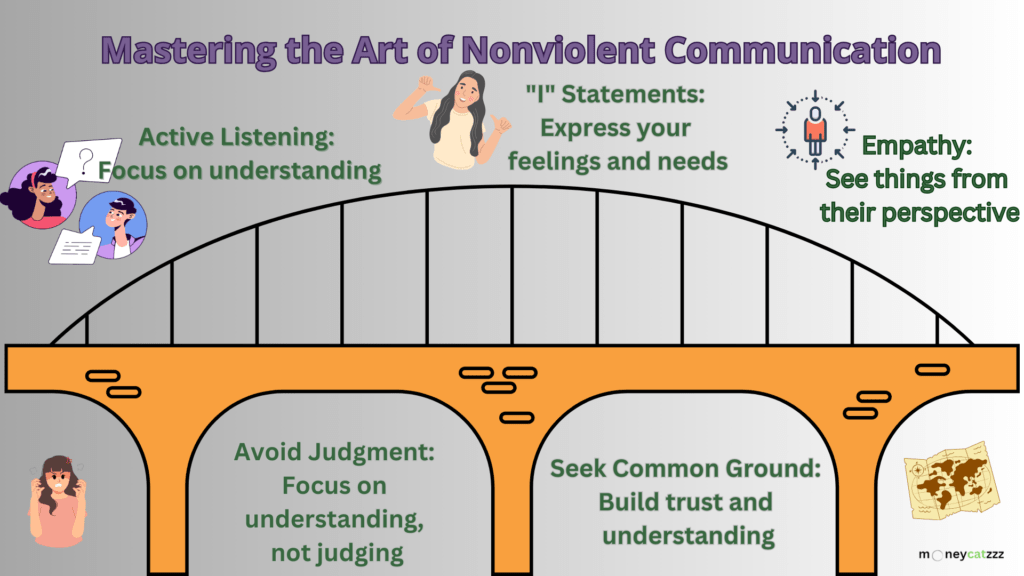
[“Mastering the Art of Nonviolent Communication” – moneycatzzz.com]
Putting It into Practice: Mastering Workplace Chaos by Taming Specific Disruptions
Now that we’ve explored communication strategies and emotional intelligence, let’s see them in action with common disruptive behaviors that challenge your ability to Master Workplace Chaos.
The Chronic Complainer
They’re like a human raincloud, always hovering overhead, ready to sprinkle negativity on everything. Use the “STATE” method from Crucial Conversations to handle their complaints effectively:
- Share specific examples of their negativity and how it impacts the team.
- Talk it out—ask for their perspective. Are they feeling overwhelmed or unsupported?
- Address the root cause and work together to find solutions.
- Take a collaborative approach instead of dismissive responses.
- Encourage constructive communication rather than constant complaining.
You can also suggest positive mindset strategies, such as focusing on accomplishments, practicing gratitude, or redirecting their attention to solutions rather than problems. By implementing these techniques, you reinforce your ability to Master Workplace Chaos and cultivate a more productive
The Gossip Monger: Mastering Workplace Chaos Without Getting Sucked into the Wormhole
Sometimes, office gossip can feel like navigating a minefield—like hapless Andy Sachs facing Miranda Priestly in The Devil Wears Prada. However, mastering workplace chaos means learning to disengage from unproductive conversations and setting firm boundaries to maintain a positive and professional work environment.
If you find yourself in the middle of office gossip, politely excuse yourself and avoid taking sides. Don’t contribute to the speculation or fuel the drama. A simple “Excuse me, I need to get back to work” or “I’m not comfortable discussing this” can help you step away without creating conflict.
If the gossip directly targets you, confront the situation with Nonviolent Communication. Express how the rumors impact you (“I feel disrespected when…”) and request that the person stop (“I would appreciate it if you wouldn’t spread rumors about me”). Addressing the behavior directly reinforces your commitment to Mastering Workplace Chaos while fostering a more respectful and professional environment.

The Micromanager: How to Untangle Yourself from the Web of Control.
Utilize the “GRIP” method from Difficult Conversations. Clearly define your roles and responsibilities. Highlight your past successes, demonstrating your competence. Work towards establishing a clear communication process where you can update your manager on progress without constant oversight.
Consider setting regular check-ins or progress reports to provide updates without micromanagement.
Setting Boundaries and Seeking Support
While effective communication is crucial, establishing healthy boundaries is equally important. Let your disruptive colleague know what behavior is unacceptable.
Example:
If they constantly interrupt you, politely but firmly state, “Excuse me, can I finish my thought?”
Disengage from Unproductive Conversations
- Take a mental break to regain focus.
- Suggest a follow-up discussion once emotions have settled.
- Protect your emotional well-being by avoiding unnecessary conflict.
Use Mindfulness to Manage Stress
Deep breathing, meditation, or other mindfulness techniques can help you stay calm and focused in stressful situations.
Seek Support When Needed
If the situation becomes overwhelming, don’t hesitate to reach out for help:
- HR professionals for workplace mediation.
- A trusted colleague for guidance.
- A therapist or coach for emotional support.
By setting boundaries and seeking support, you can Master Workplace Chaos and create a work environment that fosters productivity, respect, and collaboration.
Building Resilience and Thriving at Work
Disruptive colleagues can be challenging, but you can navigate these situations by strengthening your communication skills, enhancing your emotional intelligence, and setting healthy boundaries.
Take Control of Workplace Challenges
- Don’t tolerate negativity—protect your well-being.
- Set clear boundaries to prevent workplace disruptions.
- Develop resilience by focusing on solution-oriented communication.
Transform Disruptive Colleagues into Collaborative Partners
You can shift the dynamic from conflict to collaboration by fostering clear communication and empathy.
The strategies outlined here will empower you to Master Workplace Chaos, take charge of your work environment, and thrive—no matter the challenges.
A Harmonious Workplace is Ideal, But Not the Only Answer
A harmonious workplace is desirable, but it’s just one piece of the puzzle. Research by Gallup reveals that employees crave something more fundamental: a sense of purpose, growth opportunities, and well-being.
Organizations that focus on these core elements cultivate a thriving work environment where employees feel valued, motivated, and empowered to perform at their best.
Join the Conversation
Have you ever dealt with a disruptive colleague? Share your experiences and coping strategies in the comments below!
🔹 Subscribe to our blog for more personal and professional growth insights!
Bibliography
- Patterson, Kerry, et al. Crucial Conversations: Tools for Talking When Stakes Are High. Third Edition, McGraw-Hill Education, 2011.
Stone, Douglas R., et al. Difficult Conversations: How to Discuss What Matters Most. Penguin Random House, 1999. - Rosenberg, Marshall B. Nonviolent Communication: A Language of Life. Puddlenut Publications, 2003.
- Society for Human Resource Management
- American Psychological Association
Disclosure: This post may contain affiliate links. We only recommend products we believe in, and We may receive a commission at no cost to you! Thanks for your support!”
Acknowledgement: Cover Photo by Marek Studzinski on Unsplash
Signup to our Newsletter for regular updates:
Disclaimer: The information is provided for general information only – moneycatzzz.com makes no representations or warranties in relation to the information, including but not limited to any representation or warranty as to the fitness for any particular purpose of the information to the fullest extent permitted by law. While every effort has been made to ensure that the information provided in this article is accurate, reliable, and complete as of the time of writing, the information provided in this article should not be relied upon to make any financial, investment, real estate or legal decisions. Additionally, the information should not substitute advice from a trained professional who can take into account your personal facts and circumstances, and we accept no liability if you use the information to form decisions.