
 Reading Time: 8 mins #
 This post may contain affiliate links.
In today’s fast-paced world of self-improvement and entrepreneurship, manifestation techniques for success have gained significant traction. From achieving career milestones to attaining financial abundance, the empowering potential of manifestation is widely embraced. Popularized by books like The Secret and Atomic Habits, manifestation promises that focused intention and visualization can shape your reality. Yet, behind the glossy testimonials lies a complex interplay of mindset, neuroscience, behavior, and chance. To harness this tool effectively, it’s crucial to understand both its inspiring potential and its inherent limitations.
James Doty, a Stanford neurosurgeon and neuroscientist, delves into the neuroscience of manifestation in his book Mind Magic: The Neuroscience of Manifestation and How It Changes Everything. He explains that intentionally redirecting our attention can physically alter our brain’s structure, enhancing our ability to achieve goals.
However, psychological research presents a more nuanced view. An article in Psychology Today highlights that while manifestation practices like the Law of Attraction are popular, they may not lead to better outcomes and could be associated with risky financial decisions. The piece emphasizes that relying solely on positive thinking without concrete actions can be detrimental.
These insights underscore the importance of integrating manifestation techniques with practical efforts and critical thinking, ensuring our aspirations are grounded in reality.
“Your thoughts are the architects of your destiny.” — David O. McKay.
Understanding Manifestation: Beyond Wishful Thinking
Manifestation is not about simple wishful thinking but the deliberate process of aligning your thoughts, emotions, and actions toward a specific outcome. Influential works such as Deep Work, The Power of Now, and The Secret have made a strong case for the transformative power of visualization and positive habits. The idea is straightforward: when you set a clear goal and consistently visualize its achievement, you program your mind to recognize opportunities and overcome obstacles.
However, this process is far from magical. The popular narrative tends to oversimplify by implying that positive thoughts alone can overcome all challenges. In reality, practical manifestation involves both an internal transformation and strategic, external actions. It requires a deep understanding of your strengths, weaknesses, and the external factors that can influence your journey. True transformation is achieved by integrating these elements into a coherent strategy that allows for flexibility and critical evaluation.
The Neuroscience Behind Manifestation
Rewiring the Brain with Intention
Neuroscience provides insight into how our focused intentions can subtly reshape our brains. Researchers like Tali Sharot have explored how optimism and positive outlooks activate neural circuits associated with reward and motivation. James R. Doty, a prominent figure in the field, explains that when you visualize your goals repeatedly, you strengthen “task-positive networks” in the brain. These networks help you detect environmental cues that align with your goals.
Imagine you’re determined to network with experts in your field. Visualizing conversations and setting that clear intention makes your brain more attuned to relevant opportunities, even in a crowded, noisy space. Over time, this can lead to heightened awareness of chances to connect, which might otherwise be overlooked.

[“Manifestation – Pathway with Diverging Directions”- Image by moneycatzzz.com on Canva]
A Balanced Scientific Perspective
Notably, the neural changes resulting from visualization are subtle and occur within a more extensive, complex system. Brain imaging studies show that positive thinking is associated with increased activity in areas like the prefrontal cortex, which is involved in planning and decision-making. However, these changes are moderated by various factors:
- Genetics, Environment, and Personal Factors: The brain’s response to positive visualization is influenced not only by repeated practice but also by your genetic predispositions, current environment, and personal experiences.
- Complex Neurotransmitter Interactions: Regions of the brain that respond to optimism and reward rely on a network of neurotransmitters such as dopamine, serotonin, and oxytocin. The interplay of these chemicals means that positive visualization contributes to, but does not solely drive, success.
Thus, while a positive outlook can boost your resilience and focus, it is only one piece of a much larger puzzle.
Correlation Versus Causation: Interpreting the Evidence
Many narratives claim that individuals who practice manifestation are statistically more likely to succeed. However, such statements must be interpreted with caution. Research often reveals correlations between optimism and success, but correlation does not imply causation.
Success is inherently multifaceted. For instance, motivated individuals with a positive outlook are more persistent, resourceful, and willing to take risks. These traits, rather than mere positive thinking, can drive success. In other words, the very factors that help you remain optimistic might be the ones that propel you forward. Moreover, external factors such as social support, economic conditions, and even chance play significant roles. It’s important to recognize that while manifestation can be a powerful tool, it’s not the only factor in our lives.
Studies designed to explore these relationships are typically correlational. While they may show that optimistic people tend to achieve more, they do not prove that optimism alone creates that success. It’s critical to combine this understanding with well-designed experiments that test causality. Until such evidence is conclusive, it is wise to view manifestation as a beneficial tool that complements, rather than replaces, hard work and external support.
The Dual Nature of Manifestation: Benefits and Pitfalls
Harnessing the Power of Visualization
When used appropriately, manifestation can serve as a powerful catalyst for change. Visualization techniques help you clarify your goals and set a clear, actionable vision for the future. This process can increase motivation, boost confidence, and even help overcome self-doubt. When you focus on a goal and see yourself achieving it, you are more likely to take the concrete steps needed to make that vision a reality.

The Risk of Overemphasis and Toxic Positivity
On the other hand, an overemphasis on positive thinking can have unintended consequences. When people believe everything is under their control, they may ignore or downplay external factors such as economic conditions or interpersonal dynamics. This misinterpretation can lead to feelings of guilt or self-blame when desired outcomes are not achieved.
Furthermore, a relentless focus on maintaining a positive outlook can evolve into what some critics call “toxic positivity.” This phenomenon occurs when negative emotions are suppressed rather than acknowledged and processed. For instance, if someone is going through a difficult time and is told to ‘just think positive‘ without any acknowledgment of their feelings, this can be an example of toxic positivity. Healthy personal growth requires learning from setbacks; ignoring these lessons can stifle resilience.
Addressing the Concept of “The Ugly”
While traditional discussions of manifestation tend to focus on positive outcomes versus setbacks, the notion of attracting “the ugly” warrants deeper exploration. Here, ‘the ugly‘ is not used literally but as a metaphor for negative or undesirable outcomes. It’s a way to acknowledge that manifestation is not a one-sided process and that it’s important to consider both the good and the bad resulting from our thoughts and actions.
Misaligned Mindsets: Negative outcomes often arise not from a deliberate effort to manifest something unpleasant but from underlying self-sabotaging behaviors or cognitive distortions. When unresolved emotional issues or suppressed negative emotions dominate one’s thought process, the resulting actions can lead to harmful consequences. This is not so much the manifestation of something hideous as it is the unintended consequence of an imbalanced internal state.
Integrating the Shadow: In psychological terms, the “shadow” refers to the parts of ourselves we often repress or deny. Ignoring these darker aspects in favor of an overly simplistic, optimistic narrative can lead to a buildup of unresolved issues. When these issues eventually surface, they may result in destructive behavior. Manifesting “the ugly” in this context is less about actively creating adverse outcomes and more about failing to integrate and understand our emotions.
By exploring these dimensions, we recognize that “the ugly” in manifestation is not an external force that one can summon at will but rather a reflection of internal imbalances that must be addressed through holistic self-understanding.
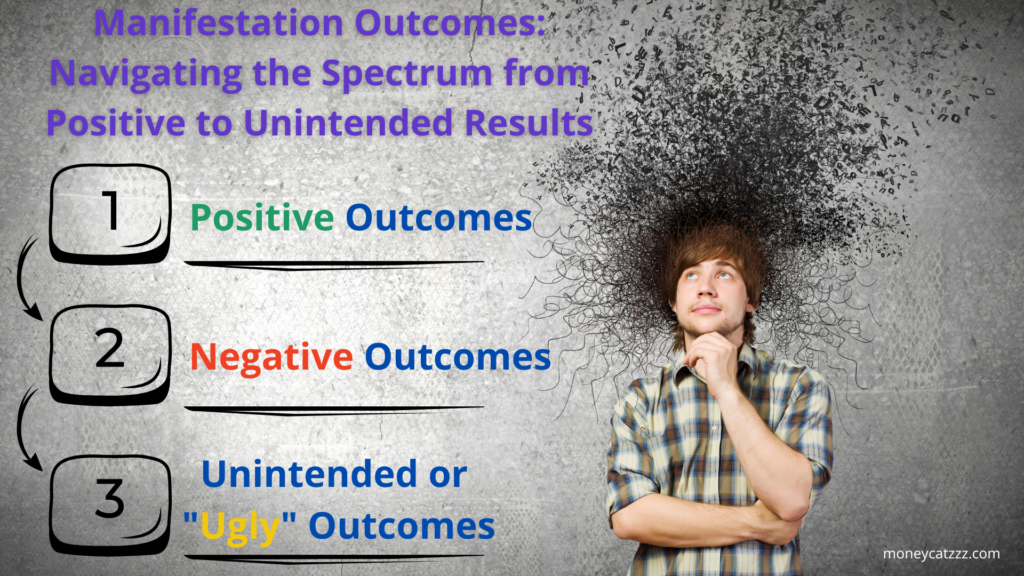
[“Manifestation Outcomes: From Positive to Unintended Results” – Image by moneycatzzz.com on Canva]
Integrating Critical Evaluation with Action
To truly benefit from manifestation, you must blend visualization with strategic action. Here is a comprehensive framework:
Begin by clarifying your vision. Write down specific, meaningful goals and engage in detailed visualization that involves all your senses. This practice reinforces neural pathways and helps you internalize your objectives.
Next, develop consistent habits that align with your goals. Break larger ambitions into manageable tasks and create routines that support your progress. Reflect regularly on your achievements and setbacks, and be willing to adjust your strategies based on new insights. Maintain emotional balance through mindfulness practices like meditation or journaling, which help regulate stress and promote a realistic yet hopeful outlook.
Finally, seek external feedback from mentors or trusted peers. This helps ensure that your approach remains grounded in reality, preventing the pitfalls of over-reliance on positive thinking alone.

Embrace an Informed, Balanced Approach
Manifestation is a multifaceted concept that can be a powerful instrument for personal and professional growth when understood in its entirety. By integrating the inspiring elements of positive visualization with a sophisticated understanding of neuroscience and the complexities of correlation versus causation, you can create a robust, balanced strategy for success. Addressing the bright and shadowy aspects of your inner world, including the nuanced discussion around “the ugly,” your journey is both holistic and realistic.
True transformation comes from harmonizing a positive mindset with deliberate action, ongoing self-reflection, and the willingness to confront and integrate all aspects of your experience. Use manifestation as one of many tools in your self-development toolkit, and remember that real growth arises from a thoughtful blend of mind, body, and environment.
Embrace your journey with optimism tempered by critical insight. Let your vision guide you, but allow your actions and the wisdom drawn from scientific inquiry to keep you grounded and adaptive in the face of life’s challenges.
Disclosure: This post may contain affiliate links. We only recommend products we believe in, and We may receive a commission at no cost to you! Thank you for your support!
Acknowledgement: Cover Image by Unsplash.com
Disclaimer: The information is provided for general information only – moneycatzzz.com makes no representations or warranties in relation to the information, including but not limited to any representation or warranty as to the fitness for any particular purpose of the information to the fullest extent permitted by law. While every effort has been made to ensure that the information provided in this article is accurate, reliable, and complete as of the time of writing, the information provided in this article should not be relied upon to make any financial, investment, real estate or legal decisions. Additionally, the information should not substitute advice from a trained professional who can take into account your personal facts and circumstances, and we accept no liability if you use the information to form decisions.