
 Reading Time: 8 mins #
 This post may contain affiliate links.
Decision Mastery: The Key to Leadership in a Disruptive World
In today’s age of constant disruption, decision mastery is no longer an option—it’s a necessity. Agility and adaptability are critical for businesses striving to survive and thrive. Leaders who excel at decision-making can confidently navigate uncertainty, turning challenges into opportunities.
A recent McKinsey and Company report paints a stark picture: 73% of executives believe poor decision-making significantly hinders their ability to achieve strategic goals. Meanwhile, companies with a strong decision-making culture outperform their peers by up to 50% in profitability. These numbers highlight one undeniable truth—decisiveness directly impacts the bottom line.
“If you’re not making mistakes, then you’re not doing anything.” – John Wooden, legendary basketball coach
But what separates leaders who make impactful choices from those who falter under pressure? The answer lies not in blind intuition or unwavering stubbornness but in a thoughtful and strategic approach. Mastering decision-making means leveraging data, fostering diverse perspectives, and communicating effectively.
The 8 Traits That Define Decision Mastery
Achieving decision mastery isn’t about making perfect choices every time—it’s about developing a process that leads to better, faster, and more effective decisions. Here, we explore the eight key traits that empower leaders to become true decision-making virtuosos.
1. Cultivate a Strategic Mindset for Smarter Decisions
Great decisions stem from a big-picture perspective. Leaders who have achieved decision mastery don’t just react to immediate challenges—they proactively shape their organization’s future. They ask critical questions like:
“How will this decision impact our strategic objectives in 5 or 10 years?”
They ensure that every move contributes to sustained business growth and success by aligning their choices with long-term goals.
2. Embrace Data-Driven Decisions—But Balance It with Judgment
In today’s digital era, data-driven decision-making is a must. However, decision mastery requires more than just analyzing numbers—integrating data insights with experience, intuition, and qualitative judgment.
🔹 Data provides clarity but doesn’t capture every nuance or account for unforeseen circumstances.
🔹 Effective leaders interpret data within the proper context rather than relying on it blindly.
🔹 As Malcolm Gladwell discusses in Blink: The Power of Thinking Without Thinking, rapid cognition can sometimes lead to better results than overanalyzing every data point.
By mastering the balance between data and intuition, leaders make well-rounded, confident choices that drive organizational success.

[“Decision-Making Powerhouse” – moneycatzzz.com]
3. Foster a Culture of Inquiry to Strengthen Decision Mastery
Great decisions are rarely made in isolation. A core principle of decision mastery is embracing diverse perspectives and fostering a culture of inquiry. Leaders who excel at this create a safe space for open dialogue and honest feedback, ensuring that every decision is well-informed.
🔹 They actively seek dissenting opinions to challenge assumptions and avoid blind spots.
🔹 They encourage healthy debate, refining ideas before committing to action.
🔹 As Daniel Kahneman explores in Thinking Fast and Slow, our cognitive biases often cloud judgment, making critical thinking and diverse input essential.
Leaders develop sharper, more resilient strategies by cultivating a decision-making culture rooted in collaboration and inquiry.
4. Master the Art of Framing for Clearer, More Impactful Decisions
The way a problem is framed can significantly impact decision outcomes. Those who have mastered decision-making understand that framing influences perception, guiding stakeholders toward better choices.
🔹 Effective leaders ensure clarity by presenting problems within the proper context.
🔹 Strategic framing minimizes ambiguity and eliminates decision paralysis.
🔹 As Chip Heath and Dan Heath highlight in Made-to-Stick, how information is structured determines whether it resonates and drives action.
Mastering the psychology of framing is a key element of decision mastery, helping leaders communicate persuasively and align teams around strategic goals.

5. Develop Cognitive Agility to Master Decision-Making
The business world is a dynamic ecosystem in constant flux. Decision mastery requires leaders to adapt to changing circumstances and adjust strategies on the fly. Those who excel at this are intellectually curious and lifelong learners—they don’t just react to change; they anticipate it.
🔹 Become a voracious consumer of information – Immerse yourself in industry publications, online resources, and thought leadership pieces. Subscribe to newsletters and blogs for daily insights into evolving trends.
🔹 Seek out diverse perspectives – Don’t limit yourself to information that reinforces your existing beliefs. Follow thought leaders and influencers with differing viewpoints on platforms like LinkedIn and Twitter.
🔹 Engage in continuous learning – Stay on the cutting edge by attending industry conferences, workshops, and online courses. Pursue professional development opportunities to expand your knowledge base.
🔹 Embrace new experiences – Seek new challenges outside your comfort zone. Attend networking events, collaborate with professionals from different backgrounds, and participate in hackathons or innovation challenges to refine your decision-making skills.
Leaders sharpen their cognitive agility by actively engaging with new ideas and approaches, ensuring they stay ahead of the curve in an ever-evolving landscape.
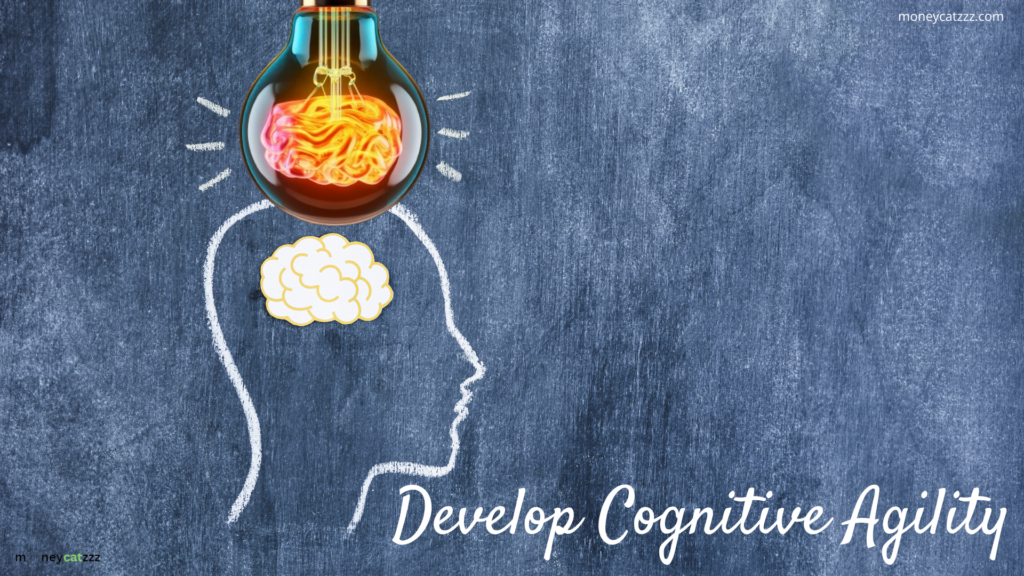
[“Cultivate Cognitive Agility” – moneycatzzz.com]
6. Acknowledge and Mitigate Biases for Smarter Decision-Making
Our brains are wired with cognitive biases that can cloud judgment and lead to suboptimal decisions. Those who achieve decision mastery recognize these biases and actively work to mitigate their influence.
🔹 Identify potential pitfalls – Leaders employ techniques like playing devil’s advocate and conducting post-mortems to uncover flawed reasoning.
🔹 Counter cognitive biases – They gather diverse perspectives to challenge anchoring bias and other unconscious influences before deciding.
🔹 Foster objective decision-making – By questioning assumptions and using structured frameworks, leaders ensure their choices are grounded in logic rather than emotion.
Mastering bias mitigation strengthens decision-making clarity, leading to more strategic and effective leadership.
7. Embrace Calculated Risks to Drive Innovation
While playing it safe may seem prudent, it often stifles growth and Innovation. Decision mastery involves understanding risk tolerance and taking calculated risks when necessary.
🔹 Weigh risks and rewards – Effective leaders analyze potential gains versus possible drawbacks before moving.
🔹 Make informed bets – They gather data, consider multiple scenarios, and prepare for contingencies.
🔹 Learn from experience – Success and failure offer valuable lessons that refine future decision-making strategies.
By embracing strategic risk-taking, leaders unlock new opportunities, fueling business growth and competitive advantage.
8. Take Decisive Action and Communicate Clearly
Once a decision is made, acting with conviction and communicating effectively is crucial for organizational alignment and success. Decision mastery ensures that choices are executed confidently and stakeholders stay engaged.
🔹 Communicate decisions concisely – Leaders articulate the rationale behind their choices to ensure clarity and buy-in.
🔹 Inspire confidence – Acting decisively reduces hesitation, ensuring teams remain focused and committed to execution.
🔹 Align teams toward a common goal – Clear communication fosters unity and direction, driving productivity and results.
Mastering decisive leadership empowers organizations to navigate uncertainty and achieve strategic objectives precisely.

Decision-making mastery is not a destination but a continuous journey of learning and refinement. Leaders who cultivate these eight traits develop the confidence and capability to make sound, strategic choices, even in the face of uncertainty. By consistently refining their approach, they strengthen their ability to navigate complex challenges and drive impactful outcomes.
Enhancing decision-making prowess requires ongoing learning. Malcolm Gladwell’s Blink explores the power of rapid cognition and intuition, revealing how quick thinking can shape effective decisions. Daniel Kahneman’s Thinking, Fast and Slow delves into the cognitive biases that often cloud judgment and provides actionable strategies to counter them. Chip and Dan Heath’s Made-to-Stick offers invaluable insights on framing information in a way that resonates, persuades, and garners support for key decisions.
Effective decision-making is like a muscle—it strengthens with consistent use. The more you apply these principles, the more adept you become at navigating business complexities, fostering innovation, and steering your organization toward lasting success.

Key Takeaways:
- Decision-making is a strategic muscle: Influential leaders cultivate a long-term perspective and leverage data alongside qualitative judgment.
- Embrace diverse thinking: Foster a culture of inquiry, seeking out dissenting opinions and challenging assumptions to make well-rounded choices.
- Frame for clarity: The way you present information significantly impacts decisions. Master the art of framing to ensure clear communication and minimize ambiguity.
- Be an agile learner: The business landscape is constantly evolving. Stay curious, embrace new information, and adapt your strategies as needed.
- Mitigate bias: Recognize the cognitive biases that can influence your judgment and employ techniques to ensure objectivity in your decision-making.
- Calculated risks are essential: Don’t be afraid to take calculated risks, weigh potential rewards against drawbacks, and learn from successes and failures.
- Act with conviction and communicate clearly: Once a decision is made, communicate it effectively, outlining the rationale and garnering buy-in from stakeholders.
By mastering these key takeaways, leaders can develop the confidence and capability to make sound choices that propel their organizations forward.
Disclosure: This post may contain affiliate links. We only recommend products we believe in, and We may receive a commission at no cost to you! Thanks for your support!”
Acknowledgement: Cover Photo by Andrea Piacquadio
Signup to our Newsletter for regular updates:
Disclaimer: The information is provided for general information only – moneycatzzz.com makes no representations or warranties in relation to the information, including but not limited to any representation or warranty as to the fitness for any particular purpose of the information to the fullest extent permitted by law. While every effort has been made to ensure that the information provided in this article is accurate, reliable, and complete as of the time of writing, the information provided in this article should not be relied upon to make any financial, investment, real estate or legal decisions. Additionally, the information should not substitute advice from a trained professional who can take into account your personal facts and circumstances, and we accept no liability if you use the information to form decisions.