
 Reading Time: 8 mins #
 This post may contain affiliate links.
Are Effective Leadership Skills Innate or Learned?
Some traits are either “born with“ or “acquired.“ Eye color? Inherited. Playing a virtuoso violin solo? Acquired through years of dedicated practice. Effective leadership skills follow a similar pattern—some naturally possess charisma and influence, while others develop their abilities over time. However, regardless of your starting point, the journey to becoming a truly effective leader is an ongoing process of learning, adaptation, and growth.
The Shift from Lone Leadership to Collaborative Success
The traditional image of a leader as a lone genius commanding from the top is becoming obsolete. Today’s most effective leadership skills emphasize collaboration, psychological safety, and open communication. Research from MIT Sloan Management Review highlights that teams with high psychological safety—where members feel comfortable sharing ideas and taking risks—consistently outperform rigid, top-down leadership structures.
Even Google, renowned for innovation, considers psychological safety a core leadership success principle. When leaders prioritize trust, empowerment, and inclusion, they create environments where teams thrive, creativity flourishes, and businesses achieve long-term success.
“No matter how brilliant your mind or strategy, if you’re playing a solo game, you’ll always lose out to a team.” – Reid Hoffman (Co-founder of LinkedIn)

From Inborn Talent to Acquired Skill: Mastering Effective Leadership Skills
How can you bridge the gap between natural leadership talent and acquired skills to develop effective leadership skills? The key lies in fostering a collaborative team environment where each member contributes to a harmonious and high-performing workplace. Below are the essential leadership pillars that help transform potential into long-term success.
1. Delegate with Trust: Empower Your Team
Effective leaders delegate strategically by identifying their team members’ strengths and assigning tasks accordingly. Trust is crucial in practical leadership skills, as micromanagement stifles creativity and motivation. Instead of controlling every detail, provide clear expectations, offer guidance, and allow space for independent problem-solving.
The best leaders don’t just delegate tasks—they delegate authority, empowering their team to take ownership of their responsibilities.
2. Open Communication: The Foundation of Strong Leadership
A culture of open communication is vital for effective leadership skills to flourish. When ideas are freely exchanged, and feedback is encouraged, teams become more engaged and productive. Regular team meetings and one-on-one discussions create an environment where employees feel heard and valued.
🔹 Active Listening Matters: The best leaders listen with intent—they engage, ask thoughtful questions, and demonstrate genuine interest in different perspectives.
🔹 Psychological Safety Boosts Innovation: When employees feel safe sharing ideas without fear of retribution, creativity and collaboration thrive—key elements of effective leadership skills.
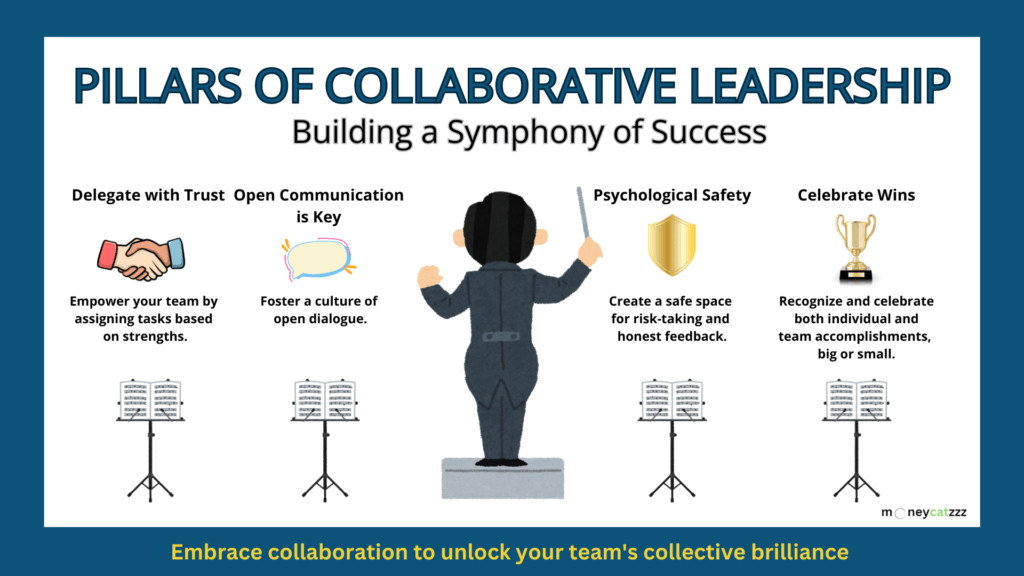
[“Pillars of Collaborative Leadership” – moneycatzzz.com]
3. Psychological Safety: The Cornerstone of Effective Leadership Skills
Creating a safe and supportive workplace is a defining trait of effective leadership skills. Innovation flourishes when employees feel comfortable taking risks, admitting mistakes, and sharing ideas. High-performing teams prioritize psychological safety, allowing individuals to contribute freely without fear of criticism.
🔹 Encourage Risk-Taking: Innovation thrives when employees feel empowered to experiment, learn from failures, and grow without fear of punishment.
🔹 Shift the Mindset: Instead of assigning blame, frame mistakes as learning opportunities that foster continuous improvement and problem-solving.
🔹 Google’s research highlights psychological safety as a key driver of team success, demonstrating its role in effective leadership skills.
4. Celebrate Wins: Reinforcing Positive Leadership and Team Morale
Recognition is one of the most powerful motivators in developing effective leadership skills. Acknowledging both individual and team achievements fosters a culture of engagement, productivity, and retention.
🔹 Appreciation Fuels Motivation: A simple “thank you,” or public recognition can strengthen team bonds and inspire greater performance.
🔹 Milestone Celebrations Matter: Recognizing small achievements along the way maintains enthusiasm and reinforces positive behaviors that drive success.
🔹 Effective leaders understand that a motivated team is high-performing, making appreciation a core leadership practice.
Beyond the Basics: Conducting Your Team to Success with Effective Leadership Skills
Mastering the fundamentals of leadership is essential, but effective leadership skills require continuous growth. True leaders go beyond delegation and structure—they inspire, mentor, and lead by example.
Become a Coach, Not a Dictator
Shift your mindset from giving orders to guiding and supporting your team. Great leaders develop talent, foster problem-solving skills, and encourage independent thinking. Strong coaching includes:
- Asking insightful questions to stimulate critical thinking
- Providing constructive feedback that empowers improvement
- Celebrating successes to build confidence and momentum
Lead by Example: Set the Standard for Excellence
Your actions define your leadership style more than your words. A leader who demonstrates accountability, hard work, and adaptability fosters a team that mirrors those values.
- Be approachable and engaged—your presence matters
- Commit to continuous learning, showing that leadership is a journey
- Exemplify excellence so your team naturally follows suit
Authenticity Builds Trust
Leadership expert Brené Brown, in Dare to Lead, highlights how vulnerability fosters deeper trust and stronger teams. Leaders who are transparent about challenges create a culture of openness and resilience—a key aspect of effective leadership skills.
By coaching, leading by example, and embracing authenticity, you can refine your leadership approach and create a high-performing, motivated team.

[“Become a Coach, Not a Dictator” – Image by Gerd Altmann]
Fostering a High-Performing Team with Effective Leadership Skills
Developing effective leadership skills requires more than just delegation—fostering innovation, trust, and continuous growth within your team.
Embrace Diversity of Thought for Innovation
Great leaders welcome diverse perspectives and avoid surrounding themselves with yes-men. Encouraging healthy debate and critical thinking leads to the following:
- Stronger problem-solving through multiple viewpoints
- More innovative solutions by challenging assumptions
- A well-rounded team that adapts to complex challenges
In Team Genius, Rich Karlgaard and Michael S. Malone emphasizes that diverse teams identify blind spots and drive creative breakthroughs—a critical aspect of effective leadership skills.
Provide Opportunities for Growth
Investing in professional development strengthens team engagement and expertise. Empower your team by:
- Supporting training programs and mentorship opportunities
- Encouraging participation in conferences, workshops, and online courses
- Promoting a learning culture where growth is continuous
Empower Decision-Making to Strengthen Accountability
Granting autonomy in decision-making fosters a sense of ownership within your team. This boosts engagement and enhances problem-solving abilities, ensuring your team:
- Takes responsibility for outcomes
- Develop confidence in their expertise
- Becomes more proactive and solution-oriented
Build Trust and Rapport for a Stronger Team Dynamic
Effective leadership is built on trust. Taking the time to understand your team’s strengths, weaknesses, and aspirations fosters a supportive work environment where individuals feel:
- Valued and motivated to contribute their best
- Connected to a shared vision, improving collaboration
- Loyal to the team, reducing turnover and disengagement
Integrating these key leadership principles allows you to create a culture of trust, innovation, and continuous growth—hallmarks of practical leadership skills.
.

[“Conducting Your Team to Success” – Image by Gerd Altmann from Pixabay]
The Symphony Effect: Collaborative Leadership Beyond Your Team
The power of effective leadership skills extends far beyond your immediate team—it influences the entire organization, creating a ripple effect of engagement, innovation, and success.
Increased Employee Engagement: Employees who feel empowered, valued, and supported are far more engaged in their work, leading to:
🔹 Higher productivity and efficiency
🔹 Greater creativity in problem-solving
🔹 Lower turnover rates, reducing hiring costs
When leadership fosters trust and collaboration, employees take ownership of their roles and contribute more meaningfully.
Enhanced Innovation Through Psychological Safety: A workplace that encourages calculated risk-taking and open idea-sharing is one where innovation thrives. A culture of psychological safety ensures that:
🔹 Employees feel safe to experiment and propose bold ideas
🔹 Teams engage in constructive discussions that drive creativity
🔹 Breakthroughs occur more frequently, pushing the organization forward
Google’s success is a prime example—its commitment to psychological safety has been a cornerstone of its innovation-driven culture.
Improved Customer Satisfaction: A well-led team directly impacts customer experience. When employees feel trusted and empowered, they are:
🔹 Proactive in solving customer issues
🔹 Dedicated to exceeding expectations
🔹 Efficient in delivering top-tier service
Satisfied employees create satisfied customers, strengthening brand loyalty and reputation.
A Culture of Lifelong Learning: Great leaders cultivate a continuous learning environment where employees are motivated to develop their skills and seek growth opportunities. This culture leads to:
🔹 More skilled and adaptable employees
🔹 Greater resilience in navigating industry changes
🔹 A competitive advantage through constant improvement
Organizations prioritizing effective leadership skills foster an environment where learning, innovation, and engagement thrive—driving long-term success.
Examples of Successful Collaborative Leaders
Satya Nadella, CEO of Microsoft: Nadella transformed Microsoft’s culture from a rigid, siloed structure to one that thrives on collaboration and cross-team communication. His leadership is built on:
🔹 A growth mindset encouraging continuous learning
🔹 Empowering employees to take risks and innovate
🔹 Breaking down silos to foster open communication
Under his leadership, Microsoft has embraced inclusivity, teamwork, and forward-thinking innovation, making it one of the world’s most adaptive and resilient companies.
Jacinda Ardern, Former Prime Minister of New Zealand: Ardern’s leadership, particularly during the Christchurch mosque shootings, was widely praised for its empathy, inclusivity, and collaboration. Her leadership approach emphasized:
🔹 Actively seeking diverse input to make well-rounded decisions
🔹 Bringing communities together to address crises
🔹 Fostering a culture of trust and unity

[“Satya Nadella, CEO of Microsoft” – Picture Source Financial Times]
Case Studies of Successful Collaborative Teams
Project X at Google: Google’s Project X, which is responsible for pioneering self-driving car technology, is a prime example of effective leadership skills in action. This team:
🔹 United engineers, scientists, and policymakers from diverse fields
🔹 Encouraged cross-functional collaboration to solve complex problems
🔹 Leveraged shared expertise to drive groundbreaking advancements in autonomous vehicles
Their ability to collaborate across disciplines led to major technological breakthroughs, revolutionizing the future of self-driving cars.
Lego Ideas: Lego Ideas is an innovative platform that showcases collaborative leadership beyond internal teams, proving that customer engagement is a powerful tool. This initiative:
🔹 Empowers Lego fans to submit and vote on new product ideas
🔹 Encourages open innovation by valuing customer input
🔹 Strengthens brand loyalty through active participation
By embracing collaborative decision-making, Lego transformed consumer engagement into a driving force for innovation, proving that effective leadership skills extend to building strong, engaged communities.

Fuel Your Leadership Journey with Diverse Wisdom
Embracing collaborative leadership allows you to unlock the collective brilliance of your team and drive extraordinary success. To refine your practical leadership skills, consider exploring these insightful books that provide valuable perspectives on leadership development:
The Leadership Pipeline – Ram Charan, Stephen Drotter, and James Noel
This leadership classic outlines the five essential stages leaders must navigate to build a world-class organization. It emphasizes:
- Developing leadership talent from within
- Fostering a culture of continuous learning
- Creating a structured leadership pipeline for long-term success
Emotional Intelligence 2.0 – Travis Bradberry and Jean Greaves
This book highlights the critical role of emotional intelligence (EQ) in leadership and provides actionable strategies to:
- Understand and manage your own emotions
- Build stronger relationships with your team
- Foster a positive, trust-driven work environment
Good to Great – Jim Collins
A must-read for leaders seeking to elevate their teams from good to exceptional, this book explores:
- The power of a disciplined leadership culture
- How clear expectations and empowerment drive success
- The Role of Purpose and Accountability in high-performing Organizations
Integrating these insights into your leadership approach allows you to cultivate effective leadership skills that inspire collaboration, innovation, and long-term growth.

[“A Culture of Lifelong Learning” – Image by Gerd Altmann]
The Power of Purpose in Leadership
In his groundbreaking book Start with Why, Simon Sinek emphasizes that successful leaders and organizations begin with a clear sense of purpose. Defining the “why” behind your leadership creates a strong foundation for motivation, engagement, and long-term success.
By instilling a compelling mission and values within your team, you:
- Empower individuals to contribute their best work
- Enhance motivation by connecting tasks to a larger purpose
- Drive engagement, as team members feel their work has meaning
When employees understand the why behind their work, they become more invested, proactive, and inspired to go the extra mile. This alignment fosters a culture of effective leadership skills, where passion and purpose fuel performance.
Your Leadership Journey: A Continuous Evolution
This list of books is just the beginning—countless insightful leadership resources are available. Choose the ones that align with your leadership style and address your challenges.
The Symphony Effect: A Legacy of Effective Leadership
Embracing collaborative leadership allows you to build a legacy beyond individual success. You create a culture of innovation, trust, and growth by fostering a diverse, empowered, and engaged team. The most effective leaders are not those who stand alone but those who inspire collective greatness.
Personal achievements don’t measure true leadership excellence—it’s defined by the harmonious collaboration and shared success of the teams you cultivate. Instead of striving to be a lone performer, embrace the role of a visionary conductor—orchestrating a team that thrives together. When collaboration is at the core of your leadership, the possibilities for success are limitless.
Disclosure: This post may contain affiliate links. We only recommend products we believe in, and We may receive a commission at no cost to you! Thanks for your support!”
Acknowledgement: Cover Photo by fauxels:
Signup to our Newsletter for regular updates:
Disclaimer: The information is provided for general information only – moneycatzzz.com makes no representations or warranties in relation to the information, including but not limited to any representation or warranty as to the fitness for any particular purpose of the information to the fullest extent permitted by law. While every effort has been made to ensure that the information provided in this article is accurate, reliable, and complete as of the time of writing, the information provided in this article should not be relied upon to make any financial, investment, real estate or legal decisions. Additionally, the information should not substitute advice from a trained professional who can take into account your personal facts and circumstances, and we accept no liability if you use the information to form decisions.