 Reading Time: 12 mins #
 This post may contain affiliate links.
“Not everything that is faced can be changed, but nothing can be changed until it is faced.” — James Baldwin on reckoning.
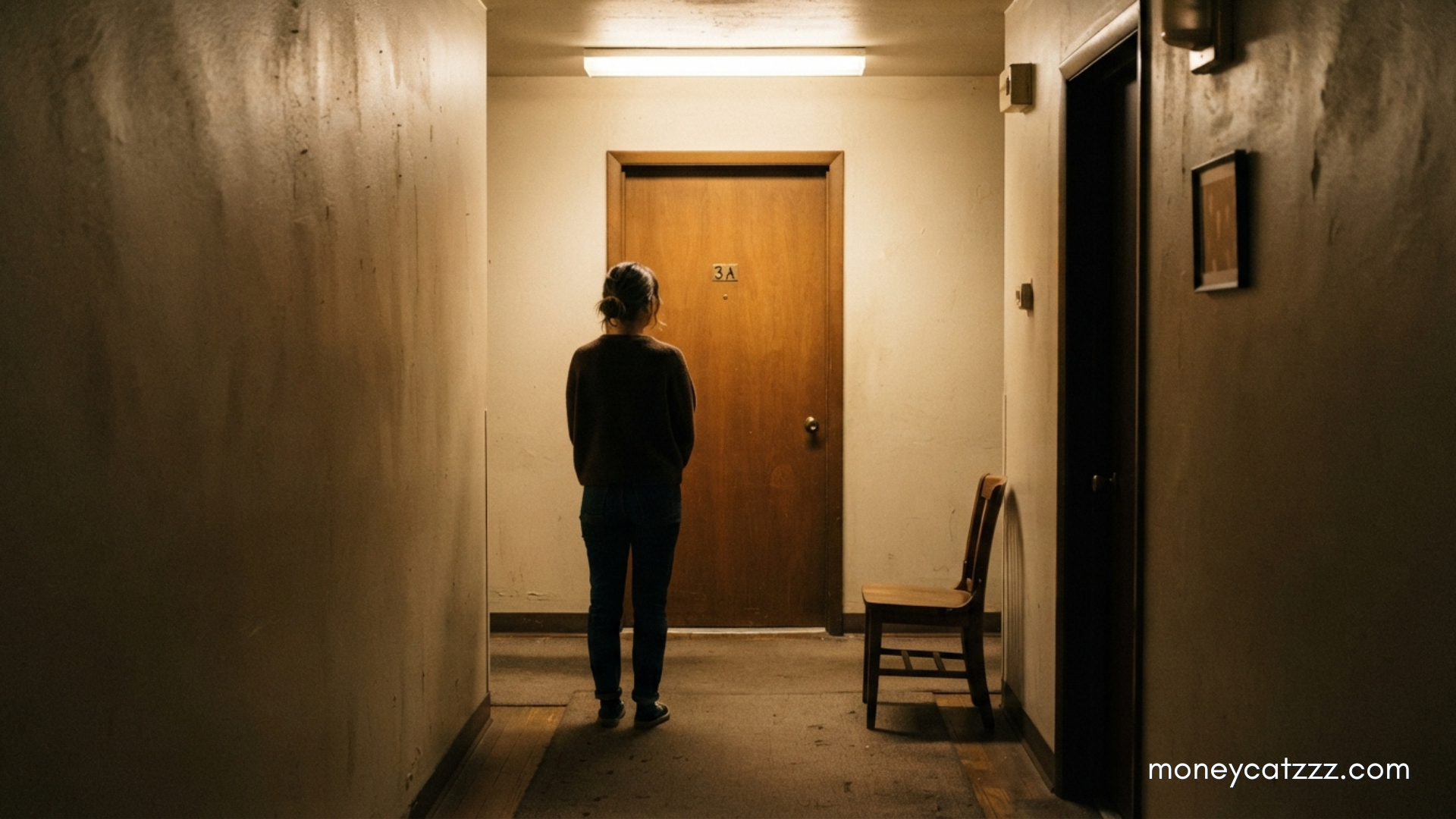
The door closed with a click.
As far as I can recollect, there was no slam; it was not as dramatic as you’d expect from an ending. Just a small, competent click. The sound a latch makes when it’s doing its job. Almost polite. Like the building was saying: Hey, fine. Whatever.
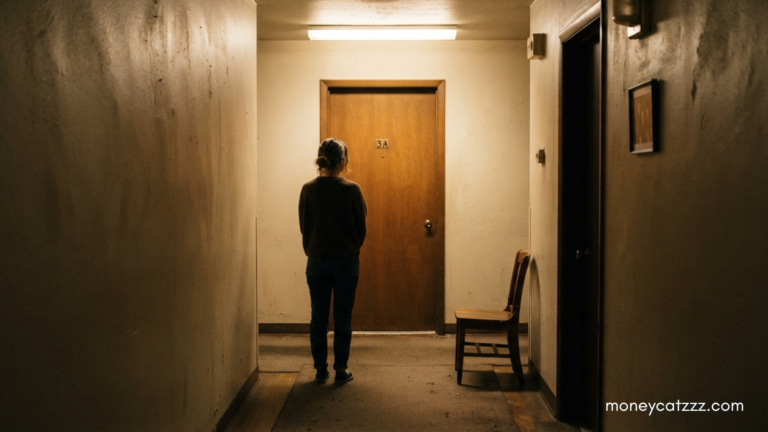
I stood in the hallway for eleven minutes. I know because I checked my phone repeatedly, and the numbers had moved.
The office was on the fourth floor of a building on Guadalupe Street in Austin. The brass handle has gone dull from three years of my hand opening it. Scuff mark near the bottom where I’d dragged a box through in March. Brown carpet with a stain near the elevator that had been there when I moved in and would probably be there long after I left.
The fluorescent light buzzed. I told myself I was gathering myself and composing my face. Preparing for the walk to my car, where I would be fine and dignified and not fall apart.
What I was actually doing was beginning the reckoning without knowing it. Gathering yourself is preparation. Waiting is avoidance with better posture.
The body had already started the review while the mind was still pretending it was heading somewhere.

[MindValley Promo | Rewire your mind, transform life. | Nir Eyal]
After the Split Gate
I thought I knew how endings worked.
I had stood at thresholds before, written about them, and had used the language of doors and gates and crossings. People had written back to tell me it helped. So when this door closed, I assumed I had the right tools. I thought I knew the territory well enough, had the vocabulary, and the solid framework.
I was wrong.
The reckoning does not care what you know.
I had written about the Split Gate, that moment when you stop standing still and walk through to the other side. I had made it sound clean. Intentional. Like crossing a threshold was something you decided to do with your whole self, and then you did it, and you found yourself somewhat “transformed” after.
This is not even close.
This was standing in a hallway with buzzing fluorescent lights, trying to remember if I had turned off the coffee maker that had been broken since June anyway, trying to figure out if I was supposed to feel something other than numb.
[The Echo of the Hallway: Why We Rush Past the Limbo | moneycatzzz.com]
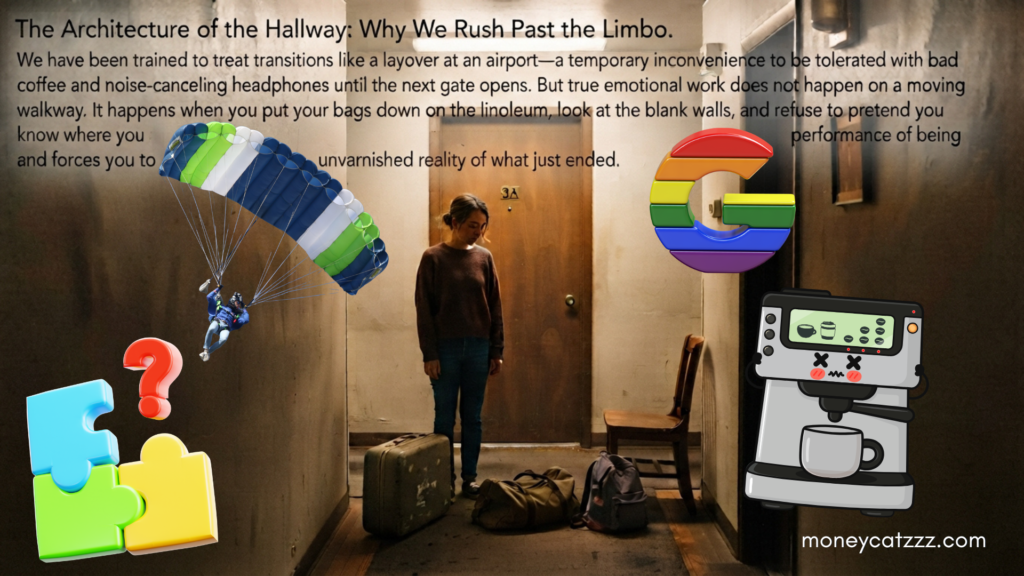
Everyone Hands You a Parachute
By Thursday, I had eleven messages and three phone calls, and every single one of them was kind.
That is the part nobody tells you. The rush is not imposed on you by strangers or by cruel people. It is handed over by the people who love you most because they cannot stand to watch you stand there.
My mother called.
“Sweetheart, I heard about the office. Are you okay?”
“I’m fine. It was time anyway.”
“Well, when one door closes…”
“Another opens. I know.”
“You always land on your feet. You’re so strong.”
I was sitting in my car in the parking lot of a grocery store I didn’t need anything from. I had driven there because I needed to be somewhere that wasn’t my apartment, and the grocery store was the only place I could think of that wouldn’t require me to explain anything to anyone.
“Have you started looking yet? You should update your LinkedIn. Oh, and Sarah’s daughter just started at a consultancy in Denver, I can get you her contact if…“
“Mom.”
“What?”
“I just… I need a minute.”
“A minute for what?”
“To feel it.”
“Feel what?”
“That it ended.”
Silence. The kind that means she’s deciding whether to say the thing she’s thinking.
“You don’t want to sit with it too long, honey. You’ll get stuck.”
I wanted to say: I’m already stuck. I’ve been stuck since November. I’m stuck in a hallway I can’t see my way out of, and you’re handing me a parachute before I’ve looked at the ground.
What I said was: “I know. I’ll be fine.”
I want to be careful here, because that conversation came from someone who loves me, and I am not owed better. But I want to be honest, too. None of those eleven messages made room for the grief. They did not ask what had actually happened in the room I had just left.
They handed me a parachute before I had looked at the ground.
Movement is faster than grief. Grief is patient, and it will wait for you at the next address.

Learn to thrive in a changing world | advaya.life | promotion
The Chair You Brought With You
I have done this. I want that on the record before I say another word about anyone else doing it.
I left a job once and announced the next one within nine days. I did not take a single day between them. I told everyone it was momentum. It was not momentum. It was a rush, and I was the one holding the parachute and pulling the cord.
Different office. Different part of Austin. Different title on the business card.
Same argument, three months in.
Same tired feeling, seven months in, sitting in my car in the parking lot, trying to find the energy to go inside.
Same ceiling I stared at on the nights I couldn’t sleep, in a different apartment, with a bigger number on the lease.
Different wallpaper. Same chair.
The chair is not furniture. The chair is the pattern, the habit, the hiding place. It is the thing you do when you feel unimportant, unseen, unanchored. The chair is the way you shrink, how you apologize, and where you pay rent for taking up space. It is the internal monitoring system you run to make sure you are not too loud, not too heavy, or not too much. It is the overworking, the over-explaining, the constant performance of competence, and the quiet defense against anyone seeing the part of you that is still asking, “Am I allowed to be here?“
You cannot leave the chair behind by changing the address, because you are the one carrying it.
The Search History I’m Not Proud Of
Week two. I could not sleep. I opened my laptop in bed and typed things into Google that I am not proud of, but that I am going to tell you anyway, because pretending I have this figured out is not the point:
- how to know if you made the right decision
- what to do when a door closes, and nothing opens
- signs you’re not meant to start over
- why am I not over this yet
- ambiguous loss
That last one was an accident. I mistyped something, and the search auto-corrected, and I clicked on a link to a research summary from the University of Minnesota. Dry academic language. A PDF that would not format properly on my phone.
I read it three times.
[The Three Kinds of Endings | moneycatzzz.com]
Pauline Boss spent decades documenting what she called ambiguous loss: endings that never fully close, situations that stop without resolution, people who are gone without a death. Her research confirms what most of us learn the hard way. Endings without explanation are common, they are studied, and they are not a failure of your coping skills.
They are a category.
The sentence that cracked me open: “Ambiguous loss is loss without closure. It is unclear, incomplete, and lacks finality.“
I cried. Which was the first time I had cried since the door closed.
The landlord sold the building. The new owners had plans. I was never told what the plans were, and I spent four months deciding the plans were about me, that the door had closed because of something I had done or failed to do or failed to be.
Boss’s research led me to consider a different possibility: that some doors close without a reason you will ever be given, that the reckoning still has to happen, and that you have to do it without an answer.
Three Kinds of Endings
I used to have only one category for how things ended, and the label on it was always my fault.
It’s just the rush of wearing a different coat, not self-awareness. Blame is faster than sitting still with a question without an answer.
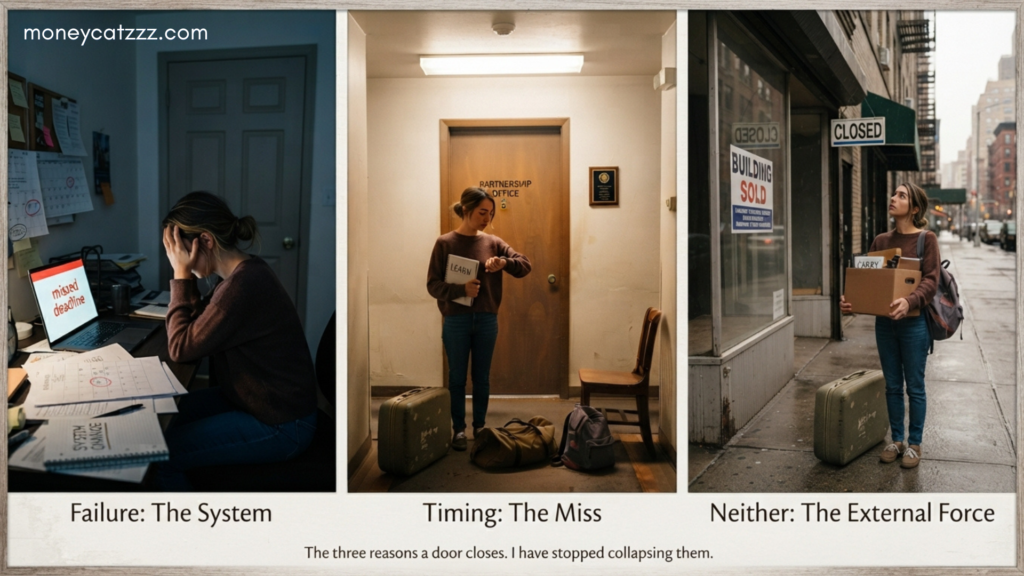
There are three reasons a door closes. I have stopped collapsing them:
- Failure. Something you did or did not do. The fault is present. You can find it, and you can name it, and naming it is useful because it tells you what to change. I lost a client once due to a missed deadline. That one was on me. I knew it. I apologized. I changed my system. The door closed. The fault was clear. This is painful but actionable, and I could work with clarity.
- Timing. Something you did not see, or did not reach in time. The fault is absent. Perception is present. You can learn from these. You cannot blame yourself for a better outcome. I almost got a partnership once. I was close. The timing was wrong. They went with someone else. It was not a failure. It was a miss. Those are different.
- Neither. The most common case and the least written about. The landlord sells the building. The market moves. The partner leaves for reasons that were never on the table. The contract ends because a number changed in a city you have never visited. Nothing here was yours to carry. It gets carried anyway.
My office on Guadalupe was category three. I am pretty sure. C.S. Lewis wrote A Grief Observed after his wife died, and the thing that stays with me is not the grief but the question. He kept asking why, and the answer never came, and he kept a record of the asking anyway.
Some doors close without a reason you will ever be given. Sometimes, you have no control. The reckoning still has to happen.
The Inventory
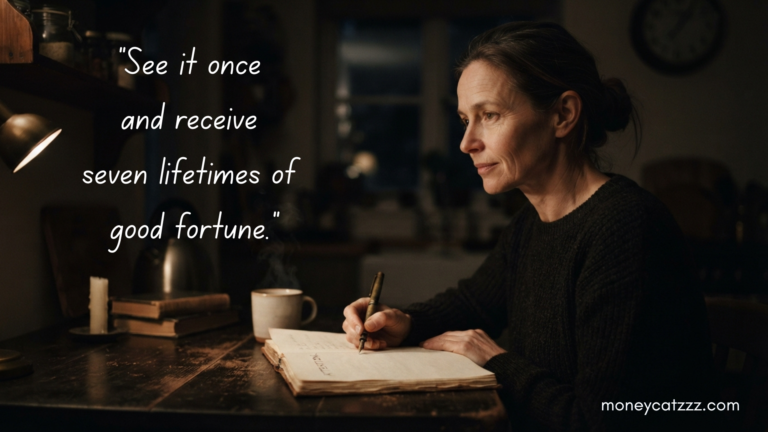
I sat down at my kitchen table with a piece of paper and did something I had been avoiding since November.
I made a list.
Column one: what actually ended when the door closed.
- The office on Guadalupe
- The client list (4 active, 2 pending)
- The weekly call with Marcus and Liz
- The rhythm of Tuesday mornings that had a destination
- The version of myself that had a business card with that address
- The coffee maker that broke in June, which I never replaced
Column two: what I decided had ended.
- My ability to build something
- My judgment about timing
- My reputation
- People’s trust in me
- My usefulness
- The thing that made me worth calling
- My momentum
- My credibility
- My clarity about what I was doing
- The next five years I’d planned
- The version of my life that made sense
- My capacity to start again
- The narrative I’d been telling about where I was going
- The person I thought I was
- My right to take up space
- The proof I was doing it right
- The evidence I wasn’t wasting time
- My answer to “What do you do“
- The thing that made me feel like I wasn’t drifting
I looked at the two columns.
Six items. Nineteen items.

[Counting the Inventory: Six Real Items Versus Nineteen Stories | moneycatzzz.com]
I laughed. I cried. Then I folded the paper, put it in the back of the notebook, and did not look at it for three weeks.
An inventory, not an autopsy. That is the difference between closure and moving on. An autopsy looks for the cause of death. An inventory counts what is still in the building.
I did not need to determine fault. I needed to know how much of my life was still standing.
It turned out to be almost all of it.
A friend sent me a PDF. She did not attach any message. Just the file. She just knew. Francis Weller’s The Wild Edge of Sorrow.
I read it in bed with a ceiling fan clicking every third rotation. The line that broke me:
“Grief is not a problem to be solved, but a weight to be carried, and the carrying is the work.”
I had read that line years ago and nodded along as I understood. This time, I understood, and it was not comforting at all. It was just true.
The Conversation That Landed
I FaceTimed Maya months later. She was in her kitchen in Denver. I was in a café in Oaxaca with wifi that kept cutting out.
“So, any movement on the next thing?”
“No. Not really looking.“
“That’s… okay. How are you feeling about that?”
“Honestly? Fine. Which is weird. A year ago, that sentence would have terrified me.”
“What changed?”
“I stopped thinking the hallway was a failure.”
“What hallway?”
“The space between the door closing and the next room opening. I used to think you were supposed to rush through it. Like, if you stayed too long, you were broken or stuck or wasting time.”
“And now?”
“Now I think the hallway is the point. That’s where the reckoning happens. That’s where you figure out what you’re actually carrying and what you’re ready to put down.”
She was quiet for a moment. “So what are you putting down?”
“The chair. The pattern. The thing I do when I feel like I need to prove I’m worth the space I’m taking up.”
“The chair, what… never mind. And how does that feel?”
“Lighter. Honest. Like I’m finally telling the truth about what actually ended instead of what I decided it meant.”
The Walk-By
I was back in Austin, just for a week. I was walking down Guadalupe to meet a friend for lunch, and I passed the building.
I did not mean to look up. I did anyway.
There was a transom window above the door. I had never noticed it before. Light was coming through. The door was shut. The light did not care.
I stood on the sidewalk for a minute. I did not turn it into a symbol. I did not mean for it to carry any weight; the arbitrary walls are no longer there. I just noticed.
Sometimes an ending is just an ending. The light still comes through.

[MindValley Promo | Rewire your mind, transform life. | Vishen Lakhiani]
What I Know Now
The hallway is a real place. People live there for a while, and no rule says you have to move.
I haven’t found the next room, and I’m not looking for it. If it matters, it will find me.
A year ago, admitting that would have felt like surrender, like drifting. Now it just feels like the truth.
The rush is still out there. People still hand me parachutes and tell me that when one door closes, another opens. I am polite about it. I don’t pull the cord.
The latch clicked. The hallway is here, and I am in it.
The room is smaller than the story I built around it. Six items on the inventory, not nineteen. Most endings close a door, not a life.
The chair is still following me, and I see it. The automatic urge to apologize for taking up space is ever-present, and I haven’t stopped doing it entirely, but I’ve stopped pretending I’m not.
The door on Guadalupe is closed. The transom window lets the light through anyway. I don’t know what happens in that room now, and I don’t need to.
The reckoning was never about the room. It was about standing still long enough to drop the weight that was never mine to haul.
You don’t need anyone’s permission to stand in the hallway. You have to realize you’re allowed to be there.
__________________________________________________
Recommended Reading for the Unvarnished Work of Grief and Reckoning

A Grief Observed

Ambiguous Loss

The Wild Edge of Sorrow

Disclosure: This post may contain affiliate links. We only recommend products we believe in, and we may receive a commission at no cost to you! Thank you for your support!
Acknowledgment: Cover Image by moneycatzzz.com
Disclaimer: The information is provided for general information only – moneycatzzz.com makes no representations or warranties in relation to the information, including but not limited to any representation or warranty as to the fitness for any particular purpose of the information to the fullest extent permitted by law. While every effort has been made to ensure that the information provided in this article is accurate, reliable, and complete as of the time of writing, the information provided in this article should not be relied upon to make any financial, investment, real estate or legal decisions. Additionally, the information should not substitute advice from a trained professional who can take into account your personal facts and circumstances, and we accept no liability if you use the information to form decisions.