
 Reading Time: 8 mins #
 This post may contain affiliate links.
Last month in Lisbon, I met a digital marketer who scheduled her bathroom breaks. She had color-coded time blocks for everything: deep work (purple), admin (yellow), networking (green). Even her lunch was subdivided into eating (12 minutes) and Instagram posting (18 minutes). She was earning six figures but looked like she hadn’t slept in six months.
“When do you think?” I asked her.
She stared at me like I’d asked when she breathes underwater. That’s when I realized: we’ve weaponized our calendars against ourselves. We’ve turned every empty moment into an enemy that must be conquered with productivity. But here’s what nobody tells you about intentional growth gaps: they’re not where your productivity dies. They’re where your genius is born.
The most successful location-independent professionals I know have mastered something I call the Lacuna Protocol. Lacuna means gap or void in Latin, but in your career, it means something more powerful: the strategic absence that makes your presence more valuable. It’s the white space on the canvas that makes the painting visible. Without intentional growth gaps, your work is just noise competing with more noise.
Today, I’m sharing the five-step protocol that transformed my frantic freelancing into sustainable success, and helped hundreds of my clients escape the optimization trap that’s slowly suffocating their creativity.
The Hidden Cost of the Optimized Life
You wake up and immediately check Slack. You meditate while listening to a productivity podcast. Your morning walk doubles as a client call. Even your evening yoga includes mentally drafting tomorrow’s proposals. You’ve optimized every second, yet you feel more behind than ever.
This is productivity paradox: the more we optimize, the less effective we become. A post by Forbes found that after 50 hours per week, productivity drops so sharply that working 70 hours accomplishes the same amount as working 55 hours. But it’s not just about hours. It’s about the quality of your thinking when you never stop thinking.
Without operational white space, your brain never gets to process information at the deeper levels where innovation happens. You’re so busy responding to the immediate that you’ve lost sight of the important. This constant mental occupation leads directly to what neuroscientists call decision fatigue, where your ability to make good choices degrades with each decision, regardless of its size.
The solution isn’t working less. It’s working with intentional growth gaps built into your architecture. Let me show you how.
Step 1: Identify Your Efficiency Leaks
The first step in creating intentional growth gaps is recognizing where your compulsive productivity is actually costing you money and meaning. Most of us use busyness as a form of armor against the discomfort of deep thought or the fear of missing out.
Start by tracking your “fake work” for one week. Fake work feels productive but doesn’t move you toward your actual goals:
- Reorganizing your project management system for the fifth time
- Attending networking events that never lead to clients
- Perfecting proposals for projects you don’t actually want
- Checking email every 10 minutes “just in case.”
When I did this exercise, I discovered I was spending 12 hours weekly on “productive procrastination.” That’s 12 hours of avoiding the tactical silence where my best ideas emerge. Verne Harnish writes in Scaling Up that leaders must transition from doing to designing. The same applies to freelancers and remote workers. If you’re constantly doing, you never get to architect your career.
Your action step: List your top 10 weekly activities. Circle the three that directly generate income or meaningful progress. Everything else is a candidate for elimination to create operational white space.

[“The “Deep Depth” Focus” – Image by moneycatzzz.com]
Step 2: Establish Your Strategic Void
At least once weekly, you need a dose of strategic void: a 90-minute block of absolute nothingness. Not meditation. Not journaling and not walking while listening to audiobooks. Nothing.
Here are the rules:
- No devices (phone in another room, laptop closed)
- No input (no books, podcasts, or “educational” content)
- No output (no note-taking, planning, or problem-solving)
This isn’t rest. It’s intentional state of being at work. Your subconscious mind processes information at speeds your conscious mind can’t match, but only when you stop feeding it new data. Jim Collins discusses the “Stop-Doing List” in Good to Great. The strategic void is your stop-doing practice.
The first time I tried this, I nearly climbed the walls. My mind screamed that I was wasting time, losing money, falling behind. But by week three, something shifted. Solutions to problems I’d been forcing started appearing effortlessly. Client issues that seemed complex revealed simple solutions. The strategic void wasn’t empty; it was full of insights I’d been too busy to receive.
Step 3: De-Gamify Your Recovery
Here’s where high achievers sabotage their decision fatigue recovery: they turn rest into another performance metric. Sleep becomes a competition for perfect scores on tracking apps. Meditation becomes a streak to maintain. Even walks get measured in steps, pace, and calories burned.
When you gamify recovery, you’re not recovering. You’re performing rest, which is just another form of work. True strategic stillness can’t be measured, optimized, or shared on social media.
Greg McKeown writes in Essentialism that “if you don’t prioritize your life, someone else will.” This includes prioritizing unmeasured, unproductive play. Buy watercolors and paint badly. Build sandcastles. Dance in your kitchen. Do things that have no outcome except joy.
I started taking “purposeless walks” where I deliberately avoid destinations, podcasts, and step counting. These walks have generated more creative breakthroughs than any brainstorming session. Decision fatigue recovery happens when you stop making decisions entirely, not when you make decisions about how to optimize your recovery.
Step 4: Deploy Tactical Silence
In every interaction, tactical silence becomes your power tool. When someone finishes speaking, wait three full seconds before responding.
This tiny gap does three things:
- It gives your brain time for decision fatigue recovery mid-conversation
- It forces others to fill the void, often revealing what they really mean
- It positions you as thoughtful rather than reactive
Most remote workers feel pressure to respond instantly to every Slack message, email, or comment. This creates a reactive cycle where you’re constantly responding to others’ urgencies instead of pursuing your priorities. Tactical silence breaks this cycle.
When a client sends a non-urgent request at 8 PM, your tactical silence might be responding the next morning. When someone asks for free advice “just quickly,” your pause before answering gives you time to decide if this aligns with your boundaries. A Forbes Council for Leadership article on organizational agility emphasizes these “pause points” as crucial for preventing costly errors and group-think.
Discretionary voids in communication isn’t rudeness; it’s respect for both your time and theirs. It ensures that when you do respond, it’s thoughtful rather than reactive.
Step 5: Create Your Annual Identity Lacuna
This is the most challenging step: once a year, take 3-5 days where you’re not your professional self: no laptop, no work conversations, no checking metrics. Go somewhere where nobody knows your client list, your hourly rate, or your LinkedIn connections.
This identity lacuna strips away the professional persona to reveal who you are beneath the achievements. It’s the ultimate strategic void that prevents you from becoming your work rather than doing your job.
My first identity lacuna was terrifying. Without my professional identity, who was I? But in that discomfort, I discovered something crucial: my worth wasn’t tied to my productivity. This revelation transformed how I present my work, set boundaries, and select projects. The intentional growth gaps at the identity level create the deepest possible recovery from decision fatigue.
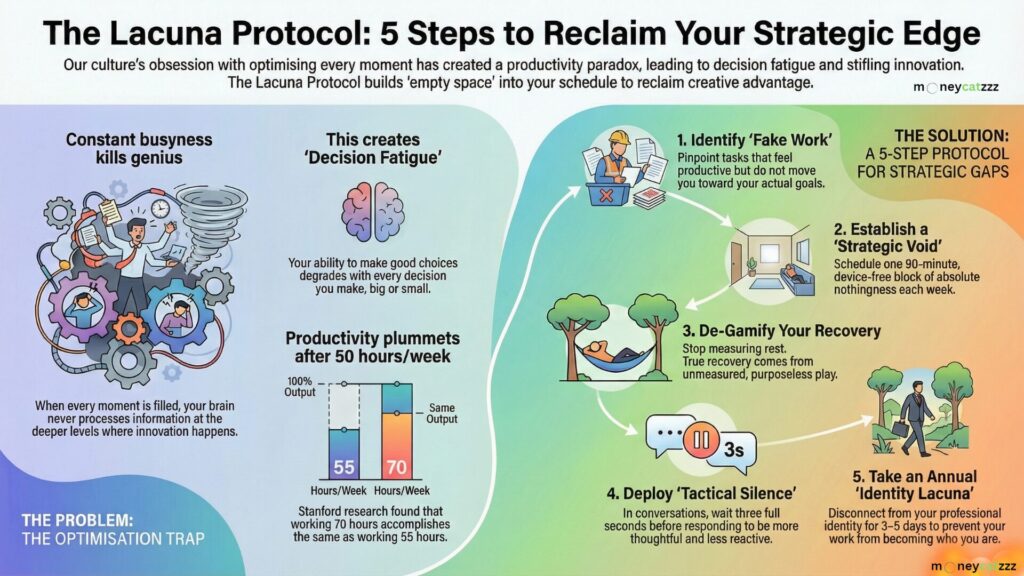
[“The 5-Steps of the Lacuna Protocol” – Image by moneycatzzz.com]
The ROI of Empty Space
What’s the return on investment for intentional growth gaps? It’s the difference between a sustainable career and inevitable burnout. When you build cognitive buffers into your life, you gain:
Better Pattern Recognition: You see opportunities others miss because you have time to connect the dots rather than collect them.
Increased Value: Scarcity creates value. When you’re not always available, your availability becomes precious.
Sustainable Energy: By building in decision fatigue recovery, you can maintain high performance for decades, not just seasons.
Creative Differentiation: Your best ideas come from tactical silence, not from consuming more content or following more frameworks.
The professionals who thrive in our digital economy aren’t the ones who do the most. They’re the ones who create the most value from the least effort. Intentional growth gaps are how you join their ranks.
Your Lacuna Challenge
This week, I challenge you to implement just one strategic void. Set a timer for 90 minutes. Turn off everything. Sit with the discomfort of not producing, not consuming, not optimizing.
You’ll feel the itch to check your phone, to make notes, to be “productive.” This discomfort is your addiction to busyness revealing itself. Sit with it. Let the sovereign authority work its magic.
The most professional thing you can do this week is absolutely nothing for 90 minutes. Your creativity, clarity, and career sustainability depend on this intentional stillness.
Remember: space isn’t wasted space. It’s the space where possibility lives.
The space between the notes makes the music. Design accordingly.
[Download The Lacuna Protocol Worksheet] A simple guide to implementing your first strategic void and tracking your relationship with space.
Resources to Reclaim Your Strategic Edge
Scaling Up

Good to Great
Essentialism
Disclosure: This post may contain affiliate links. We only recommend products we believe in, and we may receive a commission at no cost to you! Thank you for your support!
Acknowledgment: Cover Image by moneycatzzz.com
Disclaimer: The information is provided for general information only – moneycatzzz.com makes no representations or warranties in relation to the information, including but not limited to any representation or warranty as to the fitness for any particular purpose of the information to the fullest extent permitted by law. While every effort has been made to ensure that the information provided in this article is accurate, reliable, and complete as of the time of writing, the information provided in this article should not be relied upon to make any financial, investment, real estate or legal decisions. Additionally, the information should not substitute advice from a trained professional who can take into account your personal facts and circumstances, and we accept no liability if you use the information to form decisions.