
 Reading Time: 8 mins #
 This post may contain affiliate links.
Financial Literacy: The Inner Works Journey of Money
“The outer world is a reflection of the inner one—especially true when it comes to money.”
Few entrepreneurship, professional advancement, and personal growth topics evoke as much complexity, shame, aspiration, and silence as money. It’s not just numbers on a spreadsheet. It’s a mirror; a psychological playground shaped by upbringing, identity, beliefs, trauma, and ambition. This is the inner workings of money: the quiet, often invisible narratives that govern our financial choices long before we open a budgeting app or speak with a planner.
In today’s volatile economy, where financial literacy is urgent and uncertain, it’s no longer enough to chase income. We need to understand the emotional blueprint that drives what we do with it, to the real journey, not just of money and sense, but of financial self-awareness.
But understanding the numbers isn’t enough. Beneath the spreadsheets and savings goals lies something more profound, an emotional code that silently shapes every decision we make.
Money Is Never Just About Money
For years, I believed I had a “money problem.“ I was either earning too little, spending too much, or never saving enough. But as I dove deeper, through books, mentors, and confronting hard truths, I realized I had a belief problem.
I thought money would make me feel safe. But safety is an emotion, not a bank balance. Hitting income goals would mean I was successful. But success without purpose is just burnout on autopilot. Spreadsheets didn’t solve these misalignments. They required unpacking my inner works, my emotional relationship with money.
This realization isn’t unique. Dr. Brad Klontz, a financial psychologist, identified several “money scripts“, deep-seated beliefs like money is bad, rich people are greedy, or more money will solve all my problems, that unconsciously shape our financial behavior. These scripts are often rooted in childhood and trauma, not logic.
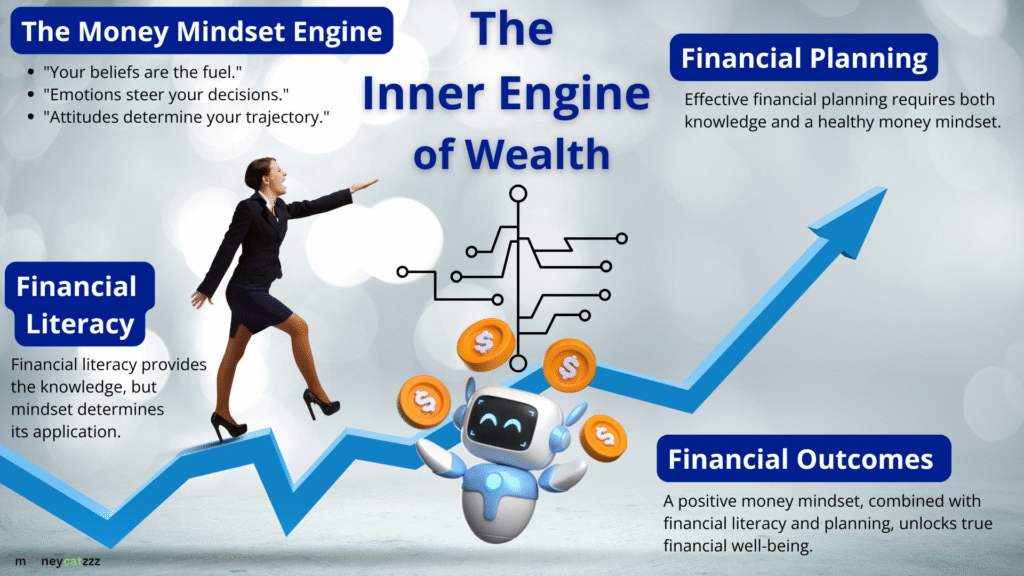
[” The Inner Engine of Wealth” – Image by moneycatzzz.com]
Case Study: From Bankruptcy to Financial Clarity—The Story of Tiffany Aliche
To understand this concept more concretely, look no further than Tiffany “The Budgetnista” Aliche, a personal finance educator whose journey is a masterclass in rewiring the inner workings of money.
After losing her job during the 2008 financial crisis, Tiffany hit rock bottom: unemployed, in debt, and living with her parents. But instead of succumbing to despair, she began to study the principles of financial literacy: budgeting, credit repair, and saving. More importantly, she began examining the emotional habits that had led her into debt in the first place.
Today, she’s not only financially secure, she’s helped over 2 million women through her Live Richer Movement and served as an advisor to financial legislation like the Budgetnista Law in New Jersey. Her success wasn’t just a turnaround in finances but a shift in identity and emotional ownership.

Financial Literacy Begins with Self-Inquiry
Most people start their financial journey by asking how to make more money. That’s a good question, but not the most powerful one. A better place to begin?
“What do I believe about money—and is it still serving me?”
This is the foundation of true financial literacy. It’s not just about understanding compound interest or how to diversify your portfolio. It’s about understanding yourself. Financial education is incomplete without psychological insight.
Harvard Business Review supports this notion. A 2022 report on financial wellness found that those who actively explored the emotional side of money were more likely to follow through with long-term financial planning. In short, the better you know yourself, the better you manage your money.
From Scarcity to Stewardship: Reframing the Game
For many professionals and entrepreneurs, money becomes a scoreboard. It measures progress, status, and even self-worth. But here’s the truth:
You don’t rise by chasing money—you rise by becoming the person who can steward it.
Stewardship is the next frontier in money and sense. It’s not about hoarding wealth, it’s about using it with intention. That means:
- Saying “no“ to opportunities that pay well but misalign your values.
- Creating a financial plan for emergencies, generosity, and legacy.
- Viewing money not as a savior but as a resource to express your highest self.
Cultivating the Inner Works of Financial Peace
Here are a few inner practices that change the outer reality of your finances:
1. Track Without Judgment
Track every dollar you earn and spend but don’t judge yourself. Just observe. You can’t shift what you’re unwilling to look at. Awareness precedes transformation.
2. Rewrite Your Money Story
Identify the money beliefs passed down from your family or culture. Were you taught that wealth is shameful? That you must work hard to deserve money? Replace outdated narratives with conscious beliefs.
[“Financial Literacy” – Image on Canva]
3. Set Emotional Financial Goals
Instead of “make six figures,“ ask: How do I want money to feel? Secure? Freeing? Abundant? Build goals around these emotional anchors.
4. Invest in Financial Therapy or Coaching
Sometimes, you need a professional mirror. Whether it’s a financial advisor who prioritizes mental health or a money coach trained in emotional literacy, get help. You’re not meant to do this alone.

Why Financial Planning Must Evolve
The traditional financial planning model: spend less, save more, invest early, is still valid. But it’s incomplete without inner alignment. The Inner Works must be integrated into every stage of the journey: budgeting, investing, earning, and giving.
This evolution is especially critical for entrepreneurs, solopreneurs, and high-achieving professionals. Without inner clarity, chasing goals that leave you empty or running businesses that burn you out is easy.
Final Reflection: Wealth as a Mirror, Not a Mask
Money will always reveal who you are, it doesn’t change you; it amplifies you. That’s why doing the inner work matters.
True wealth isn’t just financial, it’s emotional sovereignty. It’s the ability to earn and spend from a place of integrity. To plan and invest from a place of purpose. To give and receive without fear, guilt, or shame.
So the next time you review your financial planning spreadsheet or stress over a revenue dip, ask yourself:
Is this about the money—or what the money means to me?
Money becomes more than survival when your inner alignment meets your external action. It becomes stewardship. And that is when money and sense truly meet.
Further Reading & Resources: Deepening Your Inner Works Journey
For those looking to go beyond surface-level financial tips and genuinely understand the psychology, behavior, and beliefs that shape your relationship with money, these expert-backed resources offer invaluable guidance:
Harvard Business Review – Financial Wellness Meets Emotional Health: Explore how financial wellness is not just a budgetary issue but deeply linked to emotional resilience and workplace productivity. Learn why companies invest in employee financial education and why you should.
Tiffany Aliche – The Budgetnista: A leading voice in financial literacy, Tiffany Aliche offers practical, accessible tools for rebuilding your financial foundation, especially if you’re starting from scratch. Her “Live Richer“ movement has transformed the lives of thousands through real-world financial planning strategies.
Dr. Brad Klontz – Financial Psychology Institute : A clinical psychologist and financial planner, Dr. Klontz bridges the gap between mental health and money behavior. His groundbreaking work on money scripts explains why we do what we do with money, and how to change it.
The Psychology of Money by Morgan Housel: This bestselling book explains why people with less information can outperform those with more because behavior, not math, governs success — a powerful read for anyone looking to balance money and sense.
Money Scripts & Behavioral Economics Research
Dive into the academic side of the Inner Works of money. Explore studies by Dr. Klontz, Daniel Kahneman, and Richard Thaler on behavioral finance, decision-making biases, and how our subconscious beliefs drive spending, saving, and risk-taking.
Disclosure: This post may contain affiliate links. We only recommend products we believe in, and We may receive a commission at no cost to you! Thank you for your support!
Acknowledgement: Image by moneycatzzz.com on Canva
Disclaimer: The information is provided for general information only – moneycatzzz.com makes no representations or warranties in relation to the information, including but not limited to any representation or warranty as to the fitness for any particular purpose of the information to the fullest extent permitted by law. While every effort has been made to ensure that the information provided in this article is accurate, reliable, and complete as of the time of writing, the information provided in this article should not be relied upon to make any financial, investment, real estate or legal decisions. Additionally, the information should not substitute advice from a trained professional who can take into account your personal facts and circumstances, and we accept no liability if you use the information to form decisions.