
 Reading Time: 8 mins #
 This post may contain affiliate links.
If a traditional résumé is a perfectly iced cake, then my “failure résumé” was more like a burnt casserole scribbled in Sharpie on a napkin. It wasn’t something I planned to show off. It started as a joke—the kind of self-deprecating humor you lean on when your career feels like a slow-motion disaster reel.
But like most good jokes, it held a sliver of truth. What began as a tongue-in-cheek list of career flops turned into something else entirely: a mirror. Not a warped funhouse one, but a painfully honest reflection that, oddly enough, became my greatest professional asset.
The Year of Losing Loudly
It all started after a string of disappointments so absurd they felt cinematic. One month, I was rejected from three job interviews in a week. Next, a freelance project fell apart because of “budget cuts” that coincidentally aligned with the client hiring someone else cheaper. Then came the crowning jewel: a failed pitch to a dream company where I forgot the VP’s name mid-sentence.
Cue the spiral
My LinkedIn feed reads like a highlight reel of everyone else’s ascension. New titles. Promotions. Startups funded. Meanwhile, I was deep in what author Megan McArdle¹ calls “the trough of sorrow.” I wasn’t just failing. I was failing visibly.
Out of sheer frustration (and maybe a touch of masochism), I opened a blank document and titled it: “Failure Résumé.”
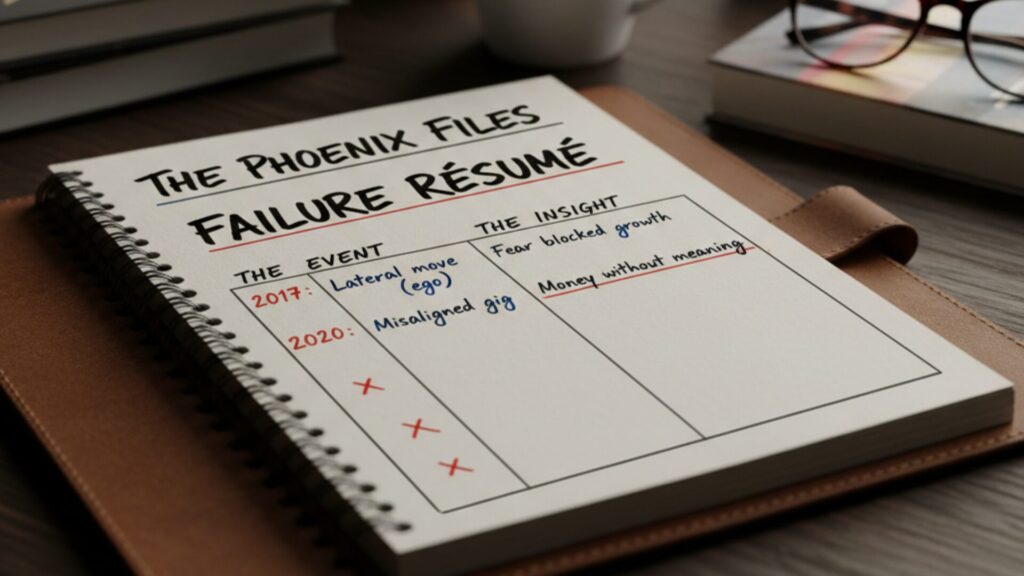
[“The Unconventional Document That Changed Everything” – Image by moneycatzzz.com]
What I Wrote Down: Failures, Lessons, and Unseen Patterns
I started with a simple two-column list: the failure on the left and the insight on the right. Over time, this list grew—a clearer picture of my patterns and growth.
- 2017: Turned down a lateral role out of ego. I watched it become a growth rocket for someone else: That taught me how fear of appearing stagnant can block real opportunity. Sometimes, lateral moves are the real leaps forward.
- 2018: Ignored advice to diversify income. Lost a big client, scrambled to recover: I learned that resilience requires preparation—not just hoping things won’t go wrong.
- 2019: Overcommitted to side projects and burned out: This failure forced me to respect my limits and focus on what truly matters.
- 2020: Took a misaligned consulting gig, burned out quickly: Money without meaning drains the spirit. Listening to my intuition about fit became essential.
- 2021: Failed to negotiate a contract, lost income and confidence: I learned that knowing your worth and asserting it is crucial.
Each entry became more than a record of mistakes; it was a growth map, revealing recurring themes and new strengths. Failure wasn’t just a set of setbacks—it was my blueprint for becoming stronger, wiser, and more self-aware.

Failure Isn’t a Dead End — It’s a Diagnostic
Tracking your failures is like running a system diagnostic of your career. You start to see where the wiring frays and where your strength is silently compensating.
This idea isn’t new. Stanford professor Tina Seelig² has long advocated keeping a failure résumé, noting that “we learn far more from failure than success,” while Nobel laureate Daniel Kahneman³ explains that intuition is built from repeated feedback loops. But most of us avoid the feedback. We’re too ashamed to stare at the ugly bits.
Looking at mine, I began to see:
- I wasn’t flaky. I was experimenting.
- I wasn’t a bad team player. I was in the wrong room.
- I didn’t lack follow-through. I lacked alignment.
Every so-called “mistake” contained a skill I had undervalued.
How It Rewired My Confidence
This quiet exercise had a loud effect.
The next time I bombed a presentation, I didn’t spiral. I opened my Failure Résumé and added it to the list. Then I noted what I learned: “Don’t skip the tech check. Ever.“
More importantly, it became my inner rebuttal to impostor syndrome. When I doubted my abilities, I didn’t just tell myself, “You’ve succeeded before.” I told myself, “You’ve survived worse. Look. It’s right here.”
My real résumé showcased achievements. But my résumé told the story of grit, evolution, and insight. And that story was far more convincing.
Lessons in the Margins: What My Failures Taught Me
Here’s where the transformation solidified. Each “failure” carried a quiet lesson, often about trusting my gut or learning what I valued.
For example:
1. Slow Down the Decision Loop
In 2019, I rushed into a business partnership out of FOMO. It imploded within two months. Looking back, I never paused to ask: Would I still want this if no one knew I was doing it? Now, I build in “cooling-off periods” for big decisions—a concept backed by behavioral economists like Dan Ariely⁴.
2. Track Emotional Cues
When a project fell off, I used to push through. But the more I reviewed my failures, the more I noticed my body always knew first. Tension. Restlessness. Insomnia. These weren’t symptoms of stress; they were intuition trying to get a word in.
3. Build a Personal Philosophy
Vicki Robin⁵ taught me to frame decisions around value-based living. Every “no” became easier when it didn’t align with my creativity, autonomy, and impact values.
4. Reflection > Prediction
Instead of trying to “see the future,” I now reflect on the patterns my failures reveal. Where did I ignore a red flag? Where did I compromise too early? As Kahneman suggests, intuition works when we learn from feedback loops.
5. Journal Your Gut Checks
Each time something felt right or wrong, I started jotting it down. Months later, reviewing those entries gave me clarity. My instincts weren’t perfect, but they were remarkably consistent.

[“From Setbacks to Soaring: The Phoenix Effect” – Image by moneycatzzz.com]
From Private Pain to Professional Power
To my surprise, this exercise began to ripple outward.
In job interviews, I stopped dodging the question, “Tell me about a time you failed.” Instead, I leaned in:
“I keep a failure résumé. One of the entries is about a launch I messed up, but it taught me more about stakeholder communication than any win ever has.”
Reactions ranged from surprise to respect. Vulnerability, when grounded in self-awareness, wasn’t a liability. It was a superpower.
When mentoring others, I started sharing my failures first. Not to scare them, but to show them that growth is iterative. No one gets a highlight reel without a blooper reel.
How to Start Your Failure Résumé
Here’s a structure that worked for me:
1. Create Two Columns
Left side: The event (date + context).
Right side: The insight, pattern, or growth.
2. Be Specific
Vague failures help no one. Write like you’re diagnosing, not blaming.
3. Look for Patterns
Do certain fears, habits, or relationships repeat? What themes recur?
4. Highlight the Strengths
What did it demand of you? What skills did you build?
5. Revisit It Often
Don’t let it collect digital dust. This isn’t a graveyard. It’s a map.
Before you start jotting down missteps, here’s a quick note: the magic isn’t just in recording what went wrong, it’s in what you extract from it. As I learned, even a single clarified insight on the “right side” of the page can reshape how you approach your future.

The Asset That Never Devalues
My failure résumé became the most honest document I’ve ever created in a world obsessed with success metrics.
It taught me to separate outcomes from identity. It revealed the quiet voice I had ignored: my own. And it helped me build a career, and life on something stronger than appearances:
Trust. Pattern recognition. Resilience. Self-compassion.
So, if you ever feel like you’re the only one stumbling while everyone else soars, start your failure résumé. Not to punish yourself but to honor the path you’re walking.
The world may reward your highlight reel. But the future? It also belongs to the ones brave enough to write the other one.
The Upside of Down
by Megan McArdle

Your Money or Your Life
Disclosure: This post may contain affiliate links. We only recommend products we believe in, and We may receive a commission at no cost to you! Thank you for your support!
Acknowledgement: Cover Photo by moneycatzzz.com
Disclaimer: The information is provided for general information only – moneycatzzz.com makes no representations or warranties in relation to the information, including but not limited to any representation or warranty as to the fitness for any particular purpose of the information to the fullest extent permitted by law. While every effort has been made to ensure that the information provided in this article is accurate, reliable, and complete as of the time of writing, the information provided in this article should not be relied upon to make any financial, investment, real estate or legal decisions. Additionally, the information should not substitute advice from a trained professional who can take into account your personal facts and circumstances, and we accept no liability if you use the information to form decisions.