
 Reading Time: 8 mins #
 This post may contain affiliate links.
Future-Proof Your Business: Key Strategies for Sustained Success
In today’s fast-paced business environment, ensuring your company’s long-term success is an urgent priority. As businesses adapt to rapid technological advancements, shifting consumer behaviors, and increasingly complex global dynamics, leaders must be strategic in securing their place in the future market. Future-proofing is no longer just a concept—it’s a vital strategy for survival and growth.
This article outlines key strategies for future-proofing your business, from digital transformation and sustainability to financial resilience and talent acquisition. These approaches are universally relevant, though regional differences in digital adoption, sustainability regulations, and talent markets should be considered as you tailor your business model.
“In the midst of chaos, there is also opportunity.” – Sun Tzu.
To successfully future-proof your business, it’s essential to recognize that the challenges of today can also serve as catalysts for tomorrow’s opportunities. Embracing change is not optional; it’s a strategic necessity. Let’s delve into the first critical step in this process: digital transformation. This is the cornerstone of long-term business success in a rapidly evolving landscape.
1. Embrace Digital Transformation: The Imperative of Innovation
Digital transformation is central to staying competitive. Companies must leverage the right technologies to streamline operations, enhance customer experiences, and improve efficiency. However, the pace and nature of digital adoption vary across regions. For instance, businesses in North America and Europe have made significant investments in cloud infrastructure and AI tools, while other regions, like parts of Africa and Southeast Asia, are still catching up due to infrastructure challenges.
Nike’s Digital Shift: A Case Study in Innovation and Customer Engagement
Nike’s pivot to digital engagement, primarily through its Nike by You customization platform, exemplifies how businesses can use digital tools to drive customer loyalty and expand their market reach. The company integrated mobile platforms and e-commerce into its business model, allowing customers to personalize products and enhancing brand engagement. This digital transformation helped Nike solidify its global presence, particularly in markets like North America and Asia (Nike, 2023).

XR Beyond AI: Transforming Customer Experience
As AI takes center stage in driving business transformation, extended reality (XR)—encompassing both augmented reality (AR) and virtual reality (VR)—is also making a significant impact. Brands are leveraging AR to create engaging, interactive shopping experiences. Take Sephora, for instance, which uses AR to enable customers to try on makeup, significantly boosting online sales virtually. Similarly, companies like Nike use immersive technologies to deepen customer engagement and enhance conversion rates.
To navigate this digital landscape successfully, Siebel’s Digital Transformation offers a strategic framework for integrating advanced technologies like AI and IoT, helping businesses adapt and thrive in a world that increasingly prioritizes digital innovation.
2. Building a Sustainable Business Model: Meeting Consumer and Regulatory Demands
Sustainability is not just a trend but a fundamental aspect of modern business models. Consumers are increasingly looking for brands prioritizing sustainability, and governments worldwide are implementing more stringent regulations to hold companies accountable for their environmental impact. Businesses that fail to adapt may lose customers and face penalties or restrictions.
Patagonia’s Commitment to Environmental Sustainability: A Case Study in Eco-Friendly Innovation
Patagonia, a leader in sustainable fashion, has successfully integrated eco-friendly practices into its business model. The company uses renewable materials like organic cotton and recycled polyester in its products, resonating with eco-conscious consumers. Their commitment to environmental activism has strengthened their brand’s reputation and fostered customer loyalty.
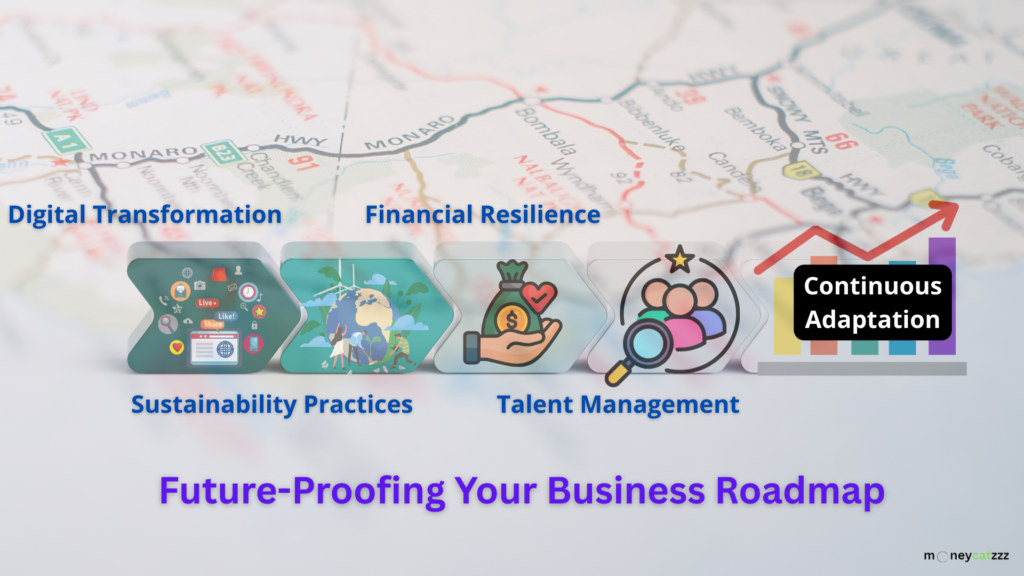
[“Future-Proof Your Business- The Path” – Image by moneycatzzz.com]
Regional Variations: Regulations and Consumer Expectations
Understanding the regional differences in sustainability regulations and consumer preferences is crucial for global businesses. For example, the European Union enforces strict sustainability standards under the European Green Deal, while regions like the United States and parts of Asia have less comprehensive mandates. Despite this, global pressure is mounting for businesses to adopt greener practices. In regions such as India, companies face the challenge of balancing sustainability with affordability, catering to a growing middle class that is just beginning to embrace eco-friendly products.
In his book The Lean Startup, Eric Ries outlines strategies for testing and scaling innovations with minimal waste, a critical approach when embedding sustainability into a company’s operations. This method enables businesses to develop green solutions more flexibly and iteratively.
3. The Future of Financial Management: Strategies for Scaling and Resilience
Effective financial management is the backbone of a future-proof business. While subscription models—used by companies like Shopify—provide stability, businesses must diversify their revenue streams to ensure long-term resilience. For example, integrating e-commerce with payment solutions can open new revenue channels while offering customers more flexibility.
Shopify’s Diversified Financial Strategy: A Modern Approach to Revenue Generation
Shopify’s success is partly due to its diversified business model, which combines subscription-based revenue with payment processing through Shopify Payments. This enables the company to maintain a steady income from merchant subscriptions while earning from transaction fees, providing a buffer against market fluctuations.
In Q2 2024, Shopify’s Subscription Solutions revenue grew by 26.8% year-over-year, reaching $563 million. This growth was primarily driven by an increase in the number of merchants joining the platform and existing merchants upgrading to higher-tier plans.
Additionally, Shopify’s Merchant Solutions revenue reached $1.44 billion in Q2 2024, up 18.5% compared to Q2 2023. This segment includes services such as payment processing, shipping, and providing working capital, further diversifying Shopify’s revenue streams.
By integrating these diverse revenue streams, Shopify effectively balances growth with profitability, ensuring a resilient financial structure that supports its expansive e-commerce ecosystem.
Beyond the Subscription Model: Diversifying Revenue Streams
To ensure financial resilience, businesses should explore additional tactics, including cash flow forecasting, hedging against market volatility, and investing in technology to streamline financial processes. Techniques such as stress-testing business models against potential economic downturns can provide valuable insights into potential risks.
In his classic book, The Intelligent Investor, Benjamin Graham presents timeless principles for managing risk and achieving steady growth in uncertain markets. This book is essential reading for entrepreneurs looking to make smarter financial decisions.
4. Talent Acquisition and Retention: The Competitive Advantage of Human Capital
The success of any business hinges on its people. As digital transformation accelerates, talent acquisition strategies must evolve. Remote work and digital collaboration are now standard across industries, but this shift also introduces new challenges in maintaining company culture and collaboration. Regional differences further influence talent markets, with some countries excelling in tech talent while others are still catching up in training and educational infrastructure.
Google’s Talent Management Strategy: Cultivating Innovation Through People
Google’s exceptional ability to attract and retain top talent is rooted in its rigorous hiring process, prioritizing cultural fit and diversity alongside technical skills. The company seeks individuals who align with its values and embrace a collaborative, innovative work environment. By hiring skilled and culturally compatible employees, Google fosters an atmosphere where creativity thrives, and diverse perspectives are valued.
Once hired, employees benefit from Google’s commitment to professional growth. The company invests significantly in training programs, workshops, and development opportunities to ensure its workforce remains at the forefront of industry trends. This focus on continuous learning, combined with a flat organizational structure that encourages open communication, enables Google to sustain its competitive edge while maintaining high employee satisfaction and retention.

[“Adaptation is Key” Image by CreativeSpace on Freepik]
Global Perspective: Regional Talent Dynamics
In North America and Europe, talent pools for tech and innovation are well-established. However, regions such as parts of Africa and Southeast Asia are experiencing rapid growth in digital skills. Companies hiring globally must understand these regional differences and develop strategies to attract and manage talent from diverse backgrounds.
Geoff Smart wrote in his seminal book, “Who,“ which provides a practical method for identifying and hiring talent, ensuring businesses can build teams aligned with their strategic goals.
5. Expanding Your Digital Presence: Leveraging Online Tools for Growth
A robust online presence is essential for businesses seeking to scale in the digital age. Whether you are focused on improving your website or building an effective social media strategy, every business must optimize its digital footprint to reach more customers.
Starbucks’ Digital Engagement Strategy: Leveraging AI for Personalized Customer Experiences
Starbucks has effectively harnessed artificial intelligence (AI) to enhance its digital engagement efforts, particularly through its mobile app. The company introduced Deep Brew, an AI engine that analyzes customer data to deliver tailored product recommendations and personalized promotions. This personalization has led to increased customer engagement, with mobile orders accounting for over 30% of U.S. transactions, highlighting the success of Starbucks’ digital transformation.
Beyond personalized marketing, Deep Brew optimizes store operations by forecasting customer traffic based on weather patterns and local events. This predictive capability ensures adequate staffing and inventory levels, enhancing customer experience. However, the surge in mobile orders has presented challenges, including longer in-store wait times and operational strain. To address these issues, CEO Brian Niccol is implementing algorithms to better manage order flow. He is reintroducing elements of the traditional Starbucks experience, such as comfortable seating and ceramic mugs, aiming to balance digital convenience with in-store ambiance.
XR in Digital Engagement to Navigating the Future of Business
As we explore how XR technologies can redefine customer engagement, it’s important to remember that a successful digital strategy goes beyond innovative tech. It must also be underpinned by a clear, resonant narrative that connects with consumers on a deeper level. This is where frameworks like Donald Miller’s Building a StoryBrand come into play, helping businesses craft a message that stands out in an increasingly crowded digital marketplace.
Yet, digital transformation is only one piece of the puzzle regarding securing long-term success. To truly future-proof your business, you must integrate sustainable practices, ensure financial resilience, and attract top talent. These strategies must be tailored to regional differences in digital adoption, sustainability regulations, and talent pools—ensuring that your business remains adaptable and poised for growth in an ever-evolving market.

Navigating the Future of Business
Future-proofing your business requires embracing digital transformation, adopting sustainable practices, ensuring financial resilience, and attracting top-tier talent. These strategies are critical for staying ahead in a fast-evolving market. However, businesses must also consider the regional variations in digital adoption, sustainability regulations, and talent markets to implement these strategies successfully.
From harnessing AI and XR to focusing on financial stability and global talent management, the strategies outlined here will help businesses survive and thrive in an ever-changing world.
By adopting these strategies, your business will be well-positioned to lead in the future, no matter the challenges.
Disclosure: This post may contain affiliate links. We only recommend products we believe in, and We may receive a commission at no cost to you! Thank you for your support!
Acknowledgement: Cover Image by Canva.com