
 Reading Time: 8 mins #
 This post may contain affiliate links.
The Hidden Battlefield: Why Office Politics Matter
Office politics is not just harmless chatter—it’s a silent force that can significantly hinder career progression and business success. Shockingly, a recent Gallup poll found that 75% of employees believe office politics is a major obstacle in their career paths. Moreover, research from the American Management Association reveals that companies lose an average of $12,000 per employee annually due to political workplace issues, including decreased productivity and high turnover rates.
The impact extends beyond finances. A study published in the Journal of Occupational Health Psychology found that excessive workplace politics contribute to stress, burnout, and even physical health issues. Ignoring office politics is not an option—it’s a game you must learn to play strategically.
“Power tends to corrupt, and absolute power corrupts absolutely.” – Lord Acton
The Invisible Threads of Power: Recognizing Office Politics
Office politics, much like the intricate web of a spider, often goes unnoticed until one becomes entangled within it. The key to navigating this web lies in early recognition. In his book “Power: Why Some People Have It, and Others Don’t,” Jeffrey Pfeffer argues that political skill is not innate but learned. By honing our observational skills, we can identify the subtle power dynamics.
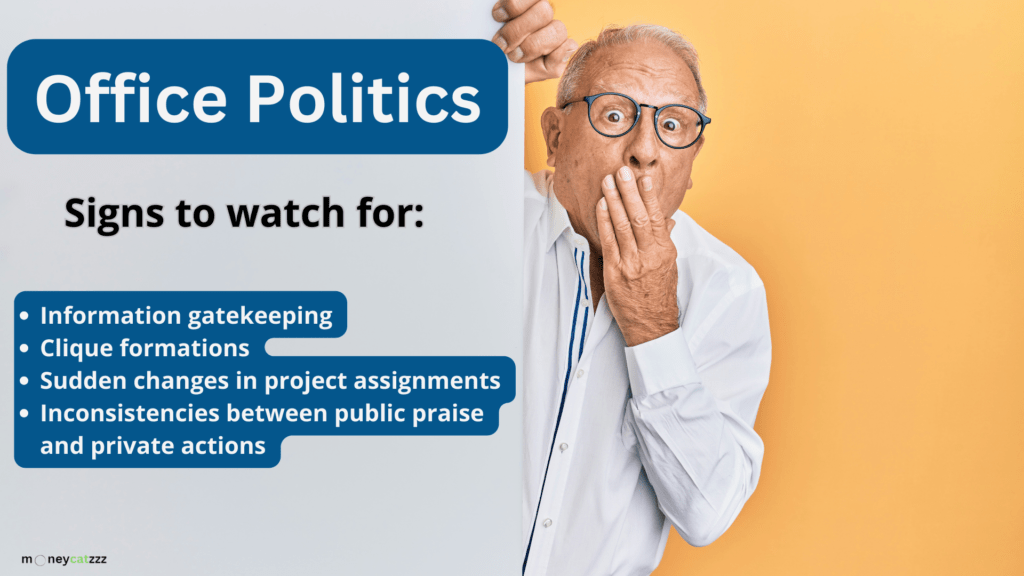
Signs to watch for include:
- Information gatekeeping
- Clique formations
- Sudden changes in project assignments
- Inconsistencies between public praise and private actions
Personal Anecdote: Early in my career, a colleague always seemed “in the know” about upcoming projects. When I observed her strategic lunch dates with key decision-makers, I realized the power of informal networks in shaping office dynamics.
[“Recognizing Office Politics” – moneycatzzz.com]
The Political Zoo: Understanding Different Types of Players
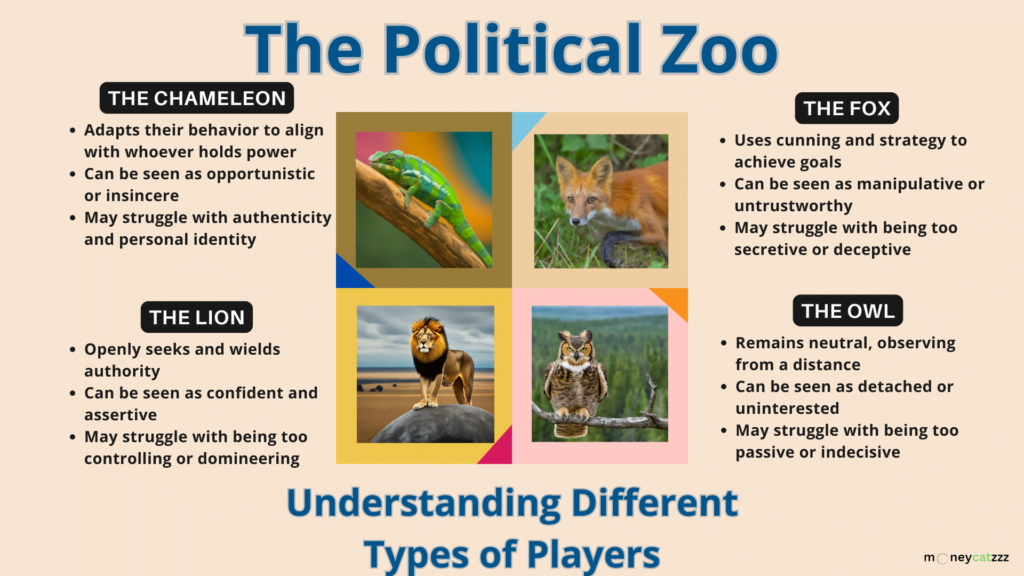
Just as a jungle houses diverse species, each workplace has its cast of political characters. Recognizing these archetypes can help you navigate interactions more effectively:
- The Chameleon: Adapts their behavior to align with whoever holds power
- The Lion: Openly seeks and wields authority
- The Fox: Uses cunning and strategy to achieve goals
- The Owl: Remains neutral, observing from a distance
Understanding these types allows you to anticipate behaviors and respond appropriately. As Robert Greene notes in “The 48 Laws of Power,” “The better you are at dealing with power, the better friend, lover, husband, wife, and person you become.“
Emotional Intelligence: Your Secret Weapon
Navigating office politics requires more than just recognizing patterns; it demands high emotional intelligence (EQ). In his groundbreaking work “Emotional Intelligence,” Daniel Goleman emphasizes that EQ is often more crucial than IQ in determining professional success.
Critical aspects of EQ in office politics include:
- Self-awareness: Understanding your reactions and biases
- Empathy: Seeing situations from others’ perspectives
- Social skills: Building and maintaining relationships across the organization
Case Study: Jane, a mid-level manager, was known for her technical skills but struggled with team dynamics. After focusing on developing her EQ, particularly empathy, she turned a contentious team into a high-performing unit. Her improved ability to read and respond to emotional cues not only diffused potential conflicts but also earned her a promotion to senior management.

Strategic Alliances: The Art of Networking
In the corporate jungle, no one survives alone. Building a solid network of allies is crucial for navigating politics and advancing your career. Keith Ferrazzi’s “Never Eat Alone” provides invaluable insights into the power of relationships in professional settings.
Strategies for effective alliance-building include:
- Offering help before asking for favors
- Connecting people with mutual interests
- Showing genuine interest in colleagues’ work and lives
- Maintaining regular contact, not just when you need something
Remember, the strongest alliances are built on mutual benefit and trust, not manipulation.
Communication: The Universal Language of Diplomacy in Office Politics
Clear, strategic communication is your most powerful tool in navigating office politics. It’s the difference between being seen as a threat or an asset to your colleagues and superiors.
Key communication strategies include:
- Active listening: Show genuine interest in others’ perspectives
- Clarity: Express your ideas and intentions transparently
- Diplomacy: Frame critiques constructively and privately
- Consistency: Ensure your words align with your actions
Personal Anecdote: I once witnessed a colleague skillfully diffuse a tense situation between two departments by facilitating a meeting where each side felt heard. Her ability to translate concerns and find common ground resolved the conflict and positioned her as a valuable mediator in future discussions.

[“Office Politics” – Image by Freepiks/moneycatzzz.com]
Integrity: The Core of Ethical Navigation
Maintaining your integrity is paramount as you navigate the sometimes murky waters of office politics. In “The 7 Habits of Highly Effective People,” Stephen Covey emphasizes the importance of principle-centered leadership.
Strategies for maintaining integrity include:
- Consistently aligning your actions with your stated values
- Admitting mistakes and taking responsibility
- Refusing to participate in gossip or unethical practices
- Standing up for what’s right, even when it’s unpopular
Case Study: Peter, a senior executive, was pressured to manipulate financial reports to meet quarterly targets. Despite the risk to his position, he refused and instead proposed a transparent plan to address the shortfall. His integrity not only saved the company from potential legal issues but also earned him the respect of the board and a promotion to CFO.
Turning Lemons into Lemonade: Transforming Conflicts into Opportunities
Conflict, when handled skillfully, can catalyze positive change and growth. The key lies in reframing conflicts as opportunities for problem-solving and innovation.
Strategies for positive conflict resolution include:
- Focusing on interests rather than positions
- Seeking win-win solutions
- Using “I” statements to express concerns without blame
- Proposing collaborative problem-solving sessions
By approaching conflicts with a growth mindset, you can turn potential career landmines into stepping stones for advancement.
Office Politics: Shaping Outcomes Without Overt Power Plays
Effective navigation of office politics often requires influencing outcomes without resorting to obvious power plays. This skill, often called “soft power,” can be more effective and sustainable than traditional authority.
Techniques for subtle influence include:
- Leading by example
- Using storytelling to convey ideas
- Building coalitions around shared goals
- Leveraging expertise to become an indispensable resource
As Joseph Nye argues in “Soft Power: The Means to Success in World Politics,” the ability to attract and co-opt, rather than coerce, is a crucial skill in modern leadership.
Proactive Politics: Anticipating and Shaping the Landscape
The most skilled players in office politics don’t just react to situations; they anticipate and shape the landscape to their advantage. This proactive approach requires a combination of strategic thinking and calculated risk-taking.
Strategies for proactive political engagement include:
- Staying informed about organizational changes and industry trends
- Volunteering for high-visibility projects
- Cultivating relationships across departments and hierarchies
- Proposing solutions to problems before they become crises
By staying ahead of the curve, you position yourself as a valuable asset and reduce the likelihood of being blindsided by political maneuvers.
[“The Political Zoo’ – moneycatzzz.com]
The Long Game: Building a Sustainable Career in a Political World
Navigating office politics isn’t just about short-term wins but building a sustainable, fulfilling career. This requires a balance of strategic thinking and authentic relationship-building.
Long-term strategies include:
- Continuously developing your skills and knowledge
- Building a personal brand based on expertise and reliability
- Mentoring others and paying it forward
- Aligning your career moves with your core values and long-term goals
As Marshall Goldsmith notes in “What Got You Here Won’t Get You There,” continued success requires constant self-reflection and adaptation.

Mastering the Art of Professional Diplomacy
Navigating office politics is not about winning at all costs or manipulating others. It’s about understanding the human dynamics in any organization and using that understanding to create positive outcomes for yourself and others. By developing your emotional intelligence, building solid relationships, communicating effectively, and maintaining your integrity, you can turn the potential minefield of office politics into a landscape of opportunity.
Remember, like any ecosystem, the corporate jungle thrives on balance and mutual benefit. As you apply these strategies, focus on personal gain and how your actions can contribute to a healthier, more productive work environment for all. In doing so, you’ll advance your career and leave a lasting positive impact on your professional world.
In the words of Peter Drucker, “Management is doing things right; leadership is doing the right things.” By mastering the art of navigating office politics, you position yourself as a successful manager of your career and a true leader in your organization.
As you embark on this journey of professional growth, remember that every interaction is an opportunity to learn, every challenge a chance to demonstrate your value, and every relationship a potential ally in your career advancement. The corporate jungle may be complex, but armed with these strategies and insights, you’re well-equipped to survive and thrive in the dynamic world of office politics.
Disclosure: This post may contain affiliate links. We only recommend products we believe in, and We may receive a commission at no cost to you! Thanks for your support!”
Acknowledgement: Cover Photo by Yan Krukau
Signup to our Newsletter for regular updates:
Disclaimer: The information is provided for general information only – moneycatzzz.com makes no representations or warranties in relation to the information, including but not limited to any representation or warranty as to the fitness for any particular purpose of the information to the fullest extent permitted by law. While every effort has been made to ensure that the information provided in this article is accurate, reliable, and complete as of the time of writing, the information provided in this article should not be relied upon to make any financial, investment, real estate or legal decisions. Additionally, the information should not substitute advice from a trained professional who can take into account your personal facts and circumstances, and we accept no liability if you use the information to form decisions.