
 Reading Time: 8 mins #
 This post may contain affiliate links.
What if the greatest competitive edge in business wasn’t a strategy, product, or even talent—but perspective?
According to a Gallup study, companies with high employee engagement—often tied to leadership outlook and organizational mindset—are 21% more profitable than their peers. The difference? A culture driven by optimism, resilience, and continuous learning is rooted in how leaders see and frame challenges.
This isn’t just psychology—it’s ROI.
“The pessimist sees the difficulty in every opportunity; the optimist sees the opportunity in every difficulty.” – Winston Churchill.
The Day My Perspective Shifted Forever
Several years ago, I lost our company’s biggest client. The news hit hard. I sat frozen, staring at the numbers, calculating the layoffs that might follow. That’s when my mentor called and said, “Congratulations—you just made room for ten better clients.” It wasn’t toxic positivity. It was a reframe. And it worked.
Within three months, we diversified our portfolio and served clients better aligned with our mission. That moment taught me a lesson no business school ever had: perspective doesn’t just influence results—it manufactures them.
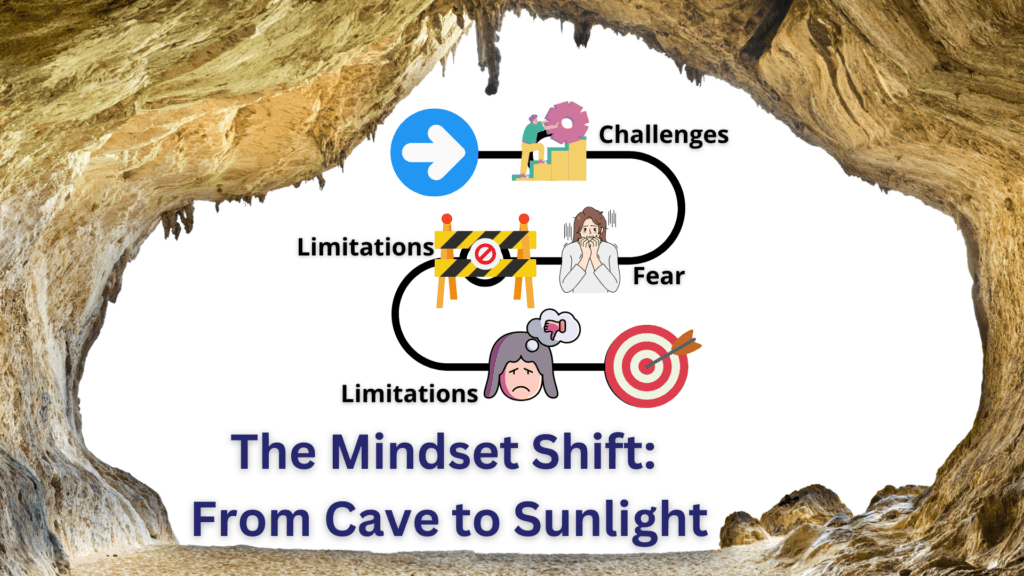
[“The Mindset Shift” – moneycatzzz.com]
What Is Perspective?
In its simplest form, perspective is how we interpret the world. In leadership, it becomes the lens through which we define problems, frame opportunities, and influence others. Leaders don’t just react—they reflect, reframe, and redirect.
In his book Thinking, Fast and Slow, psychologist Daniel Kahneman explains how our brains are wired for “fast” thinking—reactive, biased, often fear-driven. However, success usually depends on engaging our “slow” thinking—the deliberate, analytical mode that sees possibility within uncertainty.
Perspective, in this light, is a practiced discipline.

Growth Mindset: The Architecture of Adaptive Perspective
Coined by Dr. Carol Dweck in her seminal work Mindset: The New Psychology of Success, a growth mindset is the belief that abilities and intelligence can be developed through effort, learning, and persistence.
Compare this with a fixed mindset, which assumes talents are innate.
Fixed thinkers fear failure; growth-minded leaders embrace it.
Key Characteristics of a Growth Mindset:
- Curiosity over certainty: Asking, not assuming.
- Failure as feedback: Every setback is an iteration.
- Long-term over short-term thinking: Playing the infinite game, as Simon Sinek describes it.
When Zoom faced an existential crisis at the start of the COVID-19 pandemic, CEO Eric Yuan didn’t panic. He pivoted. Zoom’s capacity was expanded, security was improved, and user experience was optimized—resulting in 355% revenue growth in Q2 2020.
The mindset? “We’re not overwhelmed. We’re being invited to evolve.“
Positive Thinking: More Than Fluff
Positive thinking often gets a bad rap. Dismissed as naive or shallow, it’s frequently misunderstood. But science tells a different story.
According to Harvard Medical School, positive thinking—rooted in gratitude, optimism, and resilience—correlates with better health, higher productivity, and stronger relationships. In business, this equates to better decision-making and a more empowered workforce.
It’s not about ignoring reality but choosing which part of reality to amplify.
“The pessimist sees the difficulty in every opportunity. The optimist sees the opportunity in every difficulty.” — Winston Churchill.
Leadership: Shaping Culture Through Perspective
True leadership isn’t about position. It’s about permission—the influence earned through clarity, consistency, and courage. And perspective is at its core.
Great leaders don’t just manage logistics. They manage meaning.
They see challenges as catalysts, not crises. They invite feedback. They model emotional intelligence. And they normalize uncertainty by framing it as a natural precursor to innovation.
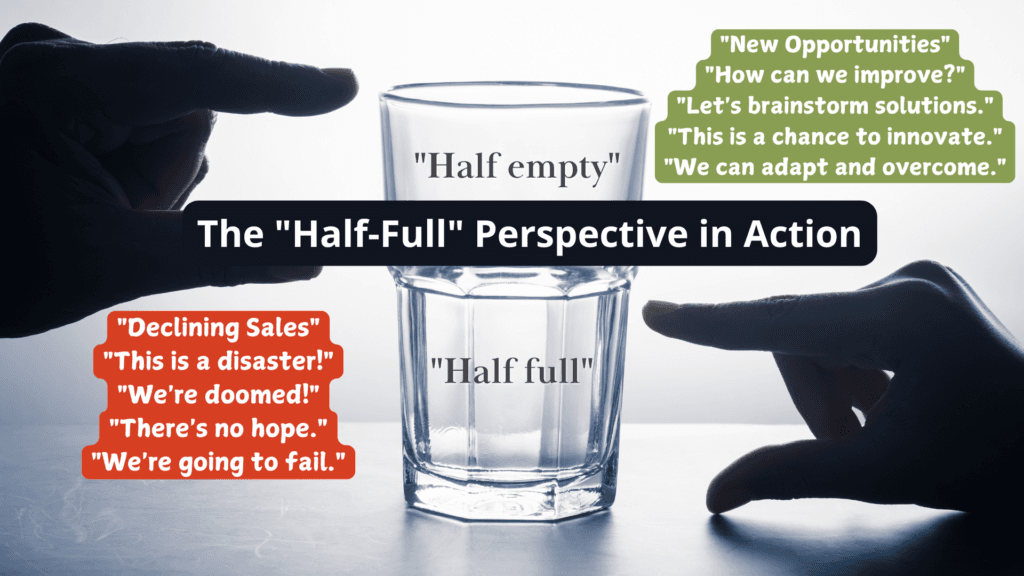
[“The “Aha!” Moment: The “Half-Full” Mindset in Action” – moneycatzzz.com]
Emotional Intelligence Meets Perspective
Leaders with high emotional intelligence (EQ) are especially effective at managing perspective. They don’t just regulate their own emotions—they shape team morale by how they interpret setbacks, success, and stress.
According to Daniel Goleman, author of Emotional Intelligence, leaders with high EQ build trust faster, resolve conflict better, and motivate more authentically.
Perspective in Practice: Tactical Shifts for Leaders
Let’s break it down. Real-world mental models and mindset shifts help leaders unlock the “half-full” advantage.
1. The Beginner’s Mindset
Originating from Zen Buddhism, this mindset advocates approaching problems without preconceptions. It’s about receptivity over rigidity.
In your next strategy session, ask one new hire for their thoughts first. Fresh perspectives often hide in inexperienced eyes.
2. Opportunity Framing
Instead of asking, “What’s wrong?” ask, “What’s possible?“
Run a “pre-mortem” before major initiatives. Ask: “If this fails, why will it fail?” Then, solve those problems in advance.
3. Perspective Audits
Each morning, list three challenges. Reframe each as a growth opportunity.
Example: “Sales are down” reframed as “We now have data to test a new messaging strategy.”
Case Study: Nintendo’s Rebound
When mobile gaming threatened Nintendo‘s relevance, the company could have folded. In a brilliant business move, it reimagined its console strategy—on the March 3, 2017, they launched the Nintendo Switch, which combined home and portable gaming resulting in 122 million units sold and a market resurgence.
The Switch was a product of a “both/and” mindset—not choosing between portability and power but integrating them. That’s the power of creative perspective in action.

Cognitive Biases: The Enemies of Perspective
To master perspective, you must also confront what blocks it:
- Confirmation bias: Only seeing what confirms your beliefs.
- Negativity bias: Overweighting threats and failures.
- Status quo bias: Resisting change out of comfort.
Awareness is key. As Adam Grant argues in Think Again: The Power of Knowing What You Don’t Know, great thinkers unlearn as actively as they learn.
The Cost of a Fixed Perspective
Perspective is not just an asset—it’s a liability when mismanaged.
Leaders who cling to fixed mindsets miss innovation signals. Teams that adopt scarcity thinking hoard information. Cultures that reward certainty over curiosity stagnate.
The cost isn’t just lost revenue—it’s lost relevance.
Cultivating the Half-Full Culture
Here’s how to integrate perspective into your team or organization starting today:
1. Codify Curiosity
- Create feedback loops where all voices are heard.
- Reward questions, not just answers.
2. Reframe Meetings
- Begin team check-ins with one “unexpected win” from the week.
- Encourage open dialogue about failures as learning moments.
3. Model the Reframe
- As a leader, narrate your thinking. Let your team hear how you reframe problems.
4. Celebrate Resilience, Not Just Results
- Highlight adaptability in performance reviews.
- Publicly share stories of setbacks that led to breakthroughs.
Metrics That Matter
Adopting a “half-full” mindset isn’t just philosophy—it drives results:
- 43% increase in innovation when teams adopt open perspective cultures.
- 37% improvement in retention linked to psychological safety and growth-focused environments.
- 31% better financial performance from high EQ, perspective-driven leadership teams (Harvard Business Review).
Your Turn: Begin with One Reframe
Find one area in your leadership or business where your default perspective is negative or fixed. Reframe it.
Instead of “The team missed the deadline,” try, “We now have data to build a more accurate project timeline moving forward.”
The most significant transformations often begin not with a strategy shift but a perspective shift.
Disclosure: This post may contain affiliate links. We only recommend products we believe in, and We may receive a commission at no cost to you! Thank you for your support!
Acknowledgement: Cover Image by moneycatzzz.com on Canva
Disclaimer: The information is provided for general information only – moneycatzzz.com makes no representations or warranties in relation to the information, including but not limited to any representation or warranty as to the fitness for any particular purpose of the information to the fullest extent permitted by law. While every effort has been made to ensure that the information provided in this article is accurate, reliable, and complete as of the time of writing, the information provided in this article should not be relied upon to make any financial, investment, real estate or legal decisions. Additionally, the information should not substitute advice from a trained professional who can take into account your personal facts and circumstances, and we accept no liability if you use the information to form decisions.