
 Reading Time: 11 mins #
 This post may contain affiliate links.
Thrive: Build Your Risk Management Strategy
“Who dares wins!”
The phrase by Baron Alvingham of Woodfold in the County Palatine of Lancaster, adopted by the Special Air Service (SAS) as their motto, rings truer than ever in today’s unpredictable world. Risk is not just something to fear—it’s something to understand, prepare for, and even embrace. From cybersecurity threats to global pandemics and climate shifts to market volatility—businesses now face constant risks. With every challenge comes an opening—the most resilient organizations aren’t just reacting but building strength through strategy.
To truly master the art of risk management, we need more than good intentions and lucky guesses—we need a clear roadmap. In this guide, we’ll walk through four essential pillars:
- Risk Assessment: Identifying and analyzing potential threats.
- Risk Mitigation: Developing smart strategies to reduce impact.
- Crisis Management: Responding quickly and decisively when things go wrong.
- Scenario Planning: Preparing for what’s next—even when we don’t know what that is.
Each pillar plays a unique role, but together they form a comprehensive approach to navigating uncertainty. By understanding risks, preparing for them, responding when needed, and staying adaptable to change, organizations can shift from being reactive to being truly resilient. Let’s start at the foundation—with risk
Risk Assessment: Understanding What You’re Up Against
You can’t manage what you can’t see. Risk assessment is about uncovering vulnerabilities and looking at what could go wrong.
In his book The Failure of Risk Management, Douglas W. Hubbard challenges conventional approaches, arguing that too many organizations rely on vague qualitative labels like “high risk” or “low probability.” His advice? Go deeper. Use data. Be specific.
How to Start Strong:
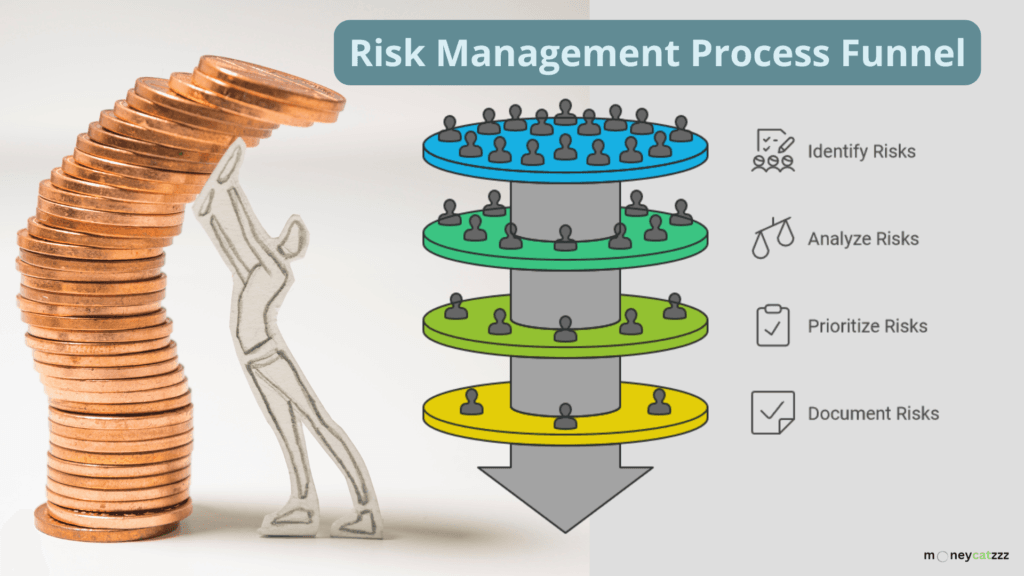
- Identify Risks: Begin with a wide lens. Look across departments, markets, and operations. Use tools like brainstorming, interviews, and industry benchmarking.
- Analyze Risks: What’s the likelihood this could happen? And if it did, how bad would it be? Use numbers (quantitative) and expert judgment (qualitative) to get a complete picture.
- Prioritize: Not all risks deserve equal attention. Focus on the high-impact, high-likelihood ones first.
- Document Everything: A living, breathing risk register helps track what you’ve found and how you respond.
Tools of the Trade:
- SWOT Analysis: Uncovers internal strengths and weaknesses alongside external opportunities and threats.
- PESTLE Analysis: Helps anticipate political, economic, social, tech, legal, and environmental trends.
- FMEA (Failure Mode and Effects Analysis): Great for understanding how and why systems might break down.
- Monte Carlo Simulation adds mathematical muscle and models possible outcomes and probabilities.
Risk assessment is never a “set it and forget it” task. Markets shift. Regulations change. Technology evolves. So should your risk assessments.
Risk Mitigation: Taking Smart, Strategic Action
Once you know what you’re facing, it’s time to act. Risk mitigation is where theory meets reality, and resilience begins to take root.
Peter L. Bernstein, in his book Against the Gods, traced humanity’s long journey toward understanding and controlling risk. The big takeaway? Progress depends on our ability to plan for the unpredictable.
[“Key Steps in Risk Assessment” – moneycatzzz.com]
Five Smart Mitigation Moves:
- Avoid the Risk: You may stay out if a market is too volatile.
- Reduce the Risk: Strengthen your processes, improve training, and double-check your systems.
- Transfer the Risk: Insurance, outsourcing, or contracts can shift some responsibility to others.
- Accept the Risk: A wait-and-watch approach with a contingency plan may be okay for smaller or unlikely events.
- Share the Risk: Collaborate through partnerships or joint ventures to spread exposure.
Making It Real:
- Build a Risk Mitigation Plan that defines what you’ll do, when, and how.
- Assign clear ownership to ensure follow-through.
- Back it up with the right resources—time, money, and talent.
- Review and adapt. Mitigation isn’t static.
And perhaps most importantly, Build a risk-aware culture. The most powerful mitigator is a workforce that can spot red flags and respond swiftly.
Mitigation isn’t about eliminating every threat. That’s impossible—and often counterproductive. It’s about keeping risk in the zone where you can still act confidently and strategically.

Crisis Management: Leading Through the Chaos
Even the best-laid plans can be upended. That’s where crisis management steps in.
Zafar Anjum’s Crisis Management: The Art of Success and Failure reminds us that what separates thriving companies from struggling ones isn’t whether they face a crisis—but how they respond to it.
What Crisis-Ready Looks Like:
- Preparedness: Don’t wait until the storm hits. Create a comprehensive crisis plan that includes roles, resources, and communication flows.
- Rapid Response: Speed matters. Time lost is often damage gained.
- Clear Communication: Internally and externally, people must hear directly, honestly, and consistently.
- Strong Leadership: Calm, decisive, and visible leadership is a stabilizing force.
- Adaptability: No plan survives first contact. Be ready to pivot.
- Post-Crisis Learning: Conduct a post-mortem. What worked? What didn’t? How can we improve?
A Real-World Example: Johnson & Johnson
In 1982, J&J faced a nightmare—tampered Tylenol capsules led to several deaths. But their response became a blueprint for crisis management:
- Immediate nationwide recall (31 million bottles).
- Transparent communication prioritizing public safety.
- Introduction of tamper-proof packaging.
- A full-scale effort to regain trust and rebuild the brand.
Instead of sinking the company, the crisis became a testament to its values. That’s the power of managing a situation well.

[“The Risk Management Matrix” – moneycatzzz.com]
Scenario Planning: Preparing for What You Can’t Predict
Forecasting assumes the future is a straight line. Scenario planning assumes the opposite—and that’s what makes it powerful.
In The Art of the Long View, Peter Schwartz outlines how scenario planning helps organizations stretch their thinking, anticipate change, and navigate uncertainty.
The Process:
- Define the Focus: What issue are you planning around?
- Identify Key Drivers: What internal and external forces matter most?
- Rank for Impact & Uncertainty: Which factors are most critical and unpredictable?
- Build Scenarios: Create 2–4 plausible future worlds.
- Tell the Stories: Flesh them with detail, personality, and narrative.
- Explore Implications: What would each scenario mean for your strategy?
- Track Indicators: Watch for signs that a particular future might be unfolding.
The Shell Example
Since the 1970s, Royal Dutch Shell has used scenario planning to foresee major disruptions—from oil shocks to geopolitical shifts to environmental movements. This mindset helped Shell stay nimble and competitive even when the world changed fast.
The lesson? Those who prepare for multiple futures tend to win in whichever one arrives.
Putting It All Together: A Holistic Risk Mindset
Each of these tools—assessment, mitigation, crisis planning, and scenario work—has power on its own. But together? They form a complete risk management strategy that’s proactive, responsive, and adaptive.
Here’s the synergy:
- Risk Assessment helps you see clearly.
- Risk Mitigation enables you to act wisely.
- Crisis Management enables you to respond effectively.
- Scenario Planning enables you to stay agile.
Together, they give you a foundation to operate from confidence, not fear.
Case in Point: Amazon
Amazon’s meteoric rise isn’t just about fast shipping—it’s about innovative risk management:
- Ongoing risk assessments across everything from supply chains to cloud services.
- Mitigation strategies like supplier diversification and in-house logistics.
- Quick crisis response during the COVID-19 pandemic with safety protocols and business model shifts.
- Scenario planning that led to early bets on AWS, smart speakers, and drone delivery.
The risk didn’t slow Amazon down—it helped it grow smarter, faster, and stronger.

Final Thoughts: Turn Risk Into Opportunity
In a world defined by volatility, uncertainty, complexity, and ambiguity (VUCA), risk management isn’t just operational—it’s strategic.
A few takeaways to keep top of mind:
- Make risk management continuous, not a once-a-year checklist.
- Balance data and judgment. One without the other is dangerous.
- Create a culture where risk is everyone’s business—not just the compliance team’s.
- And above all, don’t fear risk. Use it.
Because at the end of the day, managing risk well isn’t just about avoiding failure—it’s about building the kind of organization ready for anything.
Recommended Reading: Deepening Your Risk Management Expertise
To further enhance your understanding of risk management, consider these insightful books:
- “The Failure of Risk Management: Why It’s Broken and How to Fix It” by Douglas W. Hubbard Hubbard offers a critical look at current risk management practices and proposes quantitative methods for improvement.
- “Against the Gods: The Remarkable Story of Risk” by Peter L. Bernstein. This book provides a fascinating historical perspective on how our understanding of risk has evolved.
- “Crisis Management: The Art of Success and Failure” by Zafar Anjum Anjum offers practical insights into effectively preparing for and managing crises.
- “The Art of the Long View” by Peter Schwartz. Schwartz introduces the concept of scenario planning and provides a step-by-step guide to implementing this powerful tool.
Disclosure: This post may contain affiliate links. We only recommend products we believe in, and We may receive a commission at no cost to you! Thank you for your support!
Acknowledgement: Cover Image by freepiks.com
Disclaimer: The information is provided for general information only – moneycatzzz.com makes no representations or warranties in relation to the information, including but not limited to any representation or warranty as to the fitness for any particular purpose of the information to the fullest extent permitted by law. While every effort has been made to ensure that the information provided in this article is accurate, reliable, and complete as of the time of writing, the information provided in this article should not be relied upon to make any financial, investment, real estate or legal decisions. Additionally, the information should not substitute advice from a trained professional who can take into account your personal facts and circumstances, and we accept no liability if you use the information to form decisions.