 Reading Time: 10 mins #
 This post may contain affiliate links.
I want to retire at 50.
It’s a bold declaration that invites disbelief, skepticism, or concern. After all, we’ve been culturally conditioned to believe that retirement happens at 65 if lucky. But what if that narrative is outdated? What if early retirement is less about escaping work and more about intentionally designing a life aligned with your values?
For a growing community of financial independence seekers, retiring at 50—or earlier—isn’t just a pipe dream. It’s a personal revolution. It’s about reclaiming time, rewriting definitions of success, and putting mental clarity and lifestyle design at the forefront.
“The only limit to our realization of tomorrow will be our doubts of today.” – Franklin D. Roosevelt.
Over the past decade, I’ve been on this journey myself. It hasn’t always been easy, and it certainly hasn’t been linear. But I’ve learned that with a strong mindset, intentional choices, and consistent action—the dream of early retirement becomes a structured, achievable goal.
Let’s break down the proven strategies—and inner shifts—that can help you move from financial overwhelm to empowered action.

[“Retirement Planning” – Image by Canva]
Why Retire Early? (And What Are You Retiring From?)
Before diving into spreadsheets and savings rates, it’s worth pausing to ask: Why do I want to retire early?
For many, it’s not about sipping cocktails on a beach (though that’s nice too). It’s about autonomy. It’s the freedom to wake up without an alarm clock, to choose projects that inspire rather than deplete—to spend more time with family, community, or purpose-driven pursuits.
In psychological terms, early retirement is less about the absence of work and more about the presence of agency. It’s about reducing burnout, increasing well-being, and making room for self-directed living.
Achieving early retirement takes more than wishful thinking. It calls for a clear, deliberate approach grounded in mindset, money habits, and lifestyle choices that all work together.

1. Embrace the Power of Extreme Saving
The journey begins with taking charge of your finances and the fundamentals understanding of the power of “savings rate.” Setting aside 10% to 15% of their income may seem like progress for some, but saving 50%, 60%, or even 70% might be necessary for those serious about retiring early. Yes, it’s bold. But this level of saving forms the backbone of early financial freedom.
One of the most influential books on this mindset shift is Your Money or Your Life by Vicki Robin and Joe Dominguez. They challenge readers to reframe every expense in terms of time—how many hours of your life does that coffee subscription or car lease cost you?
This level of awareness builds what psychologists call delayed gratification—the ability to prioritize future freedom over present indulgence. It’s not about deprivation; it’s about conscious trade-offs.
I chose to live in a small apartment, buy used cars, and cut back on lifestyle inflation even when my income increased. That decision saved over 70% of my income during key years. It wasn’t glamorous—it was deeply empowering.
Automating savings is paramount and essential. Set up recurring transfers funneling money directly from your paycheck into investment accounts. Automation affords you this mantra—out of sight, out of temptation.
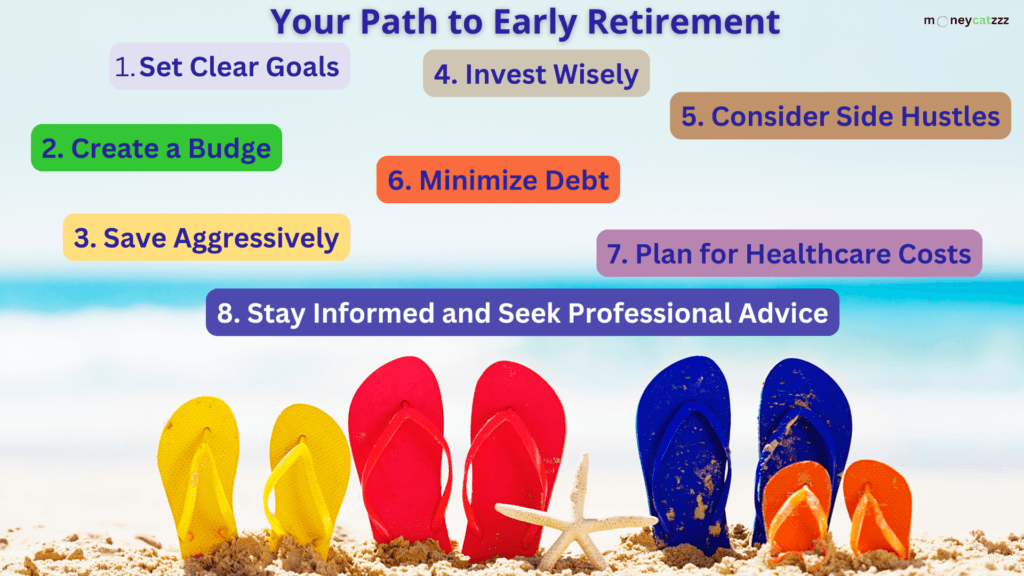
[“Unlock Financial Freedom: Your Path to Early Retirement” – moneycatzzz.com]
2. Maximize Your Earnings Potential
Saving aggressively only works if you have money to save. That’s where earning more comes in.
This isn’t about hustle culture or burnout. It’s about strategically increasing your value—through career moves, side hustles, or entrepreneurial ventures.
The Millionaire Next Door by Thomas J. Stanley and William D. Danko debunks the myth of the “flashy rich.” Many millionaires live frugally and focus on building assets. They don’t chase status—they create stability.
Another classic, Rich Dad Poor Dad by Robert Kiyosaki, reframes the entire notion of wealth-building. It emphasizes the importance of owning income-generating assets over simply collecting paychecks.
From a psychological lens, boosting your income is tied to self-efficacy—the belief that you can take actions that change your life. Whether it’s asking for a raise, switching industries, or monetizing a skill online, the confidence you build while increasing your income often translates into other areas of life.
3. Invest Aggressively—But Mindfully
Once you’ve freed up income through saving and earning, it’s time to put your money to work.
One simple yet powerful investment approach is the “three-fund portfolio,” made famous in the FIRE (Financial Independence, Retire Early) community. It involves investing in:
- A U.S. total stock market index fund
- An international stock market index fund
- A total bond market index fund
Burton Malkiel lauded this diversified, low-cost strategy in A Random Walk Down Wall Street, debunking the illusion of stock-picking and market timing.
The key is consistency over time. Let compounding do the heavy lifting and resist the emotional urge to time the market or chase trends.
4. Leverage Tax-Advantaged Accounts
Tax strategy is often overlooked but critically crucial in accelerating your path to early retirement.
401(k)s, IRAs, Roth IRAs, and HSAs (Health Savings Accounts) provide opportunities to grow wealth while minimizing taxes. Each comes with its own rules and benefits, and a thoughtful combination can help you access your money before the traditional retirement age without penalties.
Financial planner Michael Kitces suggests prioritizing tax-advantaged accounts first, then supplementing with taxable brokerage accounts to provide flexibility.
The Simple Path to Wealth by JL Collins is a must-read for a detailed breakdown. It demystifies investing and retirement planning in plain language—something both beginners and advanced planners can appreciate.
5. Create Multiple Income Streams
Diversification isn’t just for investing. It applies to your income as well.
Whether it’s rental properties, online businesses, dividend stocks, or royalties, building multiple income streams can give you a cushion against unexpected job losses or economic downturns.
One of the most mindset-shifting books on this topic is The 4-Hour Workweek by Tim Ferriss. While not solely focused on retirement, it offers practical strategies for building scalable, semi-passive income streams—and reclaiming time.
Psychologically, this diversification builds resilience. When you’re not dependent on one income source, you’re better able to navigate uncertainty and maintain peace of mind.

6. Optimize Your Lifestyle for Long-Term Fulfillment
Early retirement isn’t just about the numbers—it’s about designing a life you want to live.
That means aligning your spending with your values. It might look like moving to a lower-cost city, driving older cars, or embracing minimalism—not out of sacrifice but intention.
This principle is echoed in James Clear’s Atomic Habits: small daily choices create significant outcomes. Living below your means isn’t just practical—it builds contentment and intentionality, essential for a meaningful post-work life.
Ask yourself: What brings me joy that money can’t buy? Then, reallocate your energy—and your budget—toward that.
7. Plan for Healthcare and Unexpected Costs
One of the most significant concerns for early retirees is healthcare. Without employer-sponsored coverage, you must explore private insurance options, ACA marketplace plans, or health care sharing ministries.
You should also plan for less predictable expenses—family support, home repairs, inflation, or market downturns.
The Retirement Savings Time Bomb by Ed Slott is an excellent guide for navigating these complexities. It covers minimizing taxes, managing withdrawals, and avoiding costly mistakes as you move through different retirement phases.
Peace of mind in retirement doesn’t come from certainty—it comes from preparation.
Final Thoughts: Early Retirement Is About More Than Money
Retiring at 50—or even earlier—isn’t about escaping life. It’s about designing a better one.
Financial independence gives you options. It allows you to pursue passion projects, travel, volunteer, and spend more time with family—rest without guilt.
But the real gift of early retirement is psychological. It offers clarity, freedom, and a deeper connection to what matters most. And that’s a journey worth taking.
Start with small steps. Reframe your relationship with money. Build systems that support your values. And remember: the earlier you start, the more powerful your momentum becomes.
Your future self—the one waking up at 50 with a full day of freedom ahead—will thank you.
Disclosure: This post may contain affiliate links. We only recommend products we believe in, and We may receive a commission at no cost to you! Thank you for your support!
Acknowledgement: Cover Photo by Ilkin Safterov
Disclaimer: The information is provided for general information only – moneycatzzz.com makes no representations or warranties in relation to the information, including but not limited to any representation or warranty as to the fitness for any particular purpose of the information to the fullest extent permitted by law. While every effort has been made to ensure that the information provided in this article is accurate, reliable, and complete as of the time of writing, the information provided in this article should not be relied upon to make any financial, investment, real estate or legal decisions. Additionally, the information should not substitute advice from a trained professional who can take into account your personal facts and circumstances, and we accept no liability if you use the information to form decisions.