
 Reading Time: 6 mins #
 This post may contain affiliate links.
Active Listening: Your Guide for Success
In today’s world, conversations often feel like ships passing in the night—brief, distracted, and drifting just out of reach. With pings, alerts, and constant mental noise pulling our attention in every direction, truly listening has become rare. We move through interactions half-present, nodding while our minds are already elsewhere. Somewhere along the way, we forgot how grounding it can be to pause and tune in—to give someone the gift of our full attention.
That’s where active listening becomes more than just a helpful skill—it becomes a kind of anchor. It steadies the moment—quiets the static—it creates space for real connection. When we choose to listen with intention—we offer more than understanding; we offer presence. And in a world starved for depth and authenticity, that kind of presence can be transformational. It strengthens relationships, builds trust, and reminds us that sometimes, the most meaningful thing we can do is listen.
Whether you’re navigating personal relationships, leading a team at work, or planning for the future, learning to listen—can change everything.
“Most people do not listen with the intent to understand; they listen with the intent to reply.” – Stephen R. Covey
What Is Active Listening?
At its core, active listening is about being fully present. It’s a deliberate effort to understand the words someone says and the emotions, intentions, and experiences behind them. Think of it like tuning a radio to the right frequency—you’re not just catching the sound but tuning in to the message behind it.
This kind of listening involves three key elements:
- Pay close attention to verbal and non-verbal cues like tone, facial expressions, and body language.
- Suspending judgment—avoiding the urge to jump in with opinions or solutions too quickly.
- Focusing entirely on the speaker’s perspective—consciously trying to see the world through their eyes.
Stephen R. Covey once said, “Most people do not listen with the intent to understand; they listen with the intent to reply.” Active listening flips that script. Completely.
Why Active Listening Matters—More Than You Might Think
Let’s break down the impact of this often-overlooked skill.
In Personal Relationships
When we truly listen to the people we care about, we create space for trust, vulnerability, and healing.
Relationships deepen when we stop trying to fix or respond right away and instead show up and say, “I hear you.“
That kind of presence builds intimacy and emotional safety, whether it’s between partners, friends, or family members. It’s the kind of listening that makes someone feel seen.
In Professional Settings
Active listening can be the difference between friction and flow in the workplace. Teams work better when everyone feels heard. Managers earn more trust when they understand their employees’ concerns before reacting. Clients stay loyal when they think you’re genuinely invested in their needs—not just selling to them.
Research has shown that people who excel at active listening are significantly more likely to advance in their careers, resolve conflicts more peacefully, and maintain stronger working relationships. It’s not just a soft skill—it’s a superpower.
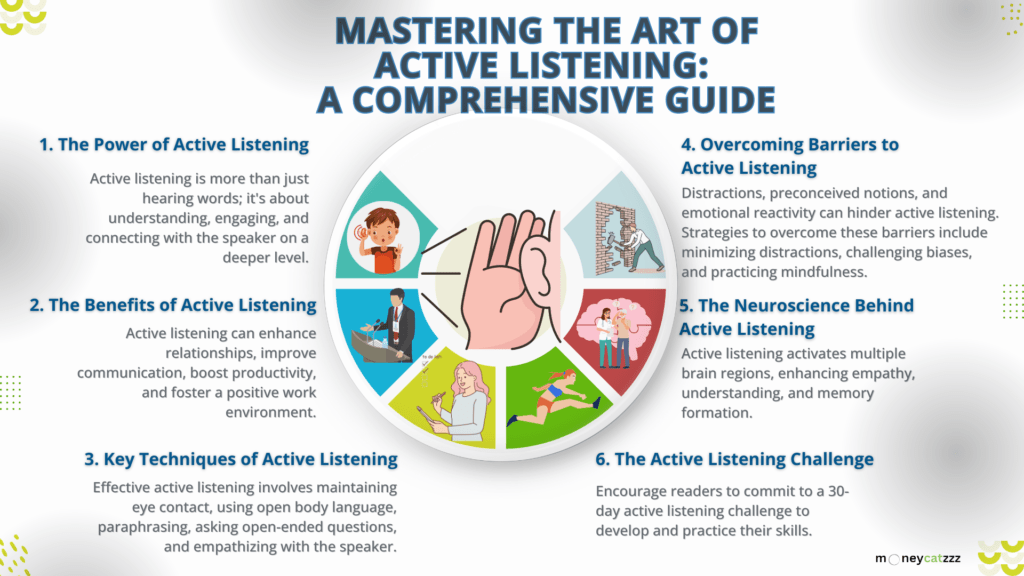
[“Mastering the Art of Active Listening” – moneycatzzz.com]
Simple Techniques to Build Your Listening Muscles
Like any skill—better listening starts with practice and intention. Here are some techniques that can help:
1. Nonverbal Presence
It is NOT what you said, but what you omit, but your presence that speaks loudest. A steady gaze, relaxed posture, and a simple nod—can quietly reassure the other person that you’re genuinely tuned in.
2. Empathetic Acknowledgment
Reflect on the speaker’s feelings in your responses with simple replies like: “That sounds overwhelming” or “I can understand why that would frustrate you” go a long way. You are not offering solutions—you’re holding space.
3. Open-Ended Questions
Avoid yes/no prompts whenever possible—ask questions that invite deeper reflection instead. Try things like: “What was that like for you?” or “Can you tell me more about that?” These help the other person feel heard and encourage a richer conversation.

4. Paraphrasing for Clarity
Repeat back what you’ve understood in your own words. “So what I’m hearing is…” is a great way to show that you’re processing the message—also giving the speaker a chance to correct any misinterpretations.
5. Summarizing Key Points
Especially in more extended conversations, it helps to summarize occasionally. “So just to recap what we’ve talked about…” reinforces that you’ve been listening and keeps everyone aligned.
The Barriers to Listening—and How to Break Them
Let’s be honest: active listening sounds simple, but it can be tough in practice. We all face distractions, biases, and emotional reactions that get in the way.
Here’s how to tackle some of the most common obstacles:
- Distractions: Our phones are often the biggest culprit—put them away or turn off notifications during important conversations. Find a quiet space if you can.
- Preconceived Notions: We tend to filter what we hear through our beliefs and assumptions. Catch yourself when you start judging or mentally rehearsing your next point, and gently bring your attention back to the speaker.
- Emotional Reactivity: If you feel triggered, it’s okay to pause. Take a deep breath. Collect your thoughts before responding. Sometimes, the best thing you can do is to give yourself a moment.
What Science Says About Listening
A growing body of neuroscience confirms what we’ve intuitively known: listening deeply rewires the brain.
When we engage in active listening, our brain lights up in areas linked to empathy and memory. Oxytocin—the “bonding hormone“—is released, reinforcing social trust. In other words, your brain is built to connect through listening.

[“It Pays to Listen” – Image by Welcome to All ! ツ from Pixabay
Real-World Examples: Listening in Action
Let’s look at how active listening is applied in the real world:
- Zappos: Known for its standout customer service, Zappos trains its team to hear the customer, not just follow scripts. Employees are encouraged to listen deeply, empathize, and find real solutions—sometimes going far beyond what’s expected.
- IDEO: At this world-renowned design firm, active listening is embedded in their process. Teams spend hours interviewing users, not to pitch ideas, but to listen—because real innovation starts with understanding what people need.
How to Measure Your Progress
Improving your listening isn’t about perfection; it’s about awareness. Try these simple ways to check in with yourself:
- Reflect after conversations: Did you interrupt? Did you truly focus?
- Ask for feedback: “Hey, do you feel like I’m hearing you when we talk?”
- Observe patterns: Notice when your listening habits change. Is it easier to listen to some people than others? Why?
A 30-Day Listening Challenge (Yes, You Can!)
Ready to take this to the next level? Try this month-long challenge. Each day, pick one thing to focus on:
- Give someone your full attention for five uninterrupted minutes.
- Ask an open-ended question and listen without jumping in.
- Notice the speaker’s body language and try to mirror it gently.
- Reflect on a difficult conversation: What emotions were behind the words?
By 30 days, you’ll feel more connected, grounded, and in tune with the people around you.
The Unexpected Connection: Active Listening and Retirement Planning
You might be wondering—what does listening have to do with retirement? Quite a bit.
- Working with Advisors: When you practice active listening with financial professionals, you ensure your vision and goals are clearly understood. You also build a relationship of trust.
- Communicating with Your Partner: Talking about money can be tricky. Active listening helps couples navigate these sensitive conversations with more empathy and less conflict.
- Listening to Yourself: It might sound strange, but tuning in to your inner voice—your hopes, fears, and dreams for the future—is a vital part of planning a life you’ll enjoy.

[“Are you Hearing or Listening?” – Image by Robin Higgins from Pixabay]
Final Thoughts: Listening as a Way of Life
Active listening is more than a communication tool—it’s a way of showing up in the world with presence, patience, and empathy—it builds bridges where there were once walls and creates connections where there might otherwise be distance.
It’s a lifelong practice. Some days, you’ll be better at it than others, and that’s okay. What matters is the intention to keep showing up and to keep listening.
So, the next time you’re in a conversation, pause. Set your phone down. Look the other person in the eye. And listen—not just to respond, but to understand.
Because in a noisy world, the ability to truly hear someone is one of the rarest and most beautiful gifts you can give.

Recommended Books for Further Reading
Deepen your understanding of active listening and personal development—consider these books:
- “Just Listen” by Mark Goulston: Practical strategies for improving your listening skills and building stronger relationships.
- “Crucial Conversations” by Kerry Patterson, Joseph Grenny, Ron McMillan, and Al Switzler: This book provides 2 valuable insights into effective communication, including active listening techniques for navigating challenging conversations.
- “The 7 Habits of Highly Effective People” by Stephen R. Covey: Emphasizes the importance of effective communication, including active listening, as a key habit for personal and professional success.
- “Mindfulness” by Jon Kabat-Zinn: Mindfulness practices can enhance your ability to focus, be present, and truly listen to others. This book offers practical guidance on meditation and mindfulness techniques.
Disclosure: This post may contain affiliate links. We only recommend products we believe in, and We may receive a commission at no cost to you! Thanks for your support!”
Acknowledgement: Cover Image by Joseph Mucira
Disclaimer: The information is provided for general information only – moneycatzzz.com makes no representations or warranties in relation to the information, including but not limited to any representation or warranty as to the fitness for any particular purpose of the information to the fullest extent permitted by law. While every effort has been made to ensure that the information provided in this article is accurate, reliable, and complete as of the time of writing, the information provided in this article should not be relied upon to make any financial, investment, real estate or legal decisions. Additionally, the information should not substitute advice from a trained professional who can take into account your personal facts and circumstances, and we accept no liability if you use the information to form decisions.