 Reading Time: 8 mins #
 This post may contain affiliate links.
Sunday, a warm cup, one open page. Not a heroic overhaul, just ten quiet minutes that keep your week steady. That’s the weekly money reset: a tiny, humane budgeting routine that restores financial peace so you can get back to living. Predictable cash flow lowers background stress. Lower stress makes better choices easier. Better choices compound.
Snapshot — The Weekly Money Reset in 30 Seconds
In this guide, we will take a look at how we can optimize our weekly schedule with efficient routines.
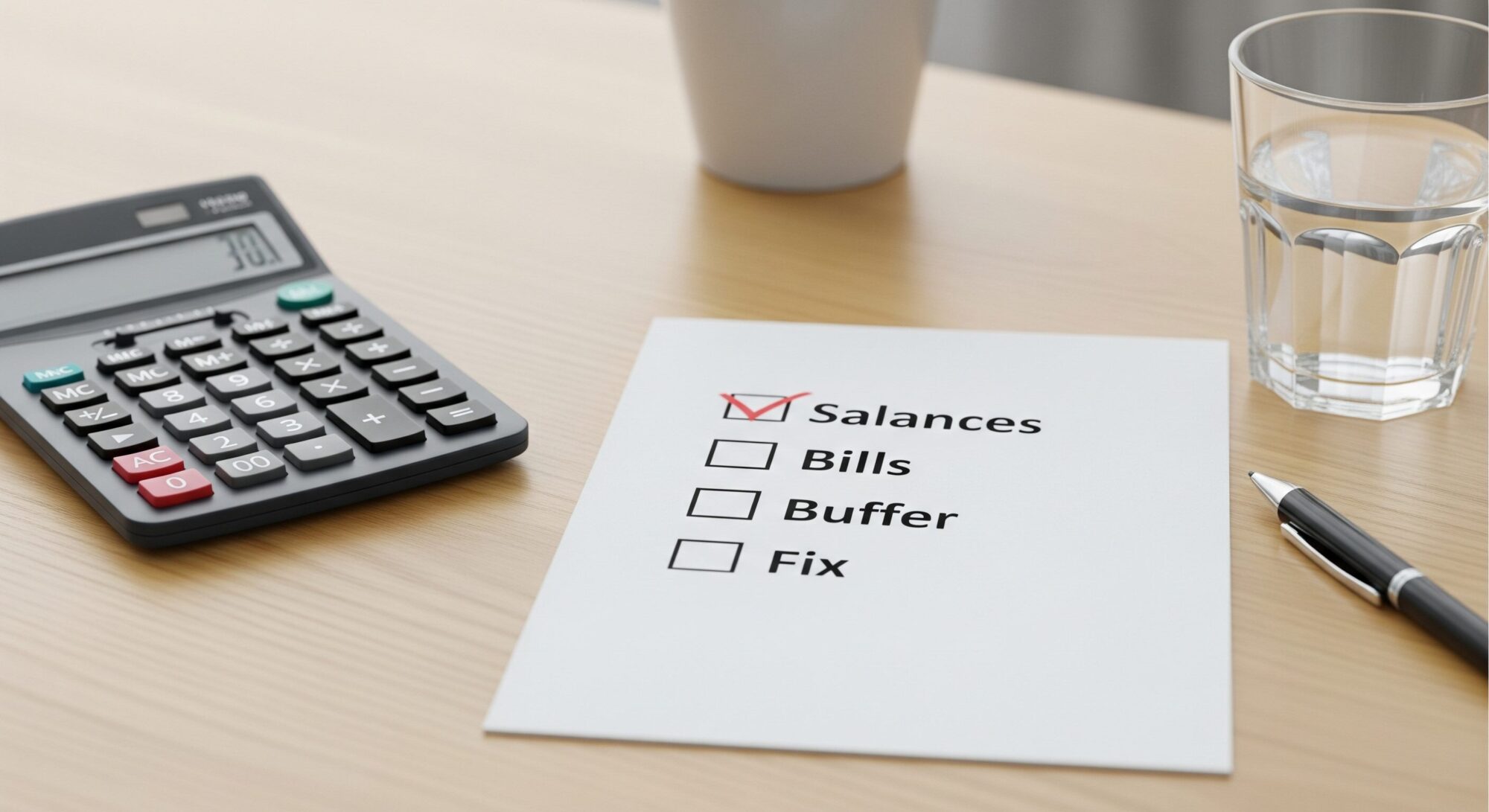
- Look: balances and the next 7–14 days of bills
- Move: $10–$25 into your emergency buffer (Just‑in‑Case Fund)
- Fix: one friction point (cancel/adjust/automate)
- Note: one line—“Money OK. Did X.”—close the tab
Why Weekly Beats Monthly (and Panic)
| Approach | Time | Emotion | What You Do | Risk | Likely Result |
|---|---|---|---|---|---|
| Monthly “overhaul” | 60–120 min | Heavy, avoidant | Rebuild spreadsheets, relive mistakes | Procrastination, blowups | Starts big, fades fast |
| Weekly money reset | 8–12 min | Light, doable | Balances → Bills → Buffer → One fix | Small course corrections only | Boring, steady progress |
Boring money is peaceful money. Weekly wins.
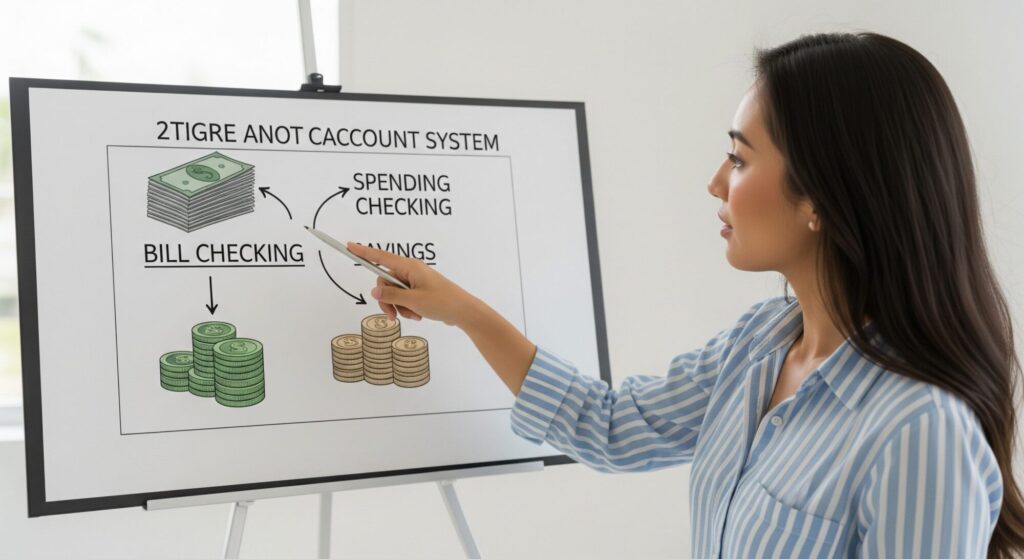
[“Architecture at a Glance (Bills • Spend • Savings)” – Image by Nano Banana]
Architecture at a Glance (Set Once, Then Relax)
| Account | Purpose | What Flows In/Out | Notes |
|---|---|---|---|
| Bills checking | Fixed essentials (rent, utilities, insurance, minimum debt) | Autopays only | Clarity prevents “oops” spend |
| Spend checking | Daily swipes/variable expenses | Groceries, fuel, eating out | Low friction; watch the burn |
| Savings (buffer + sinking) | Emergency buffer + predictable non‑monthly costs | Small weekly transfers | Keep separate; often high‑yield |
- Two‑account system: separate “Bills” from “Spend” to clarify cash flow.
- Sinking funds: set tiny weekly transfers for annual premiums, holidays, travel.
- Pay‑cycle alignment: biweekly? Put autopays in two windows (1–14, 15–28). Irregular income? Funnel deposits into a holding bucket, then pay yourself a fixed “salary” twice a month.
The Weekly Money Reset (10 Minutes, No Drama)
Minute 1 — Open Money Home: One page with links to Bills, Spend, Savings, and Cards.
Minutes 2–3 — Glance Balances: Look for anomalies. If any card’s credit utilization > ~30%, plan a small payment this week.
Minutes 4–5 — Preview Bills (7–14 Days): Will the Bills account cover autopays? Move a bit from Spend or adjust a due date if needed.
Minutes 6–7 — Emergency Buffer Move: Transfer $10–$25 (or a % of new income) into your buffer until you hit $500 → $1,000.
Minute 8 — One Friction Fix: Cancel a trial, lower a subscription tier, switch a stubborn bill to the Bills account, or set a micro‑automation.
Minutes 9–10 — Note + Close: “Money OK. Did X.” Update your metric if you track one. Close tabs. Go live your weekend.
Choose Your Mode (Pick What Fits Today)
| Mode | Time | Do This | Skip This |
|---|---|---|---|
| 5‑Minute Lite | 5 | Balances + Bills + Buffer | Friction fix (do it next week) |
| 10‑Minute Standard | 10 | Full flow (Balances → Bills → Buffer → One fix) | Nothing |
| 20‑Minute Deep | 20 | Standard + categorize top 5 spends; check utilization | Only if calm and curious |
Scripts + Micro‑Automations (Copy, Paste, Breathe)
- Due‑date shift (phone/chat): “Could we move my due date to align with my paycheck on the 1st/15th?”
- Autopay confirmation: “Please route autopays from my Bills account ending ‑1234.”
- Subscription trim: “I’d like to switch to the lower tier effective next cycle.”
Small automations are worth it:
- Auto‑save $10–$25/week → buffer
- Autopay minimums and fixed bills
- Monthly sweep: leftover Spend → Buffer
Calm Cash Index (CCI): One Number to Track Calm
CCI = liquid savings ÷ average monthly expenses
- Example: $900 savings ÷ $2,400 expenses = 0.375 (~1.5 weeks)
- Celebrate each +0.1. Progress becomes visible, motivation stays alive.

[“One Number to Track Calm – CCI” Image by moneycatzzz.com]
Edge Cases (Handled Calmly)
- Variable income: Pay yourself a fixed draw from a holding bucket; reset weekly keeps the draw honest.
- Debt heavy: Build a micro‑buffer ($500–$1,000) while paying minimums; then avalanche/snowball high‑interest debt.
- Multi‑currency/nomad: Keep a small local Spend account; hold buffer in home‑currency high‑yield savings; run the reset in home currency weekly.
- Couples: 10‑minute weekly sync. Shared Bills + individual Spend accounts; one shared CCI to celebrate.
Security Hygiene (Quiet Risk Reducer)
Use 2FA on bank/credit/email, strong unique passwords, enable transaction alerts. Glance at alerts during your reset. Secure email = secure accounts.
A Practical Example
At the start, Casey’s CCI was 0.15 (≈1 week), with three overdrafts in 90 days.
Week 1: split Bills/Spend, moved three autopays, pinned Money Home.
Week 2: auto‑saved $15/week, canceled two trials.
Week 3: shifted two due dates, paid a card to keep utilization under 30%.
Week 4: CCI hit 0.35—no overdrafts. “Boring” turned into relief. Work felt quieter.
FAQs — Weekly Money Reset
What is a weekly money reset?
A 10‑minute budgeting routine to review balances, preview bills, move a small amount to your emergency buffer, and fix one friction point.
How big should the emergency buffer be?
Start with $500 → $1,000. Over time, aim for 1–3 months. Track progress with your CCI.
Do I need budgeting software?
No. A notebook or simple sheet is fine. Tools help; habits wi
Where should I keep the buffer?
Typically in a separate high‑yield savings account you won’t accidentally spend. Confirm FDIC/NCUA insurance and transfer times.
Will this help with variable income?
Yes — route income to a holding bucket, pay yourself a fixed draw twice a month, and use the reset to adjust.
Final Thoughts
Financial peace isn’t a windfall; it’s a rhythm. Ten quiet minutes — Balances • Bills • Buffer • One Fix — turn a noisy week into one you can navigate. Keep your Calm Cash Index rising by tenths; keep the flow simple enough to repeat on your tired days.
Pair this with a Morning Routine for Inner Peace and one protected deep‑work block from our Calm Productivity framework. Money gets boring; life gets richer.
- Read next: Morning Routine for Inner Peace (10‑minute morning reset)
- Build capacity: Calm Productivity — Framework + 7‑Day Plan

Your Money or Your Life


References for better money management
- CFPB — Budgeting basics
- CFPB — Building an emergency fund
Disclosure
This guide is educational and general in nature. It is not financial advice. Consult a professional for guidance tailored to your situation. Some links may be affiliate; we may earn a commission at no cost to you.
Disclosure: This post may contain affiliate links. We only recommend products we believe in, and We may receive a commission at no cost to you! Thank you for your support!
Acknowledgement: Cover Image by moneycatzzz.com
Disclaimer: The information is provided for general information only – moneycatzzz.com makes no representations or warranties in relation to the information, including but not limited to any representation or warranty as to the fitness for any particular purpose of the information to the fullest extent permitted by law. While every effort has been made to ensure that the information provided in this article is accurate, reliable, and complete as of the time of writing, the information provided in this article should not be relied upon to make any financial, investment, real estate or legal decisions. Additionally, the information should not substitute advice from a trained professional who can take into account your personal facts and circumstances, and we accept no liability if you use the information to form decisions.