
 Reading Time: 8 mins #
 This post may contain affiliate links.
Objectives and Key Results (OKRs) are a proven goal-setting framework that empowers businesses to define, track, and achieve strategic objectives. Industry leaders like Google, Intel, and Spotify use OKRs to foster clarity, accountability, and team alignment. By setting ambitious yet measurable goals, companies can enhance performance, drive innovation, and sustain long-term growth. This guide explores implementing Objectives and Key Results (OKRs) effectively, avoiding common pitfalls, and leveraging this methodology to transform your business strategy.
“Ideas are easy. Execution is everything.” – John Doerr.
The Genesis of Objectives and Key Results (OKRs): From Intel to Global Adoption
The story of Objectives and Key Results (OKRs) began in the 1970s at Intel, where Andy Grove pioneered this goal-setting system to drive the company’s rapid expansion. OKRs enhanced productivity, aligned teams, and fostered innovation within Intel. However, their breakthrough came in 1999, when John Doerr, a former Intel employee and venture capitalist, introduced OKRs to Google.
Since then, OKRs have gained global adoption, helping organizations—from agile startups to Fortune 500 companies—achieve strategic alignment and measurable success. In his book Measure What Matters, John Doerr emphasizes how Objectives and Key Results (OKRs) create focus, engagement, and accountability across all levels of an organization.
The simplicity and flexibility of the OKR framework have fueled its widespread use across various industries, from tech giants like Amazon and LinkedIn to healthcare, finance, and non-profits. By implementing Objectives and Key Results (OKRs) effectively, businesses can drive innovation, optimize performance, and accomplish ambitious goals in a structured, measurable way.
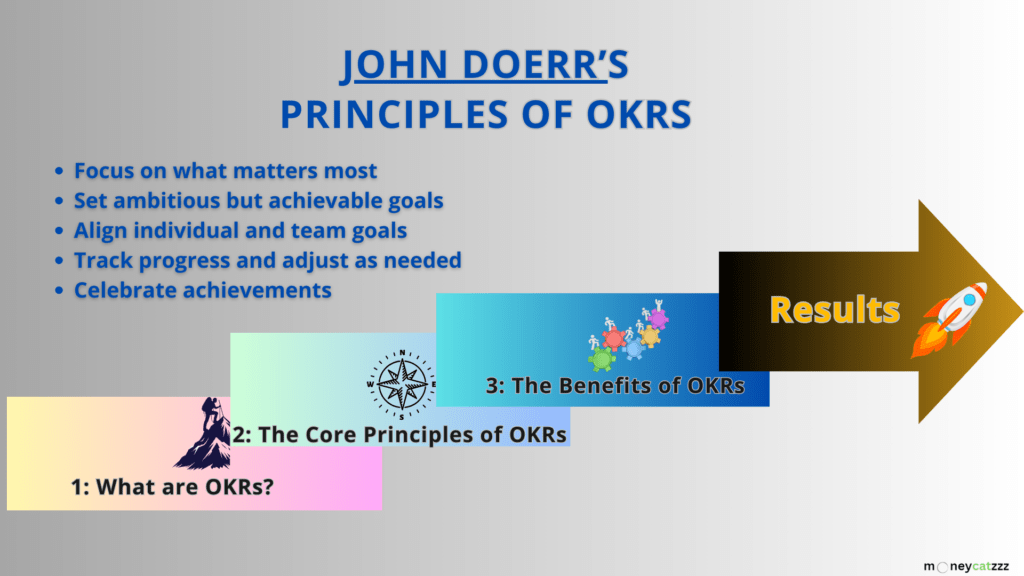
[“John Doerr’s Principles of OKRs” – moneycatzzz.com]
Understanding the Objectives and Key Results (OKR) Framework: Aligning Ambition with Measurable Success
The Objectives and Key Results (OKR) framework is a goal-setting methodology designed to drive focus, alignment, and measurable outcomes within an organization. The framework consists of two primary components:
- Objectives – These are qualitative, ambitious goals that define what an organization, team, or individual aims to achieve. Objectives should be inspiring, challenging, and aligned with the company’s mission and long-term vision.
- Key Results are quantifiable, time-bound metrics that indicate progress toward achieving the objective. Well-defined key results should be specific, measurable, and outcome-driven, ensuring accountability and tracking success.
The power of Objectives and Key Results (OKRs) lies in their ability to integrate ambition with execution, creating a structured roadmap that encourages innovation while maintaining accountability. Organizations can ensure that every team member understands the overarching goals and the specific metrics that define success by setting clear objectives and defining concrete key results.
When properly implemented, OKRs drive strategic focus, empower teams with goal clarity, and foster a data-driven performance culture. This makes the OKR framework a powerful tool for businesses of all sizes, from startups to multinational corporations.
Case Study: How Google Leveraged Objectives and Key Results (OKRs) for Exponential Growth
In its early days, Google’s adoption of Objectives and Key Results (OKRs) was pivotal in shaping its exponential growth. One of the most striking examples of OKR-driven innovation was the development of Gmail.
In 2001, Google set an ambitious OKR with the objective:
🟢 “Create the next generation of email.”
The key results tied to this objective included:
✅ Achieve 1 billion users
✅ Maintain 99.99% uptime
By setting a bold objective and defining measurable key results, the Gmail team had a clear vision and actionable targets. This structured approach fueled innovation, guided decision-making, and ultimately led to the launch of Gmail in 2004. Over the years, Gmail revolutionized email services and surpassed 1 billion users by 2016, achieving the ambitious key result set 15 years prior.
Google’s success with Objectives and Key Results (OKRs) highlights the framework’s power in driving high-impact innovation and accomplishing seemingly impossible goals. This case study is a testament to how OKRs can align teams, set clear priorities, and accelerate business growth.

The Benefits of Implementing OKRs in Your Organization
Adopting Objectives and Key Results (OKRs) can transform how organizations set, track, and achieve goals. Here’s how OKRs drive success across teams and businesses:
🎯 Alignment and Focus
OKRs create a clear connection between individual efforts and organizational objectives, ensuring that every team member understands how their work contributes to the bigger picture.
⚡ Agility and Adaptability
The frequent cadence of OKR-setting and reviews enables quick adjustments, helping businesses stay responsive to market changes and seize new opportunities.
🔍 Transparency and Accountability
By making OKRs visible across teams, organizations enhance collaboration and encourage shared responsibility, fostering a culture of ownership and mutual support.
🚀 Ambitious Goal-Setting
OKRs push organizations to set bold, stretch goals, challenging teams to think bigger and accomplish more than they initially thought possible.
📊 Data-Driven Decision-Making
By focusing on measurable key results, OKRs promote a data-driven mindset, leading to continuous improvement and better-informed strategic decisions.
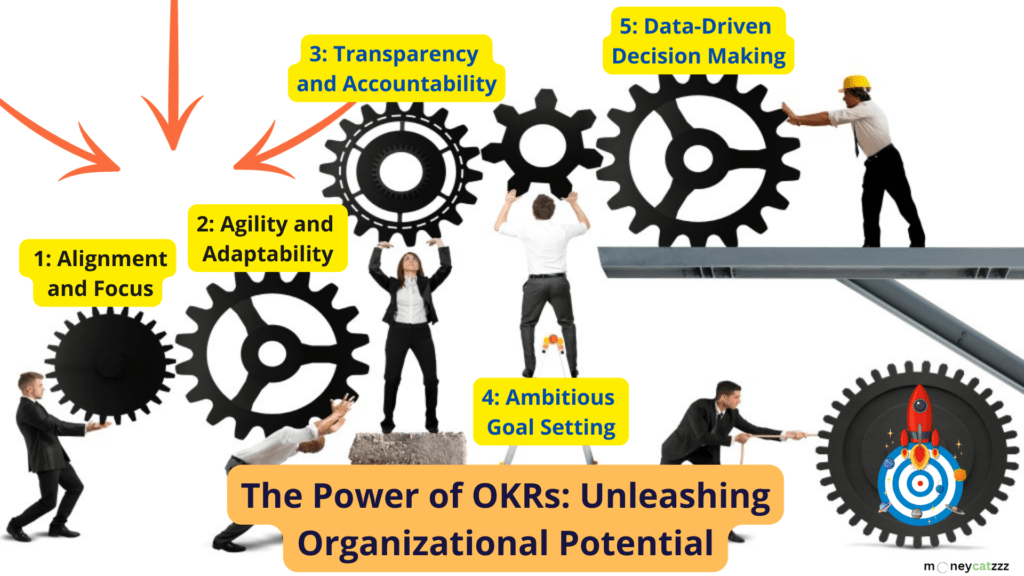
[“The Power of OKRs: Unleashing Organizational Potential” – moneycatzzz.com]
Implementing OKRs: A Step-by-Step Guide
Successfully adopting Objectives and Key Results (OKRs) requires a structured approach. Follow this step-by-step guide to ensure seamless implementation.
1️⃣ Define Your Mission and Vision
Start by clearly articulating your organization’s long-term mission and vision. This serves as the foundation for all OKRs and ensures strategic alignment.
2️⃣ Set Company-Level Objectives
Establish 3-5 high-level objectives that align with your mission and represent your top priorities for the upcoming quarter or year.
3️⃣ Cascade Objectives Across Teams
Work with department heads and team leaders to create aligned objectives that support company-wide OKRs. This ensures every team contributes toward broader goals.
4️⃣ Develop Key Results
For each objective, define 2-5 key results that are specific, measurable, and time-bound. These results quantify progress and provide a clear roadmap for success.
5️⃣ Communicate and Align OKRs
Transparency is key! Share OKRs across the organization, so employees understand how their work contributes to the company’s success.
6️⃣ Establish Regular Check-Ins
Set up a rhythm of weekly or bi-weekly check-ins to track progress, address roadblocks, and ensure continuous alignment.
7️⃣ Conduct Quarterly Reviews
At the end of each OKR cycle, typically every quarter, performance is reviewed, wins are celebrated, and insights are used to refine future OKRs for continuous improvement.
Overcoming Common Challenges in Implementing Objectives and Key Results (OKRs)
While Objectives and Key Results (OKRs) provide a robust framework for goal-setting and alignment, organizations often encounter hurdles in their implementation. Below are the most common OKR challenges and strategies to overcome them.
1. Lack of Leadership Buy-In
Without strong leadership support, OKRs can feel like just another corporate initiative.
✅ Solution: Ensure top executives actively participate in the OKR process, setting clear examples by aligning their goals with company-wide objectives.
2. Over-Complexity in OKR Implementation
Some companies attempt to track too many objectives simultaneously, leading to confusion and inefficiency.
✅ Solution: Start with a few well-crafted OKRs that target the most impactful areas. As teams become comfortable, they gradually introduce more complexity.
3. Misalignment with Performance Reviews
Employees may fear that OKRs are tied to performance evaluations, leading to conservative goal-setting rather than ambitious thinking.
✅ Solution: Communicate that OKRs are a tool for alignment and progress measurement, not a performance rating system. This separation fosters innovation and risk-taking.
4. Insufficient Training on OKRs
Without proper guidance, teams struggle to set practical Objectives and Key Results.
✅ Solution: Invest in comprehensive OKR training, ensuring employees understand how to create measurable and impactful OKRs.
5. Lack of Flexibility in OKR Cycles
Market shifts and evolving priorities can render rigid OKRs ineffective.
✅ Solution: While consistency is key, maintain the flexibility to adjust OKRs mid-cycle if significant changes occur.
By addressing these common OKR challenges, companies can enhance their goal-setting process, drive organizational alignment, and achieve sustainable growth with Objectives and Key Results (OKRs), giving the flexibility needed for rapid innovation and sustained growth.
Case Study: How Spotify’s Agile Approach to Objectives and Key Results (OKRs) Drives Innovation
The music streaming giant Spotify has adapted the Objectives and Key Results (OKRs) framework to fit its agile culture, ensuring flexibility in a fast-evolving industry. Unlike traditional quarterly OKR cycles, Spotify employs a unique “Spotify Rhythm“ system, which blends OKRs with agile methodologies, allowing teams to set and adjust goals more frequently.
Spotify’s OKR Structure: A Cascading Approach
Spotify reimagines OKRs by structuring them into:
🔹 Company Bets – High-level, bold strategic goals.
🔹 Divisional Bets – Department-wide objectives aligned with Company Bets.
🔹 Team-Level OKRs – Tactical goals driving execution at a granular level.
This cascading approach ensures team alignment while maintaining the agility needed to adapt to market changes.
OKRs in Action: Spotify’s Expansion into Podcasting
One of Spotify’s most successful OKR-driven initiatives was its expansion into podcasting. The company set an ambitious objective:
🟢 “Become the world’s leading audio platform.”
The key results driving this objective included:
✅ Increase podcast listening hours by 30%
✅ Launch 50 Spotify-exclusive podcast shows
By leveraging the OKR framework, Spotify made data-driven investments, acquiring major podcast networks and developing exclusive content. This strategic OKR implementation played a key role in Spotify’s dominance in podcasting, significantly increasing its user engagement and market share.
Spotify’s success with Objectives and Key Results (OKRs) showcases how organizations can customize goal-setting frameworks to fit their unique culture. By integrating OKRs with agile methodologies, Spotify maintains strategic focus while retaining the flexibility needed for rapid innovation and sustained growth.
Integrating OKRs with Other Business Methodologies
OKRs can be effectively combined with other popular business frameworks to create a comprehensive approach to strategy and execution:
- OKRs and Balanced Scorecard: Use OKRs to set specific, measurable goals within the four perspectives of the Balanced Scorecard (Financial, Customer, Internal Processes, and Learning & Growth).
- OKRs and Agile: OKRs can provide a higher-level strategic direction in agile environments, while agile methodologies guide day-to-day execution and iteration.
- OKRs and SMART Goals: While similar, OKRs often encourage more ambitious goal-setting. Use SMART criteria (Specific, Measurable, Achievable, Relevant, Time-bound) to refine your key results.
- OKRs and KPIs: Key Performance Indicators (KPIs) can be incorporated as key results within the OKR framework, providing continuity with existing performance metrics.

[“The Role of Technology in OKR Implementation” – Image by Pexels.com]
The Role of Technology in OKR Implementation
As organizations scale their OKR practices, technology can be crucial in managing and tracking progress. Several platforms have emerged to support OKR implementation:
- Dedicated OKR Software: Tools like Lattice, 7Geese, and Weekdone offer comprehensive OKR management features, including goal setting, tracking, and reporting.
- Project Management Platforms: Many project management tools, such as Asana and ClickUp, now include OKR features, allowing seamless integration with existing workflows.
- Collaboration Tools: Platforms like Microsoft Teams and Slack can be used to create OKR-focused channels, promoting transparency and regular communication around goals.
- Data Visualization Tools: Tools like Tableau or Power BI can be used to create dashboards that visualize OKR progress, making it easier for teams to track and present their results.
When selecting an OKR tool, consider factors such as ease of use, integration capabilities with existing systems, and the ability to customize the platform to your organization’s needs.
Best Practices for OKR Success
To maximize the impact of OKRs in your organization, consider these best practices:
- Keep Objectives Aspirational: Objectives should inspire and challenge teams to reach beyond their comfort zones.
- Make Key Results Specific and Measurable: Avoid vague language and ensure that progress can be objectively measured.
- Limit the Number of OKRs: Focus on quality over quantity. A good rule of thumb is 3-5 objectives, each with 3-5 key results.
- Encourage Bottom-Up Input: While top-level OKRs should provide direction, they allow teams and individuals to contribute to the goal-setting process.
- Regularly Communicate Progress: Create a culture of transparency by periodically sharing updates on OKR progress across the organization.
- Embrace Failure as Learning: If teams consistently achieve 100% of their OKRs, they may need to set ambitious goals. Aim for about 70% achievement.
- Continuously Refine the Process: Treat your OKR implementation as iterative, gathering feedback and improving with each cycle.
The Future of OKRs: Trends and Innovations
As the business landscape continues to evolve, so too will the application of OKRs. Some emerging trends to watch include:
- AI-Powered OKR Recommendations: Machine learning algorithms may soon suggest relevant objectives and key results based on organizational data and industry trends.
- Integration with Employee Development: OKRs are increasingly linked to personal development plans, helping employees align their career growth with organizational objectives.
- Real-Time OKR Tracking: Advanced analytics and IoT technologies may enable real-time tracking of critical results, allowing for faster adjustments and interventions.
- Cross-Organizational OKRs: As business ecosystems become more interconnected, we may see the emergence of OKRs that span multiple organizations, driving collaborative innovation.
- Sustainability-Focused OKRs: With a growing emphasis on corporate social responsibility, more organizations will likely incorporate sustainability metrics into their OKRs.

Harnessing the Power of OKRs for Sustainable Growth
Objectives and Key Results offer a robust framework for aligning organizational efforts, driving innovation, and achieving ambitious goals. By combining inspirational objectives with measurable vital results, OKRs provide a clear roadmap for success in today’s dynamic business environment.
As you embark on your OKR journey, remember that implementation is an iterative process. Start small, learn from each cycle, and gradually refine your approach. With commitment and consistent execution, OKRs can transform your organization’s goal-setting process, fostering a culture of ambition, accountability, and continuous improvement.
In the words of John Doerr, “Ideas are easy. Execution is everything.” OKRs bridge ambitious ideas and effective execution, empowering organizations to turn their boldest visions into reality. As you implement OKRs in your organization, you’re not just setting goals – you’re charting a course for sustainable growth and success in an ever-changing business landscape.
Disclosure: This post may contain affiliate links. We only recommend products we believe in, and We may receive a commission at no cost to you! Thanks for your support!”
Acknowledgement: Cover Photo by fauxels
Signup to our Newsletter for regular updates:
Disclaimer: The information is provided for general information only – moneycatzzz.com makes no representations or warranties in relation to the information, including but not limited to any representation or warranty as to the fitness for any particular purpose of the information to the fullest extent permitted by law. While every effort has been made to ensure that the information provided in this article is accurate, reliable, and complete as of the time of writing, the information provided in this article should not be relied upon to make any financial, investment, real estate or legal decisions. Additionally, the information should not substitute advice from a trained professional who can take into account your personal facts and circumstances, and we accept no liability if you use the information to form decisions.