
 Reading Time: 8 mins #
 This post may contain affiliate links.
The first time I realized I needed to set a boundary with a long-time friend, I didn’t feel empowered. I felt ashamed. Disloyal. Like I was betraying something sacred. We’d known each other for over a decade.
We’d grown together, laughed, and leaned on each other through life’s messiness. But lately, our conversations have left me drained. Every new idea I shared was met with skepticism. Every boundary I attempted was gently brushed aside, cloaked in the familiar, “But I know you.”
It’s a strange ache; mourning the version of a friendship that once fit like a second skin. I asked quietly: What if the connection that once felt like home now keeps me from growing? That question haunted me, not because I no longer cared, but because I did.
And that’s where so many of us get stuck: in the tension between love and evolution.
The Delicate Dance of Evolution
Friendship is often imagined as a constant, a source of loyalty and comfort through life’s changes. But what happens when you change, and the friendship doesn’t?
Growth isn’t always a shared timeline. One of the most disorienting experiences in personal evolution is realizing that relationships built on old versions of you no longer feel fully aligned. Yet, we hesitate to act. Why? Because we’re taught that good people don’t abandon others.
Choosing yourself means selfishness. That discomfort is just part of staying connected.
But what if choosing alignment isn’t severance but transformation?
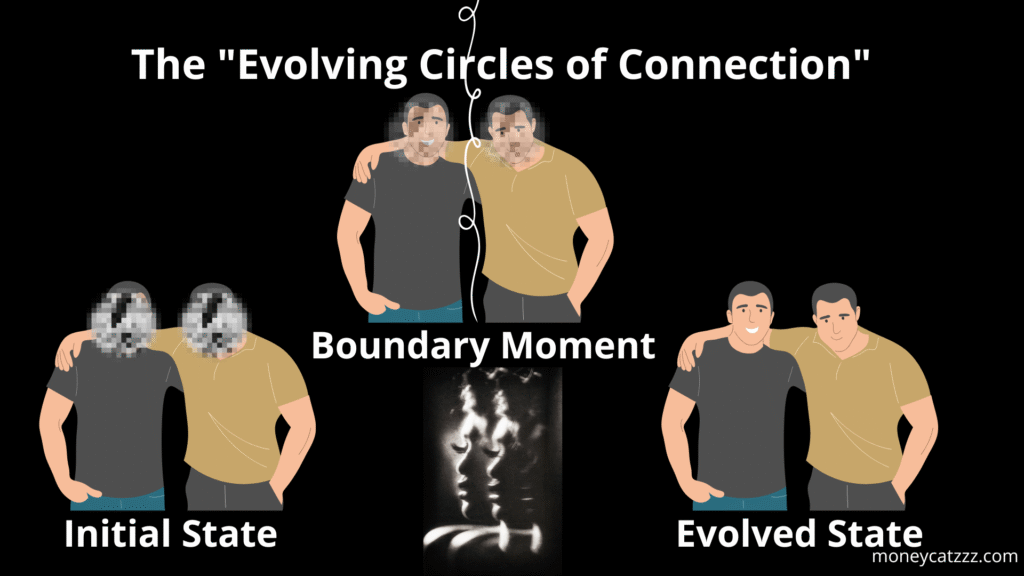
Recognizing Relational Drift
Many of us sense when a friendship starts to feel “off” but struggle to name why. The signs of relational misalignment can be subtle:
- Passive-aggressive remarks that undercut your choices.
- Lack of support when you try something new or share a win.
- Constant comparisons that leave you questioning your worth.
- Energy depletion after every interaction — the emotional hangover.
Psychology Today emphasizes that chronic emotional exhaustion in relationships can be a key sign of unhealthy dynamics, often overlooked in platonic contexts. Naming these patterns is the first act of boundary-setting: you acknowledge what your nervous system already knows.
The Art of Gentle Recalibration
Boundaries are often misunderstood as walls. But Nedra Glover Tawwab, in her bestselling book Set Boundaries, Find Peace, reframes them as clarity: “Boundaries are the distance at which I can love you and me simultaneously.“

So, how do we recalibrate without severing ties?
1. Identify Your Non-Negotiables
Before initiating any conversations, get clear on what you need more of, and less of. Do you need:
- More space to process?
- Less unsolicited advice?
- Time boundaries around draining conversations?
Write them down. This clarity becomes your compass.
2. Script with Compassion, Not Blame
Hard conversations don’t need to be harsh. Start with shared values or affirmations:
“I value our friendship, and I’ve noticed something on my mind…” “Lately, I’ve been working on protecting my energy. Can I share something I’m learning about myself?”
Empathy opens ears. Defense closes them.
3. Say No With Grace
Every “yes” to someone else is a “no” to yourself. Learning to decline invitations or limit engagement, without guilt, is a form of self-respect.
In Radical Acceptance, Tara Brach reminds us that the root of so much people-pleasing is fear of disconnection, rejection, and abandonment. But when we trust that we are inherently worthy, our “no” becomes less threatening. It becomes an invitation to know us more honestly.
When Boundaries Are Met With Resistance
Not everyone will applaud your boundaries. Some may question your motives. Others might accuse you of changing too much or caring too little.
This resistance is often a reflection of their discomfort, not your wrongdoing. As Brené Brown explores in The Gifts of Imperfection, those committed to growth will honor your authenticity. Those committed to comfort may see your evolution as a threat.
Hold your line.
The Mayo Clinic underscores the importance of assertive communication in maintaining workplace harmony and psychological safety. This is equally true in personal spaces. You are not responsible for managing someone else’s discomfort with your truth.
Shifting the Dynamic, Not the Person
Sometimes, you don’t need to cut someone off to redirect the current. Guide conversations towards aligned topics. Propose activities that reflect your evolving values.
If a friend only calls to vent, ask, “Can we talk about something lighter today? I’m a bit emotionally spent.”
If someone always brings up the past, try: “I’m trying to focus more on the present lately. What’s lighting you up these days?“
Change the rhythm. See if they dance differently.
The Power of Intentional Distance
Not all transformations are verbal. Sometimes, recalibration is quiet. Fewer texts. More pauses before responding. Choosing not to initiate every plan.
Robin Dunbar, an evolutionary psychologist known for Dunbar’s Number, notes that our social bandwidth is limited. We can only maintain close emotional intimacy with about 5 people at a time. Choosing who gets your deepest presence is not betrayal. It’s biology.
The Framingham Heart Study, a decades-long look at social networks, revealed that our friends’ emotions, habits, and health directly affect our own. Your circle isn’t just a reflection of you; it’s a projection of your future.

[“Setting Boundaries” – Image by moneycatzzz.com]
Holding Space for Their Journey (and Yours)
It’s tempting to want people to grow alongside us. But not everyone is on the same timeline, and that’s okay. Compassion allows us to love someone where they are while still loving ourselves enough to step where we need to go.
Sometimes, aligned relationships reemerge after space is created. Sometimes, they evolve in parallel. And sometimes, they fade without blame.
The Liberating Truth
Boundaries are not betrayals. They are bridges to deeper authenticity, for you and those walking beside you.
You create room for relationships built on mutual respect, curiosity, and care whenever you honor what you need. The ones who grow with you will meet you on that bridge.
Not to pull you back. But to walk beside you.

Further Reading: Empower Your Relational Wisdom
Deepen your understanding of relational health, boundaries, and growth with these resources and transformative insights:
- Set Boundaries, Find Peace by Nedra Glover Tawwab: A foundational guide to understanding and implementing healthy boundaries.
- Radical Acceptance by Tara Brach: Learn how to release guilt and fear through self-compassion and emotional clarity.
- The Gifts of Imperfection by Brené Brown: Explore how vulnerability and authenticity form the bedrock of aligned connection.
- Psychology Today on Emotional Drain in Friendships: Identify signs of draining dynamics.
- Harvard Business Review on Assertive Communication: Transferable insights for professional and personal relationships.
- Robin Dunbar on The Science of Friendship: Understand how your emotional bandwidth shapes your social world.
- The Framingham Heart Study’s findings on social contagion and health: How your friendships impact your wellbeing.
You don’t have to choose between connection and authenticity. Boundaries let you have both.
Disclaimer: The information is provided for general information only – moneycatzzz.com makes no representations or warranties in relation to the information, including but not limited to any representation or warranty as to the fitness for any particular purpose of the information to the fullest extent permitted by law. While every effort has been made to ensure that the information provided in this article is accurate, reliable, and complete as of the time of writing, the information provided in this article should not be relied upon to make any financial, investment, real estate or legal decisions. Additionally, the information should not substitute advice from a trained professional who can take into account your personal facts and circumstances, and we accept no liability if you use the information to form decisions.