
 Reading Time: 6 mins #
 This post may contain affiliate links.
Find Support: Build a Thriving Community
Life’s victories and setbacks often come in rapid succession—one moment, you’re riding high, and the next, you’re scrambling to stay afloat. It’s tempting to retreat behind your own four walls and insist you’ve got this under control. But the secret to lasting resilience isn’t going alone—realizing it takes a village. When you tap into your community, rally your tribes, and lean on trusted allies, you can transform every challenge into an opportunity for deeper connection and growth.
Why It Takes a Village in Today’s Fast-Paced World
We’ve all felt the dizzying swirl of back-to-back meetings, text alerts, and endless to-dos: genuine connection can slip through the cracks—yet our ancient need for belonging hasn’t changed.
From Fireside Circles to Group Chats
Centuries ago, tribes huddled around flickering flames, swapping stories under open skies. Those gatherings weren’t just entertainment—they wove a safety net of shared purpose and mutual care. Fast-forward to now, and though our “fires” glow on screens, the craving for authentic bonds remains. In fact, with stress levels higher than ever, belonging to a community is a lifeline.
The Invisible Toll of Going Solo
Science confirms it: chronic isolation triggers the same fight-or-flight alarm bells as physical threats. Johann Hari’s Lost Connections even likens disconnection to unhealthy habits like poor diet or sleep deprivation. By contrast, having allies on speed dial floods us with calm, helping us face adversity with clear heads and full hearts.

Embracing Vulnerability: The Heart of Every Tribe
No strong community was ever built on armor—vulnerability—showing your cracks and scars—cementing true bonds.
The Power of “I’m Not Okay”
Brené Brown’s research in Daring Greatly reveals a paradox: admitting you’re overwhelmed doesn’t signal defeat; it sparks deeper alliances. When you whisper, “I need help,” you permit others to step forward as your allies, and they feel safe sharing their struggles in return.
A Shelter, a Stranger, and a Lifeline
On my first day volunteering at a shelter, I arrived tense and self-conscious—like a stranger at a private party. Then I met Maria. Her story on her personal struggle with single motherhood and job loss helped crack my façade and before the shift ended, we weren’t simply co-volunteers; we were staunch allies, exchanging texts of encouragement and small acts of kindness that taught us that resilience springs from shared vulnerability.
Mapping Your Village: Four Key Tribes
Every village thrives on diversity. Think of your support network as a tapestry, each thread a different tribe that enriches the whole.
1. Family Roots (Tribe of Origin)
Anchors in History and Heart: Your family may be messy, but it’s the well you draw from when you need unconditional acceptance. Lean into rituals—Sunday dinners, birthday calls, holiday traditions—to re-anchor your sense of home.
2. Chosen Kin (Friendship Tribe)
Friends Who Fuel Your Fire: Friends are the people you invite into your inner circle. C.S. Lewis called friendship “a school of character” because real friends challenge you to grow. Carve out regular catch-ups—coffee, hikes, video chats—to keep those bonds thriving.
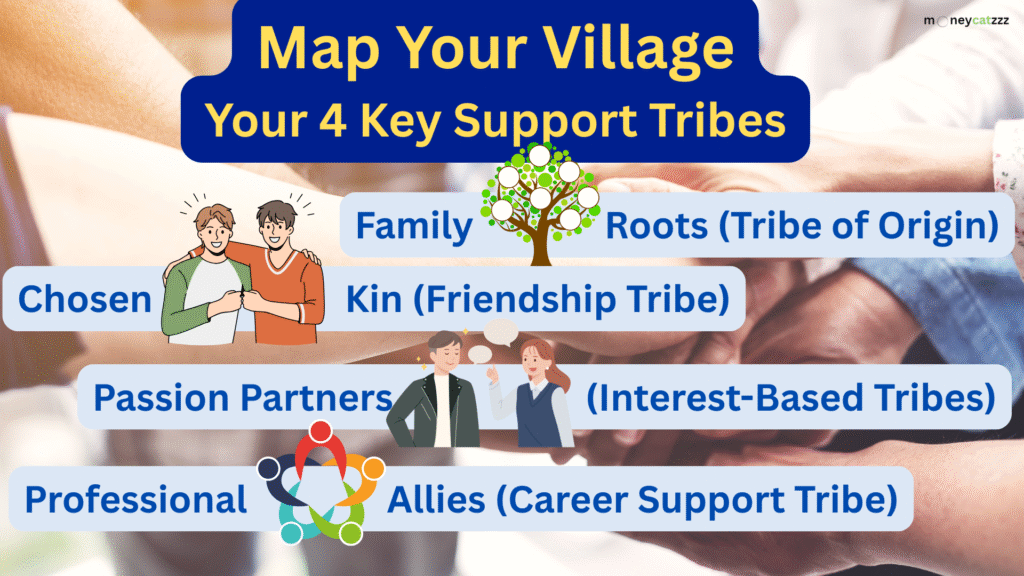
[“Map Your Village: Your 4 Key Support Tribe” – Image by moneycatzzz.com]
3. Passion Partners (Interest-Based Tribes)
Building Community Through Shared Joy: Hobbies aren’t just pastimes but gateways to tribes. My dawn birdwatching group began as a curiosity. By sunrise’s end, I’d found a community whose excitement was contagious—we tracked rare warblers, traded life stories between binocular glimpses, and learned that shared passion easily bridges strangers.
4. Professional Allies (Career Support Tribe)
Colleagues, Mentors, and Industry Circles: Your allies are the hidden scaffold beneath your career at work. During my first job hunt, alums from my university network lined up informational interviews, critiqued my resume, and ran mock interviews. Their guidance didn’t just sharpen my pitch—it reminded me I had a team rooting for me.
Now that you know your key tribes, let’s explore how to tend each patch of your village garden.
Building Your Village: Six Practical Steps
Empowering yourself with a strong support system is within reach. Here are six practical steps to guide you in building your village.
1. Be Fully Present
Silence your phone, lean in, and ask: “What’s been the highlight of your week?” Listen without drafting your reply—validate feelings and watch trust bloom.
2. Show Up Locally
Scout bulletin boards, neighborhood Facebook pages, or Meetup.com for events that spark your interest. Even a single hour at a food bank or park cleanup can introduce you to lifelong tribes.
3. Follow Your Passions
Turn hobbies into hangouts. Puzzle over crosswords in a club hit local trails with a running crew, or geek out at a gaming café. Shared joy dissolves barriers faster than small talk ever could.

[“Community – Stronger Together” – Image on Canva]
4. Give Before You Get
Offer help first—a homemade loaf to a neighbor, run errands for a busy friend or organize a book swap in your community center. Generosity cements your role as a trusted ally.
5. Ask for Help When You Need It
It takes courage to say, “Can you help me move this weekend?” or “Would you mind listening for a bit?” But most people are honored to step up when invited.
6. Curate Your Digital Community
Unfollow draining accounts. Seek out positive, moderated forums or Slack channels relevant to your interests. Share resources celebrate wins, and when you can, take those digital connections into video or real life.
With these practical steps in mind, it’s also wise to anticipate potential challenges in building and maintaining your village. Let’s explore some common roadblocks and how to navigate them effectively.

Crushing the Barriers to Connection
Building your village isn’t always easy. Let’s address some common hurdles that might stand in your way and how to overcome them.
- Lone-Wolf Lore: We’re sold on rugged individualism, but every hero’s journey involves a fellowship.
- Time Crunch: If “I don’t have time” is your go-to, block 15 minutes for a coffee or call. Small, consistent gestures build trust faster than grand but rare events.
- Fear of the Unknown: Curious about local groups? Spend five minutes a week browsing community calendars or asking friends for tips.
- Past Scars: A bad experience can sting, but treat each new connection as a blank canvas.
- Distance & Mobility Limits: Use technology—video calls, letters, hybrid meetups—so geography or ability doesn’t break your community.
Your Village Roadmap Workbook
Ready to make it actionable? Download our free PDF worksheet, “Your Village Roadmap: 5 Questions to Map Your Support Network,” to identify your tribes, spot gaps, and craft a clear action plan.
It Takes a Village—Let’s Begin
Start small: a frank conversation, a shared coffee, one selfless act. As the world quiets at day’s end, you’ll feel it: life wasn’t designed for lone-wolf living. We’re wired to walk shoulder-to-shoulder, weaving compassion, courage, and connection into a tapestry far stronger than us alone.
Because it takes a village, and your town is waiting.
Disclosure: This post may contain affiliate links. We only recommend products we believe in, and We may receive a commission at no cost to you! Thank you for your support!
Acknowledgement: Cover Photo by thinkstock
Disclaimer: The information is provided for general information only – moneycatzzz.com makes no representations or warranties in relation to the information, including but not limited to any representation or warranty as to the fitness for any particular purpose of the information to the fullest extent permitted by law. While every effort has been made to ensure that the information provided in this article is accurate, reliable, and complete as of the time of writing, the information provided in this article should not be relied upon to make any financial, investment, real estate or legal decisions. Additionally, the information should not substitute advice from a trained professional who can take into account your personal facts and circumstances, and we accept no liability if you use the information to form decisions.