
 Reading Time: 8 mins #
 This post may contain affiliate links.
Retirement isn’t just a destination—it’s a carefully constructed journey that requires strategic financial planning, emotional intelligence—a readiness to adapt. As longevity increases, healthcare becomes more expensive, and economic uncertainty persists, the need for a robust retirement fund is more crucial than ever.
This retirement planning guide is tailored for professionals, entrepreneurs, and growth-focused individuals who understand that financial freedom in later years doesn’t happen by accident—it’s engineered with foresight, discipline—and informed decision-making.
“The future depends on what we do in the present.” – Mahatma Gandhi.
1. Start Early, Contribute Consistently 🕰️
Compound interest—what Albert Einstein once called the “eighth wonder of the world“—is a powerful force that rewards time and consistency. Early contributions grow not just on your principal but also on the interest your money earns.
Example: If you save $200/month at age 25 and earn a 7% annual return, you’ll have over $500,000 by age 65. Delay until age 35? You’ll only have around $300,000—a $200K opportunity cost due to a single decade.
In Your Money or Your Life by Vicki Robin, compound interest is positioned as the ultimate driver toward financial independence through intentional money habits.
Automate contributions—via payroll or your bank—to keep investing even when life gets busy. What matters most isn’t the amount—it’s the habit.

[“Retire with Grace” – Image by Ri Butov from Pixabay]
2. Choose the Right Retirement Accounts 💼
Leveraging tax-advantaged accounts is a cornerstone of retirement success.
- 401(k): Employer-sponsored with contribution limits of $22,500 in 2025, plus a $7,500 catch-up for those 50+. Employer matching = free money—don’t skip it.
- Traditional & Roth IRAs: Contribution cap of $7,000/year. Traditional IRAs give tax deductions now, and Roth IRAs offer tax-free income later.
- Health Savings Accounts (HSAs): Offer a triple tax advantage—tax-deductible contributions, tax-free growth, and tax-free withdrawals for qualified medical expenses.
The IRS contribution limits update annually—review them to maximize your tax shelter potential.
Use both Roth and Traditional IRAs to diversify your tax exposure in retirement.

3. Diversify Investments & Match Risk Appetite 📊
It’s not only about how much you save but how you invest.
Diversification Is Your Safety Net
Mixing stocks, bonds, real estate, and alternatives reduces exposure to any single market downturn.
In the 2008 crisis, stocks plummeted, but long-term Treasuries and gold soared. A diversified portfolio could’ve mitigated losses.
Age-Appropriate Allocation
- In your 20s–30s: Favor equities (growth).
- In your 50s–60s: Shift to bonds/cash (preservation).
Use target-date funds or create a custom allocation via platforms like Vanguard or Fidelity.
Stay on Course with Rebalancing
Market shifts can distort your original mix. Review and rebalance at least annually.
Risk Insight: Tools like Monte Carlo simulations endorsed by Investopedia can project thousands of scenarios to inform your investment strategy better.
4. Plan for Healthcare and Long-Term Costs 🏥
Healthcare may become your most significant expense in retirement—yet many people are underprepared.
Medicare ≠ Everything
While Medicare starts at 65, it doesn’t cover dental, vision, hearing, or long-term care. That gap matters.
Solution Options:
- Medigap or Medicare Advantage: To bridge gaps in basic coverage.
- Long-Term Care Insurance: Offsets costs of assisted living, nursing homes, or home health aides.
Case Study: According to Fidelity’s 2024 Retiree Health Cost Estimate, the average couple retiring at 65 will need $315,000 just for health care. Long-term care? Depending on services and duration, that could spike another $150,000–$300,000.
Protect your nest egg: Factor medical and care costs into your retirement plan.
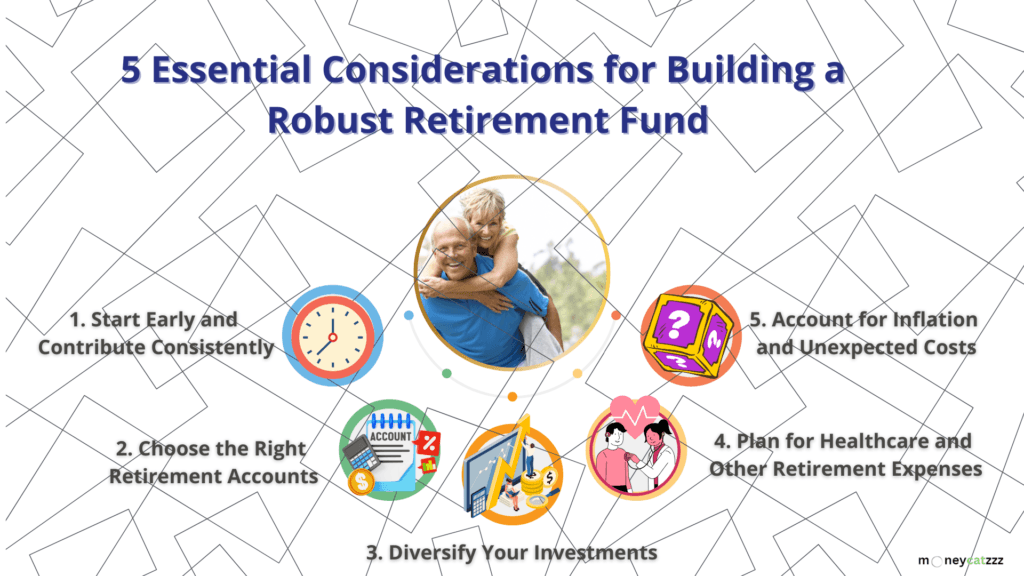
[“5 Essential Considerations for Building a Robust Retirement Fund” – Image by moneycatzzz.com]
5. Factor in Inflation and Emergencies 💸
Over 20–30 years, inflation can eat into even a million-dollar portfolio.
Combat Inflation With These Assets:
- TIPS (Treasury Inflation-Protected Securities)
- Dividend-paying stocks
- REITs
- Commodities ETFs
These options preserve purchasing power, especially during inflationary periods.
Expect the Unexpected
Retirement is full of curveballs: medical bills, home repairs, or family emergencies.
Create an emergency fund: Keep 6–12 months of expenses in cash or short-term bonds.
Use Flexible Withdrawal Strategies
- 4% rule: Withdraw 4% annually for 30-year sustainability.
- Dynamic spending: Adjust yearly based on market returns.
- Bucket strategy: Segment assets by timeframe—short-term (cash), mid-term (bonds), long-term (stocks).
Additional Keys to Retire Smarter
Optimize Social Security
Delaying Social Security past full retirement age can boost benefits by 8% annually up to age 70. Evaluate based on:
- Health
- Marital status
- Other income streams
Prepare for Life Interruptions
Career breaks for caregiving or parenting can stall savings.
Use spousal IRAs and roll over old 401(k)s to keep money consolidated and growing.
Secure Estate Plans
Don’t overlook:
- A valid will
- A durable power of attorney
- Healthcare proxy
- Trusts (where appropriate)
These steps ensure your legacy passes efficiently—with minimal legal and tax headaches.

Case Study: The FIRE Success Story
Jacob Lund Fisker, author of Early Retirement Extreme, reached financial independence at age 33 by saving 80% of his income and living on minimal expenses. His approach proves how radical frugality and strategy can expedite retirement—even decades early.
Final Thoughts
This guide proves that financial freedom in retirement isn’t a fantasy—it’s a formula:
- Start early and stay consistent
- Maximize your retirement accounts
- Diversify and assess your risk
- Plan for rising healthcare and unexpected events
- Adjust your strategy as life evolves
Whether you’re chasing a beach house, a cabin in the woods, or simply peace of mind, retirement is what you design it to be. The blueprint is here—now it’s your move.
📚 Further Reading:
- Your Money or Your Life by Vicki Robin
- Early Retirement Extreme by Jacob Lund Fisker
- The Intelligent Investor by Benjamin Graham
Disclosure: This post may contain affiliate links. We only recommend products we believe in, and We may receive a commission at no cost to you! Thank you for your support!
Acknowledgement: Cover Photo by Harli Marten on Unsplash
Disclaimer: The information is provided for general information only – moneycatzzz.com makes no representations or warranties in relation to the information, including but not limited to any representation or warranty as to the fitness for any particular purpose of the information to the fullest extent permitted by law. While every effort has been made to ensure that the information provided in this article is accurate, reliable, and complete as of the time of writing, the information provided in this article should not be relied upon to make any financial, investment, real estate or legal decisions. Additionally, the information should not substitute advice from a trained professional who can take into account your personal facts and circumstances, and we accept no liability if you use the information to form decisions.