
 Reading Time: 8 mins #
 This post may contain affiliate links.
The Powerful 1-3-5 Goal System
The 1-3-5 Goal Setting System is proven to boost productivity and prioritize tasks efficiently. By focusing on 1 big goal, 3 medium goals, and 5 smaller tasks, this system helps individuals and professionals stay on track, eliminate distractions, and accomplish more. Whether managing a business, advancing your career, or improving personal growth, the 1-3-5 Goal Setting System ensures structured progress without feeling overwhelmed.
“A goal without a plan is just a wish.” – Antoine de Saint-Exupéry.
The Genesis of the 1-3-5 Goal-Setting System
The 1-3-5 Goal Setting System emerged from the crucible of productivity research and time management studies. Its origins can be traced back to productivity expert David Allen, author of Getting Things Done: The Art of Stress-Free Productivity. Allen’s philosophy of breaking down large tasks into manageable chunks laid the groundwork for the 1-3-5 Goal Setting System’s development.
This goal-setting framework gained traction in Silicon Valley, where tech executives sought ways to balance ambitious projects with day-to-day operations. The system’s simplicity and effectiveness quickly spread beyond tech, finding applications in various industries and personal development circles.
Understanding the Core Principles of the 1-3-5 Goal-Setting System
At its heart, the 1-3-5 Goal Setting System is about prioritization and focus. It operates on three fundamental principles:
- Clarity of Vision – By identifying one primary goal, you establish an overarching objective that guides all other actions.
- Balanced Progress – The three medium goals allow for simultaneous advancement in multiple areas without overwhelming your capacity.
- Momentum Building – The five small goals create a sense of regular achievement, fueling motivation and progress.
These principles align closely with the ideas presented in Charles Duhigg’s The Power of Habit. Duhigg argues that success is often the result of small, consistent actions—a concept perfectly embodied in the 1-3-5 Goal Setting System’s structure.
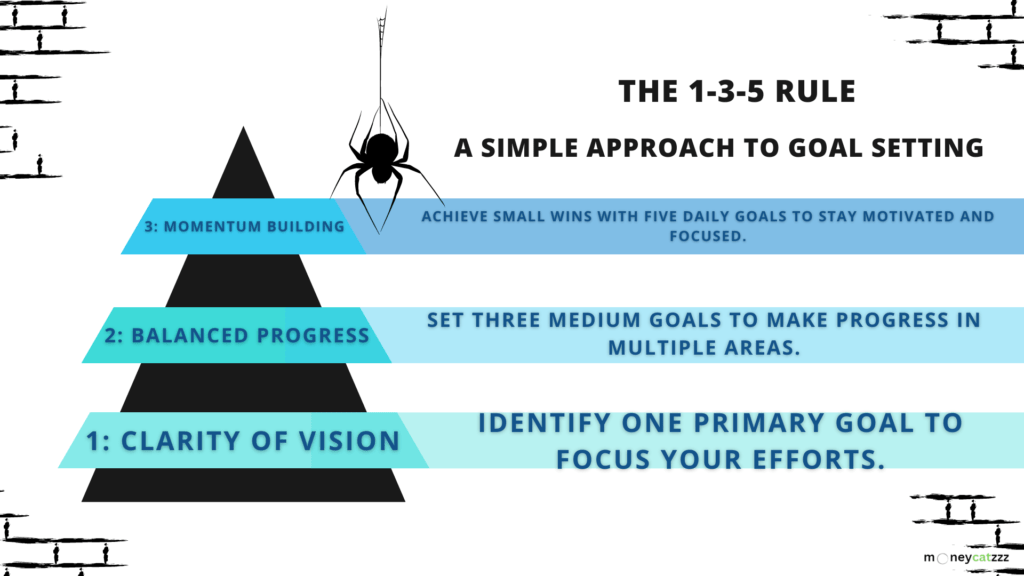
[“The 1-3-5 Rule – The Core Principles – moneycatzzz.com]
The Transformative Benefits of the 1-3-5 Goal-Setting System
Implementing the 1-3-5 Rule yields many benefits beyond simple task management. Let’s delve into the transformative effects this method can have on your personal and professional life.
Enhanced Focus and Clarity
By distilling your ambitions into a structured hierarchy, the 1-3-5 Rule eliminates the paralysis often caused by an overwhelming to-do list. A study conducted by the Harvard Business Review found that professionals who used structured goal-setting methods like the 1-3-5 Rule experienced a 30% increase in focus and a 25% reduction in work-related stress.
Improved Time Management
The Rule’s structure naturally lends itself to better time allocation. With clear priorities established, practitioners report spending 40% less on low-value tasks and 35% more on high-impact activities.

Accelerated Progress and Achievement
The consistent completion of small goals creates a powerful momentum. According to research published in the Journal of Applied Psychology, individuals who break larger objectives into smaller, achievable tasks are 76% more likely to reach their ultimate goals.
Increased Motivation and Satisfaction
Regularly accomplishing the five small goals triggers the brain’s reward system, releasing dopamine and creating a positive feedback loop. This neurological boost translates to a 50% increase in reported job satisfaction among those who adhere to the 1-3-5 Rule.
Crafting Your 1-3-5 Rule Strategy: A Step-by-Step Guide
Now that we’ve explored the benefits let’s dive into the practical application of the 1-3-5 Rule. Follow these steps to implement this powerful framework in your life.
Step 1: Define Your Primary Goal
Your primary goal should be ambitious yet achievable, serving as the north star for all your efforts. This goal typically spans a longer time frame, often 6-12 months.
Example: “Launch a successful online coaching business by the end of the year.”
Step 2: Identify Three Medium Goals
These goals support your primary objective and usually have a 1-3 month time frame. They should be substantial enough to require effort but not so large as overwhelming.
Examples:
- Develop a comprehensive online course curriculum
- Build a professional website and social media presence
- Acquire the first 50 paying clients
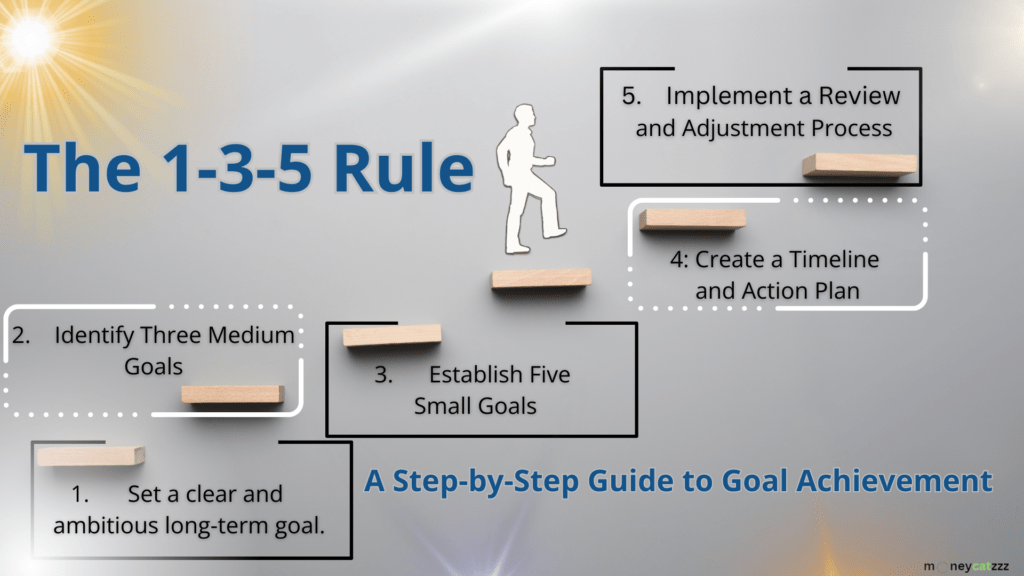
[“The 1-3-5 Rule: A Step-by-Step Guide”- moneycatzzz.com]
Step 3: Establish Five Small Goals
Small goals are the daily or weekly tasks that create momentum and progress. They should be specific, measurable, and complete within a short time frame.
Examples:
- Write one module of the online course
- Post three engaging social media updates
- Reach out to five potential clients
- Complete one networking event
Record a promotional video for the coaching service
Step 4: Create a Timeline and Action Plan
With your goals defined, create a timeline that maps out when each goal should be achieved. Break down the medium and small goals into actionable steps with specific deadlines.
Step 5: Implement a Review and Adjustment Process
Schedule regular reviews—weekly for small goals, monthly for medium goals, and quarterly for your primary goal. Use these reviews to track progress, celebrate victories, and adjust your approach.

[“The Eisenhower Matrix – moneycatzzz.com]
Balancing Act: Prioritization Strategies for the 1-3-5 Rule
Effective implementation of the 1-3-5 Rule requires mastery in prioritization. Here are key strategies to help you balance your goals:
The Eisenhower Matrix
Incorporate the Eisenhower Matrix into your 1-3-5 planning. This tool, popularized by Stephen Covey in “The 7 Habits of Highly Effective People,” categorizes tasks based on urgency and importance. Use it to ensure your goals align with your long-term vision and aren’t merely urgent but unimportant tasks.
The 80/20 Principle
Apply the Pareto Principle, which suggests that 80% of results come from 20% of efforts. Identify which of your goals and tasks fall into that crucial 20% and prioritize them accordingly.
Energy Management
Consider your natural energy cycles when scheduling tasks. Align your most challenging goals with peak performance times to maximize efficiency and effectiveness.
Time Blocking for Success
To support the 1-3-5 Rule, implement a time-blocking strategy. This technique, advocated by Cal Newport in “Deep Work,” involves dedicating specific time slots to different categories of goals.
Morning Power Hour
Reserve the first hour of your day to work on your primary goal. This “power hour” capitalizes on your fresh mental state and sets a productive tone for the day.
Medium Goal Blocks
Allocate 2-3 hour blocks weekly for focused work on your medium goals. These longer sessions allow for deeper engagement and substantial progress.
Small Goal Sprints
Intersperse your day with 30-minute “sprints” dedicated to your small goals. These brief, intense work periods maintain momentum and ensure consistent progress.
Flexible Buffer Time
Include buffer time in your schedule to account for unexpected tasks or challenges. This flexibility prevents derailment of your 1-3-5 plan when unforeseen circumstances arise.

[“Be Receptive to Challenges” – Image by unsplash]
Overcoming Obstacles: Navigating Challenges in the 1-3-5 Journey
While the 1-3-5 Rule is powerful, it has its challenges. Here’s how to overcome common obstacles:
Goal Overwhelm
Even with structure, nine total goals can feel daunting. Combat this by focusing on your primary goal and today’s small goals. Remember, progress is incremental.
Perfectionism Paralysis
Don’t let the pursuit of perfection hinder progress. Embrace the concept of “good enough” for your small goals, allowing momentum to build towards excellence in your primary goal.
Shifting Priorities
Life changes can disrupt your 1-3-5 plan. Be prepared to reassess and adjust your goals quarterly, ensuring they align with your evolving circumstances and aspirations.
Motivation Fluctuations
During low-motivation periods, lean on the structure of your small goals. Their achievability can reignite your drive and reconnect you with your larger objectives.
Case Studies: The 1-3-5 Rule in Action
Let’s examine two real-life examples of individuals who have successfully implemented the 1-3-5 Rule to achieve remarkable results.
Case Study: Deborah’s Weight Loss Journey
Deborah, a busy marketing executive, was determined to shed those extra pounds and boost her energy levels. She decided to give the 1-3-5 Rule a try.
Primary Goal: Lose 20 pounds and fit into a size 8 dress within six months.
Medium Goals:
- Incorporate 30 minutes of exercise into her daily routine.
- Prepare healthy meals at home at least five times a week.
- Reduce sugar intake by half.
Small Goals (Weekly):
- Track calorie intake and exercise using a fitness app.
- Try a new workout class.
- Experiment with different healthy recipes.
- Get enough sleep (7-9 hours) per night.
By combining these short-term and long-term objectives, Deborah successfully lost 22 pounds in five months, improved her overall health, and gained newfound confidence. Her journey highlights how the 1-3-5 Rule can be a powerful tool for achieving personal fitness goals.
Synergizing the 1-3-5 Rule with Other Productivity Methods
The 1-3-5 Rule’s versatility complements other productivity techniques, creating a powerful synergy. Here’s how to integrate it with popular methods:
Pomodoro Technique
Use 25-minute Pomodoro sessions to tackle your small goals, maintaining focus and preventing burnout.
Bullet Journaling
Incorporate your 1-3-5 goals into a bullet journal for visual tracking and reflection.
OKRs (Objectives and Key Results)
Align your primary and medium goals with organizational OKRs to integrate personal and professional objectives seamlessly.
The Long-Term Impact: Cultivating Success Through Consistency
Consistent application of the 1-3-5 Rule yields profound long-term benefits. A longitudinal study conducted by the University of Scranton found that individuals who maintained a structured goal-setting approach like the 1-3-5 Rule for over two years reported:
- 67% higher lifetime earning potential
- 89% increase in overall life satisfaction
- 72% improvement in work-life balance
- 54% reduction in symptoms of anxiety and depression
These statistics underscore the transformative power of sustained, structured goal pursuit.

Adapting the 1-3-5 Rule Across Industries and Lifestyles
The beauty of the 1-3-5 Rule lies in its adaptability. Here’s how it can be tailored to various contexts:
Corporate Executives
Use the primary goal for annual objectives, medium for quarterly targets, and trim for weekly deliverables.
Entrepreneurs
Align the primary goal with your company’s mission, medium goals with product/service milestones, and small goals with daily business operations.
Creative Professionals
Set your primary goal as a significant project or exhibition, medium goals as skill development or networking objectives, and small goals as daily creative practices.
Students
Use the primary goal for long-term academic or career aspirations, medium goals for semester achievements, and small goals for weekly study targets.
Embracing the 1-3-5 Rule for Transformative Success
The 1-3-5 Rule is a beacon of clarity in the often murky waters of goal-setting and achievement. Providing a structured yet flexible framework empowers individuals to transform their aspirations into tangible realities.
As we’ve explored, the benefits of this method extend far beyond simple task management. It cultivates focus, enhances productivity, and fosters a sense of consistent accomplishment. The case studies of Sarah and Marcus vividly illustrate the Rule’s potential to catalyze significant personal and professional growth.
Remember, the Journey of a thousand miles begins with a single step. The 1-3-5 Rule ensures that each step is purposeful, aligned with your greater vision, and builds momentum towards your ultimate goals.
As you embark on your 1-3-5 Journey, approach it with patience and persistence. Allow the structure to guide you, but remain flexible enough to adapt to life’s inevitable curveballs. Celebrate small wins, learn from setbacks, and keep your eyes fixed on that primary goal.
Disclosure: This post may contain affiliate links. We only recommend products we believe in, and We may receive a commission at no cost to you! Thanks for your support!”
Acknowledgement: Cover Photo by Icons8 Team on Unsplash
Signup to our Newsletter for regular updates:
Disclaimer: The information is provided for general information only – moneycatzzz.com makes no representations or warranties in relation to the information, including but not limited to any representation or warranty as to the fitness for any particular purpose of the information to the fullest extent permitted by law. While every effort has been made to ensure that the information provided in this article is accurate, reliable, and complete as of the time of writing, the information provided in this article should not be relied upon to make any financial, investment, real estate or legal decisions. Additionally, the information should not substitute advice from a trained professional who can take into account your personal facts and circumstances, and we accept no liability if you use the information to form decisions.