
 Reading Time: 8 mins #
 This post may contain affiliate links.
Many of us struggle with an internal critic undermining our confidence—a voice that feels like an imposter lurking in our minds, constantly downplaying our achievements and questioning our abilities. This phenomenon, commonly known as Imposter Syndrome, is fueled by deep-seated limiting beliefs that keep us trapped in the status quo, even when we yearn for change. This article will explore five common limiting beliefs that sabotage personal and professional growth. We’ll dive into their root causes, share inspiring case studies, and offer practical exercises to silence your inner critic.
“It is during our darkest moments that we must focus to see the light.” – Aristotle.
Before we dive into the specifics, it’s essential to understand why these limiting beliefs are so powerful. Imposter Syndrome and its accompanying self-doubt aren’t sudden, isolated issues—the cumulative result of deep-rooted experiences embedded in us over time. Often, these beliefs originate long before we even step into the professional world, subtly shaping our thoughts and behaviors.
The following sections will uncover the 5 Limiting Beliefs Silently Sabotaging Your Growth. By exploring these beliefs, we can trace their origins to childhood experiences, past failures, and pervasive negative self-talk. Understanding these roots is the first step toward dismantling the chains that hold us back, enabling you to replace self-doubt with a mindset poised for success.
1. Uncovering the Roots of Imposter Syndrome: How Limiting Beliefs Begin
Our self-doubt often starts much earlier than we realize—rooted in childhood experiences, past failures, and relentless negative self-talk. These experiences create invisible chains that restrict our true potential.
Key Contributors:
- Childhood Experiences: Consider a child whose every success was met with indifference or constant comparisons. For example, if you grew up in an environment where achievements were never celebrated and mistakes were magnified, you might have internalized the belief that you’re never enough.
- Past Failures: Early professional setbacks can create a lasting fear of failure. Imagine a young entrepreneur who, after experiencing multiple rejections from investors, believes that any attempt will fail. These experiences can instill a crippling reluctance to take risks.
- Negative Self-Talk: The constant internal dialogue focusing solely on what went wrong can chip away your self-confidence. A senior manager once described how the habit of dismissing every compliment eventually led to a pervasive feeling of inadequacy.
Actionable Strategies:
- Challenge Your Thoughts: When the inner critic whispers, “You’re not good enough,” pause and ask yourself: “What concrete evidence do I have?” Keep a daily log of even the small wins to counteract negative self-talk.
- Reframe Your Narrative: Instead of saying, “I always fail,” try, “Every setback is a learning opportunity.” This shift in perspective is crucial for developing a growth mindset.
- Create a ‘Brag Folder’: Compile a digital or physical folder of your achievements, awards, and positive feedback. Refer to it whenever self-doubt creeps in.
MindTools has an excellent guide on imposter syndrome; you can read it here.
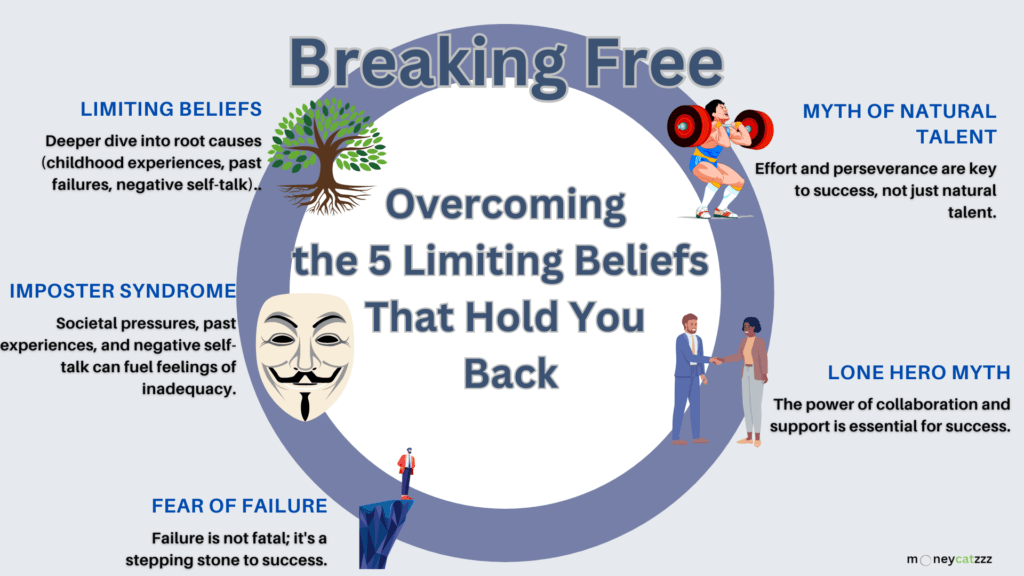
[“Breaking Free: Overcoming the 5 Limiting Beliefs That Hold You Back” – moneycatzzz.com]
Case Study: Arianna Huffington and Overcoming Imposter Syndrome
Despite her impressive achievements, Arianna Huffington, the co-founder of The Huffington Post openly discussed her struggles with imposter syndrome. Early in her career, she constantly questioned her abilities. However, Huffington didn’t let this belief hold her back. (We can analyze how her actions might be connected to addressing these root causes here. Did surrounding herself with mentors help combat negative self-talk? Did continuous learning address a fear of inadequacy?)
She embraced continuous learning, surrounded herself with supportive mentors, and focused on building her expertise, as highlighted in her book “Thrive: The Third Metric of Success.” Today, she’s a testament to the power of overcoming self-doubt.
2. The Imposter Syndrome Fear of Failure: “Failure is Fatal”
Society often glamorizes overnight success, making failure seem like a catastrophic, irreversible setback. This fear can paralyze you, causing you to stick with what’s familiar—even if it’s unfulfilling.
Case Study: J.K. Rowling’s Journey
Before Harry Potter became a global phenomenon, J.K. Rowling faced countless rejections. Each “no” could have confirmed her worst fears, but instead, she used them as stepping stones to refine her craft. Her persistence demonstrates that failure isn’t fatal—it’s simply part of the path to success. This story exemplifies the transformative power of perseverance, as emphasized in Carol Dweck’s book “Mindset: The New Psychology of Success.” Failure is not a dead end but a stepping stone to success.
Actionable Strategies:
- Celebrate Small Wins: Break your big goals into smaller, manageable tasks. For instance, if you’re launching a new product, celebrate each completed phase rather than waiting for the grand finale.
- Learn from Role Models: Research stories of individuals who turned setbacks into success. Let their journeys inspire you to view failure as an opportunity.
- Adopt a ‘Fail Forward’ Mentality: Write down each failure and document what you learned from it. Over time, this practice will transform fear into a powerful motivator.
The Road Not Taken: Embracing Failure as a Stepping Stone
Failure is an inevitable part of the growth process. It provides valuable learning opportunities and helps us identify areas for improvement.
Befriending Failure: Strategies to Overcome the Fear
- Focus on Progress: Celebrate small wins along the way, not just the final destination.
- Celebrating progress acknowledges your effort and helps sustain motivation, even in the face of setbacks.
- Learn from Role Models: Research successful people who have overcome significant setbacks. Their stories can be a source of inspiration.
3. The Myth of Natural Talent: “Talent Is All That Matters”
Many believe that success is solely the result of natural talent. While innate ability can give you a head start, the relentless pursuit of growth and continuous improvement truly defines success. Carol Dweck’s “growth mindset“ concept reminds us that hard work, perseverance, and ongoing learning are the real drivers of achievement.
Case Study: Michael Jordan’s Work Ethic
Michael Jordan is celebrated as one of the greatest basketball players ever, but his legacy isn’t just built on natural talent. Jordan’s incredible work ethic—practicing tirelessly, pushing through injuries, and constantly refining his skills—illustrates that effort trumps raw talent every time.
Vocal.media has an excellent piece on Michael Jordan here.
Actionable Strategies:
- Embrace Challenges: Instead of avoiding challenging tasks, see them as opportunities to stretch your abilities. Each challenge is a chance to grow.
- Celebrate Effort: Focus on the progress you make, no matter how incremental. For example, if you’re improving your sales skills, celebrate every slight increase in performance.
- Invest in Continuous Learning: Enroll in courses, attend workshops, and read widely. Over time, these investments in yourself will compound into significant personal and professional growth.
For further insights into the growth mindset, visit Carol Dweck’s Mindset Works

[“Michael Jordan and the Growth Mindset” – moneycatzzz.com]
Lorem ipsum dolor sit amet, consectetur adipiscing elit. Ut elit tellus, luctus nec ullamcorper mattis, pulvinar dapibus leo.
4. The Imposter Syndrome‘s Lone Hero Myth: “Success Is a Solo Act”
We often idolize the lone genius, yet the reality is that success is rarely achieved in isolation. Most high achievers build robust support networks, lean on mentors, and collaborate with peers to reach their goals.
Real-Life Example: Reid Hoffman
Reid Hoffman, the co-founder of LinkedIn and author of The Start-Up of You, is a prime example who understands that success is a team effort. Hoffman has consistently emphasized that his achievements are deeply rooted in the strength of his network. In various interviews and writings, he explains that the relationships he built throughout his career—from mentors and collaborators to the broader Silicon Valley community—were instrumental in shaping his success. Hoffman’s approach to business, which centers on leveraging networks and shared expertise, clearly debunks the myth that success is a solo act.
By openly discussing how collaboration and mutual support have propelled his career, Hoffman reminds us that no one succeeds alone. His story is a powerful testament to the value of building and nurturing relationships, and it offers a clear roadmap for overcoming the isolation that can often accompany imposter syndrome.
Actionable Strategies:
- Build a Support System: Cultivate relationships with mentors, peers, and industry experts. Join professional organizations and attend networking events to expand your circle.
- Delegate and Collaborate: Learn to share responsibilities. Trusting others not only lightens your load but also brings in fresh perspectives.
- Engage in Peer Accountability: Create or join groups where members set goals and regularly share progress. This mutual accountability reinforces your commitment to growth.
You can find additional insights on teamwork and collaboration read this Harvard Business Review article on the power of collaboration.
5. The Age Barrier Myth: “It’s Too Late for Me to Change”
Many believe that personal and professional growth is reserved for the young, but the truth is that learning is a lifelong process. The “age barrier myth“ can prevent you from embracing new challenges and opportunities, regardless of age.
Inspiring Examples:
- Nelson Mandela: After 27 years in prison, Mandela emerged as a beacon of resilience and transformed South Africa. His journey proves that significant growth can occur at any stage in life.
- Grandma Moses: Starting her painting career at age 78, Grandma Moses defied all expectations and became an internationally acclaimed folk artist.
Actionable Strategies:
- Cultivate Curiosity: Stay engaged by exploring new interests and learning new skills. Whether taking a course or picking up a hobby, curiosity is the key to continuous growth.
- Embrace Challenges: View every new challenge as an opportunity to reinvent yourself. Even if you’re considering a career change later in life, take small steps—like attending a workshop—to ease the transition.
- Seek Inspirational Role Models: Look for stories of individuals who achieved success later in life. Their journeys can remind you that it’s never too late to pursue your dreams.
Remember: It is never too late, too old, or anything else. It is always about the “will.”

[“Defying the Age Barrier Myth” – Photo by Marcus Aurelius]
Shattering the Chains: Practical Strategies to Dismantle Limiting Beliefs
Remember, dismantling limiting beliefs is a continuous process. There will be setbacks and moments of doubt. But by employing these strategies, cultivating a growth mindset, and surrounding yourself with a supportive network, you can break free from these invisible chains and unlock your full potential.
Here are some additional tips to keep in mind:
- Self-compassion is critical: Be kind to yourself throughout the process. Change takes time, so don’t get discouraged if you have setbacks.
- Celebrate small wins: Acknowledge and celebrate your progress, no matter how small. This will help you stay motivated on your journey.
- Seek professional help: If you’re struggling to overcome limiting beliefs on your own, consider seeking help from a therapist or counselor.

[Enjoy 20% off with this link]
Conclusion: Embrace Your True Potential not The Imposter Syndrome
Limiting beliefs can keep you from achieving your dreams and living a fulfilling life. But by recognizing these beliefs, understanding their root causes, and employing the strategies outlined in this article, you can silence your inner critic and unlock your full potential. Take the first step today!
- Journal about a limiting belief that is currently holding you back.
- Challenge that belief using the strategies outlined in this article.
- Identify one action you can take this week to move forward despite your limiting beliefs.
Remember, change is possible. Believe in yourself, embrace the growth journey, and watch your potential unfold.
Key Takeaways:
- Recognize the root causes—childhood experiences, past failures, and negative self-talk—fuel limiting beliefs.
- Embrace failure as a necessary stepping stone; learn from setbacks, just as J.K. Rowling and Michael Jordan have demonstrated.
- Reject the lone hero myth by building a strong support system of mentors and peers.
- Understand that age is never a barrier to growth; your capacity to learn and evolve is limitless.
- Apply practical exercises like journaling, challenging negative thoughts, and building a brag folder to shift your mindset.
Take the first step today: journal about one limiting belief, challenge it with evidence, and celebrate a small win. Remember, transformation is a journey. You’ll turn your inner critic into your greatest motivator by taking consistent action.
Resources
To further your exploration of overcoming limiting beliefs, consider these resources:
- Books:
- Mindset: The New Psychology of Success by Carol Dweck
- Learned Optimism: How to Change Your Mind and Your Life by Martin Seligman
- The Gifts of Imperfection: Let Go of Who You Think You Should Be and Embrace Who You Are by Brené Brown
- Websites:
- Mindset Works: Carol Dweck’s website offers resources and workshops on developing a growth mindset.
- The Greater Good Science Center at UC Berkeley: This website explores happiness, compassion, and altruism, providing science-based strategies for well-being.
- Apps:
- Headspace: This app offers guided meditation and mindfulness exercises to help manage stress and negative thinking.
- Insight Timer: Another meditation app with guided meditations and talks focused on personal growth.
- Podcasts:
By taking advantage of these resources and applying the strategies outlined in this article, you can silence your inner critic, overcome limiting beliefs, and unlock your full potential.
Disclosure: This post may contain affiliate links. We only recommend products we believe in, and We may receive a commission at no cost to you! Thanks for your support!”
Acknowledgement: Cover Photo by Aleksandr Neplokhov
Signup to our Newsletter for regular updates:
Disclaimer: The information is provided for general information only – moneycatzzz.com makes no representations or warranties in relation to the information, including but not limited to any representation or warranty as to the fitness for any particular purpose of the information to the fullest extent permitted by law. While every effort has been made to ensure that the information provided in this article is accurate, reliable, and complete as of the time of writing, the information provided in this article should not be relied upon to make any financial, investment, real estate or legal decisions. Additionally, the information should not substitute advice from a trained professional who can take into account your personal facts and circumstances, and we accept no liability if you use the information to form decisions.