
 Reading Time: 8 mins #
 This post may contain affiliate links.
How to Practice Safe Clarity (Without Overcommitting)
We live in a world where clarity is praised. We are told it is the kindest form of communication. And it is until it isn’t.
Because what many of us call clarity is overcommitting.
It’s explaining too much. It’s responding too fast. It’s saying “yes” when your body pleads, “please don’t.” It’s emotional labor disguised as good manners. And if you’ve ever walked away from a conversation thinking, Why did I say all that? you’re not alone.
This is the clarity trap. And today’s guide is here to help you find your way out, with tools rooted in safe clarity, self-trust, and practical boundaries.
What Is Safe Clarity?
Safe clarity is the art of being direct without defensiveness. It is firm but gentle. You can speak your truth without spilling all your energy onto the floor.
Think of safe clarity as a clear windowpane. It lets the light in without letting the rain pour through. It communicates enough without leaving you soaked in communication burnout.
In contrast, unsafe clarity often comes from anxiety. It’s the overexplaining. The disclaimers. The fear that a simple “no” needs an essay. We do this because we’ve been conditioned to believe that clarity must be earned through emotional labor.
But real clarity doesn’t need to be long. It needs to be honest.
Why Clarity Feels Risky
If you struggle with boundaries at work or in personal relationships, it’s probably not because you don’t know your limits. It’s because you fear how people will respond when you express them.
Here’s why:
- You’ve been rewarded for being “the easy one.”
- You’ve internalized the belief that to be liked is to be accommodating.
- The more precise you are, the less room for rejection.
Clarity doesn’t mean having all the answers; it means choosing your words carefully and that’s where real connection begins.
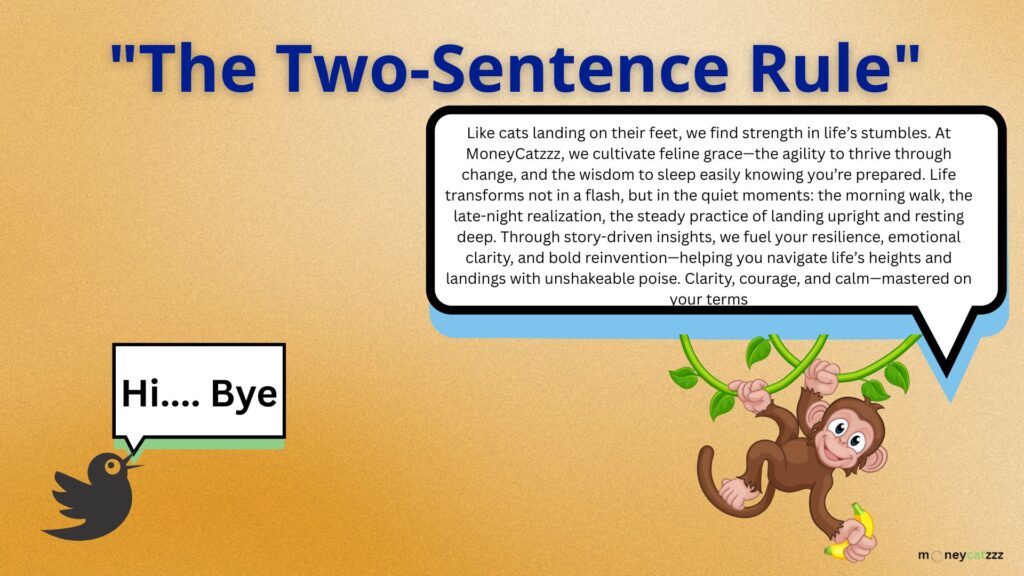
[“The Two-Sentence Rule” – Image by moneycatzzz.com]
Small Ways to Practice Clear Communication
These quiet shifts can help you speak with honesty without slipping into apology or saying yes when you mean no.
1. Use Anchor Phrases
These gentle, go-to phrases can help you express yourself clearly, without overexplaining or overextending.:
- “That won’t work for me right now.”
- “Let me sit with that and get back to you.”
- “I’m not available for that, but I appreciate you thinking of me.”
- “I need to protect my time this week.”
Each of these protects your boundary without attacking the other person. They are tools of assertive communication, not avoidance.

2. The Two-Sentence Rule
If your response takes more than two sentences, check your intent. Are you clarifying or are you justifying?
Try to condense your message. Safe clarity is rooted in simplicity. If you find yourself writing a novel to say “no,” that’s a sign you’re trying to manage someone else’s disappointment. That’s not your job.
3. Create Time Gaps
Most people respond too quickly out of habit, not urgency. Safe clarity often lives in the pause.
Before replying to a message, take 5 to 10 minutes. This gap allows you to respond instead of react. You can even automate this with tools like Boomerang’s Inbox Pause, so you’re not tempted to overperform online.
Practicing Safe Clarity in Real Life
Clear communication doesn’t need to be confrontational. It often needs the right words; gentle, grounded phrases that honor both your limits and your relationships. Here are a few ways to express boundaries with grace, not guilt.
At Work
The situation: Your manager asks you to take on something new, but you’re already stretched thin.
The correct reply: “I’d like to help, but I’m currently at full capacity. If we can look at my priorities together, I’d happily explore what’s possible.”
Results: This isn’t a hard “no.” It invites partnership around workload management. You’re being thoughtful and accountable, while still standing for your bandwidth, a mark of mature professionalism.
With Friends
The setting: A friend sends a late-night message expecting a quick reply.
The correct response: “I usually unplug after 8 p.m. to reset. I’ll reach out when I’m more present.”
The landing: This response model rests without defensiveness. You’re not making excuses, leading by example, showing that true connection doesn’t depend on 24/7 availability.
On Social Media
The pickled moment: A message drops in with an implied sense of urgency.
The reply: “Hey! I’ve been slowing down my online time lately so that responses might take a bit. I appreciate your patience; it means a lot.”
Why It Works: You’re resetting expectations with warmth; this isn’t about being unreachable, it’s about choosing presence over pressure, and showing that thoughtful responses take time.
Reframing the Urge to Overcommit
We live in a world that praises quick yeses and constant availability. But behind that praise often lies depletion.
Saying yes too often fragments your focus and eventually, you become a faint outline in your calendar.
Practicing safe clarity is how we come back to ourselves.
Let’s challenge these quiet myths:
- Clarity needs a long backstory.
- Saying no means you’re difficult.
- If someone pulls away after a boundary, you’ve done something wrong.
As therapist and bestselling author Nedra Glover Tawwab writes in Set Boundaries, Find Peace:
“Clear is kind. Overexplaining is often a trauma response—not a form of care.”

[“Time Gaps for Intentional Pauses”- Image by moneycatzzz.com]
Your Inner Signal System
To practice safe clarity, tune into these physical cues:
- Tight chest when asked for a favor = resentment building.
- Rushed responses = anxiety driving communication.
- Overwritten emails = fear of being misunderstood.
Pause. Breathe. Rewrite from alignment, not urgency.
If you find this difficult, consider resources like:
- Therapist Aid’s Boundary Worksheets
- Radical Candor by Kim Scott, which explores assertive communication without ego
- MindTools Guide to Communication Overload
Words to Carry with You
“Safe clarity doesn’t apologize for existing.”
“You don’t owe an emotional TED Talk every time you say no.”
“Say less. Trust more. Let the silence do some of the talking.”

Gentle Reminders: What Safe Clarity Offers
Not every truth needs a thesis. Sometimes, the clearest thing you can offer is your presence not your performance.
Here’s what matters most:
- Safe clarity is not about pleasing others but honoring your alignment.
- Simple phrases when offered with calm intent, often speak loudest.
- Give yourself room to respond, and not just react.
- Tune in to your body, it often knows before your mind does.
- Assertiveness isn’t forceful. It’s clarity offered with care.
You don’t need to be perfect. Just attuned.
So the next time you feel the urge to overexplain or overextend, pause. Breathe.
Your value was never in your availability.
Disclosure: This post may contain affiliate links. We only recommend products we believe in, and We may receive a commission at no cost to you! Thank you for your support!
Acknowledgement: Photo by Nothing Ahead
Disclaimer: The information is provided for general information only – moneycatzzz.com makes no representations or warranties in relation to the information, including but not limited to any representation or warranty as to the fitness for any particular purpose of the information to the fullest extent permitted by law. While every effort has been made to ensure that the information provided in this article is accurate, reliable, and complete as of the time of writing, the information provided in this article should not be relied upon to make any financial, investment, real estate or legal decisions. Additionally, the information should not substitute advice from a trained professional who can take into account your personal facts and circumstances, and we accept no liability if you use the information to form decisions.